


Art & Culture
|
Report on the Socio-Economic Impact of Counterfeiting, Smuggling, Tax Evasion on 7 key sectors releasedBy Deepak Arora NEW DELHI, Dec 20: FICCI-CASCADE (Committee Against Smuggling and Counterfeiting Activities Destroying the Economy), with the support of Ministry of Consumer Affairs observed National Consumer Rights Week 2012 to increase awareness about the menace of smuggled, fake and counterfeit goods and advocate socially responsible behavior. FICCI CASCADE as part of its efforts to create awareness, commissioned a special study on the impact of smuggling and counterfeiting on seven key sectors of the economy. The report has been prepared by Thought Arbitrage Research Institute (TARI) made a pioneering attempt to estimate the size of the ‘grey market’ for selected industry sectors in India and projected the economic loss to industry, government and consequent social impact. The report was released by Prof. K.V. Thomas, Minister of Consumer Affairs, Food Supply and Distribution, here on Thursday. He also gave a special address on “Building a Consumer Rights Movement— Empowering the Consumer of Today.” According to the study the estimated annual Tax loss to government is Rs. 26,190 crores. The overall estimate of annual sales loss to industry is put at Rs. 1,00,000 crores per the report. The key sectors which were included in the study were Auto Components, Alcohol, Computer Hardware, FMCG (Personal Goods), FMCG Packaged Goods), Mobile Phones and Tobacco. The National Consumer Week was flagged off with the “Awareness through Art” programme on December 18th, where over 200 students participated from various schools of NCR Delhi in an “On the Spot Painting Competition on Consumer Rights.” The competition focused on the detrimental effects of smuggled, counterfeit and fake goods on the health and safety of consumers, with specific topics like, “Say no to Fakes”, and “Does Black Money encourage crime in society?” The paintings by the students also brought to fore the steps, which can be taken by consumers to avoid being duped into purchasing these fake products, with topics like “Buying a product without receipt—Sensible or Dangerous” and “Be responsible: Insist on a bill”. The paintings by the students also brought to fore the steps, which can be taken by consumers to avoid being duped into purchasing these fake products. All the participating students were issued certificates. Cash prizes of Rs. 5,000/-, Rs. 3,000/- and Rs. 2,000/- were issued to the 1st, 2nd and 3rd prize winners respectively. Prizes and certificates were issued by Renu Agrawala wife of Mr. Pankaj Agrawala, Secretary, Department of Consumer Affairs. On December 19th a “National Consumer Rights Meet” was organized where Consumer Rights Activists from various states of India gathered to discuss the future course of the Consumer Rights Movement. During his keynote address on the occasion, Mr. Pankaj Agrawala, secretary, Ministry of Consumer Affairs said that, “The market was becoming very complex with service industry overtaking the manufacturing industry.” He said that a sizeable section of the population was not even aware of quality products. He wanted consumer organisations to be more active in creating awareness. Mr. Anil Rajput, Chairman, FICCI-CASCADE said that, “Awareness is the beginning of change.” He said that FICCI-CASCADE would continue its efforts to create consumer awareness through various campaigns throughout the nation. Awareness thru Art on Consumer RightsBy Deepak Arora
FICCI-CASCADE organized an “On the spot Inter-School painting competition” in which almost 200 students participated from various schools of NCR Delhi. The competition focused on the detrimental effects of smuggled, counterfeit and fake goods on the health and safety of consumers, with specific topics like, “Say no to Fakes”, and “Does Black Money encourage crime in society?” The paintings by the students also brought to fore the steps, which can be taken by consumers to avoid being duped into purchasing these fake products, with topics like “Buying a product without receipt—Sensible or Dangerous” and “Be responsible: Insist on a bill”. Speaking on the occasion, Mr. Deep Chand, Advisor, FICCI-CASCADE, Retired Special Commissioner of Delhi Police stated, “By not insisting on Bill a consumer not only disarms himself of his valuable rights as a consumer but also risks falling prey to unscrupulous identities selling them fake products and endangering their lives”.
All the participating students were issued certificates. Cash prizes of Rs. 5,000, Rs. 3,000 and Rs. 2,000 were issued to the 1st, 2nd and 3rd prize winners respectively. Prizes and certificates were issued by Mrs Renu Agrawala. The prize winners in painting competition were Suraj Patra, St. Thomas School, Vasundhra Surya of Modern School and Aditi of Mount Carmel School. They were also given cash prizes of Rs. 5000, Rs. 3000 and Rs. 2000. Delhi regional Brain Bee heldBy Deepak Arora
The competition was conducted by an eminent panel of neurologists of the department of Neurology of Army Hospital, under Col Shankar Prasad Gorthi, Senior Advisor Med & Neurology and RV Ravindranadh, National Coordinator and State Coordinator Ms Baljinder Kaur. The event also involved a series of lectures to motivate students in this field of Neurosciences. The Quiz had four rounds - a written round followed by three rounds of oral questions pertained to the human brain and how it related to intelligence, memory, emotions, sensation, moment, stress, aging, sleep, and brain disorders such as drug addiction, Alzheimer’s and stroke. The contest was very exciting and witnessed by a large gathering that included teachers and parents who took keen interest in the program. Each round was keenly contested among 31 participants of various schools from Delhi. Divyansh Pandey, a class XI student ST. COLUMBA`S SCHOOL, ASHOK PALACE, New Delhi, has emerged the Regional Brain Bee Champion of Delhi for 2013. The 1st runner up was Vishesh Goel, Laxman Public School, Hauz Khas New Delhi and Udit Chadha was 2nd runner up from Salwan Public School, New Delhi. Divyansh will participate in the 6th Indian National Brain Bee to be held at the Dayananda Sagar Medical College and Hospital, Ludhiana in April 2013. The Indian National Brain Bee champion-2013 will be invited to participate in the International Brain Bee finals scheduled to take place, in Hawaii, in the first week in August, 2013. Indian National Brain Bee, established in 2005, promotes Neuroscience in student community and inspires the Indian Students to pursue careers in biomedical brain research. Revealed! Why we lieWASHINGTON: In a new study, researchers have investigated what factors influence dishonest behaviour. Previous research has shown that a person’s first instinct is to serve his or her own self-interest and that people are more likely to lie when they can justify such lies to themselves. With these findings in mind, psychological scientists Shaul Shalvi of the University of Amsterdam and Ori Eldar and Yoella Bereby-Meyer of Ben-Gurion University colleagues hypothesized that, when under time pressure, having to make a decision that could yield financial reward would make people more likely to lie. They also hypothesized that, when people are not under time pressure, they are unlikely to lie if there is no opportunity to rationalize their behaviour. “According to our theory, people first act upon their self-serving instincts, and only with time do they consider what socially acceptable behaviour is,” Shalvi said. “When people act quickly, they may attempt to do all they can to secure a profit—including bending ethical rules and lying. Having more time to deliberate leads people to restrict the amount of lying and refrain from cheating,” Shalvi said. For the study, the researchers first tested participants’ tendency to lie when doing so could be easily justified - approximately 70 adult participants rolled a die three times such that the result was hidden from the experimenter’s view. The participants were told to report the first roll, and they earned more money for a higher reported roll. Seeing the outcomes of the second and third rolls provided the participants with the opportunity to justify reporting the highest number that they rolled, even if it was not the first – after all, they had rolled that number, just not the first time they rolled the die. Some of the participants were under time pressure, and were instructed to report their answer within 20 seconds. The others were not under time pressure, and had an unlimited amount of time to provide a response. The experimenters were not able to see the actual die rolls of the participants, to ensure all rolls were private. Instead, in order to determine whether or not the participants had lied about the numbers they rolled, Shalvi and colleagues compared their responses to those that would be expected from fair rolls. They found that both groups of participants lied, but those who were given less time to report their numbers were more likely to lie than those who weren’t under a time constraint. The second experiment followed a similar procedure, except that the participants were not given information that could help them justify their lies - instead of rolling their die three times, they only rolled it once and then reported the outcome. In this experiment, the researchers found that participants who were under time pressure lied, while those without a time constraint did not. Together, the two experiments suggest that, in general, people are more likely to lie when time is short. When time isn’t a concern, people may only lie when they have justifications for doing so. “One implication of the current findings is that to increase the likelihood of honest behaviour in business or personal settings, it is important not push a person into a corner but rather to give him or her time,” Shalvi said. “People usually know it is wrong to lie, they just need time to do the right thing,” Shalvi added. The study has been published in Psychological Science. |
|
||||||||
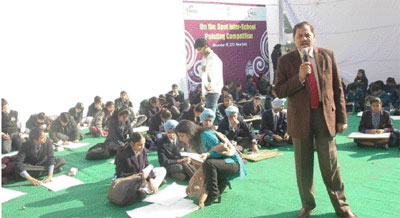 NEW DELHI, Dec 18: FICCI-CASCADE (Committee Against Smuggling and Counterfeiting Activities Destroying the Economy), with the support of Ministry of Consumer Affairs is observing National Consumer Rights Week. Under this various activities are being undertaken to increase consumer awareness about the menace of smuggled, fake and counterfeit goods and advocate socially responsible behavior amongst consumers.
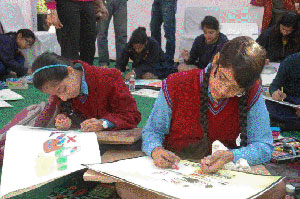 Addressing the students in her welcome address, Ms. Meenu Chandra, Head, FICCI-CASCADE said, “We constantly look towards our young blood to bring change in our Society. ‘Child is the father of man’ and indeed it is true when children say no to Fireworks, Delhi has less polluted Diwali. We hope today and always our future generation would choose to say no to Fake goods; No to wastefulness and constantly remind all of us to ask for a bill for very purchase."
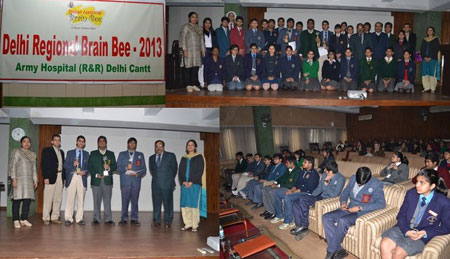 NEW DELHI, Dec 16: Army Hospital (R & R) in association with Indian National Brain Bee, has conducted the 3rd Delhi Regional Brain Bee, a neuroscience contest for 11th grade biology students at their hospital here.

Aviation
| Business | Defence
| Foreign Affairs | Communication
| Health | India |
United Nations
India-US | India-France
| Entertainment | Sports
| Photo Gallery | Tourism
| Advertise with Us | Contact
Us
© Noyanika International, 2003-2009. All rights reserved.