


India
Shiv Sena calls BJP ‘wild bull’, rules out future tie-up with BJPMUMBAI, Jan 26: Shiv Sena chief Uddhav Thackeray called off on Thursday the alliance with Bharatiya Janata Party (BJP) for the upcoming municipal corporation elections in Mumbai. Addressing a party rally in Mumbai, Thackeray said the Sena would no longer have an alliance with the BJP in any of the future polls, also indirectly putting a question mark on the future of the state government. “I will not tie up with BJP in any of the future polls in any city or district council. From this day onward, Sena will tread a new path. For the last 25 years, we rotted in this alliance..If in the past Sena founder Bal Thackeray had not stood behind them (BJP), they would have been destroyed by now,’’ Thackeray said. The Sena chief also referred to the BJP as a “wild bull” that had got out of control and now had to be “tamed”. Addressing the crowd, Thackeray said, “You (the BJP) have the prime minister, the chief minister. We have never asked for any plum portfolios or deputy chief minister’s post… We have always been loyal to you and even saved you from the opposition several times. But now if you are going to encroach on my home, we are not going to stay quiet.” The split translates into the Sena and the BJP facing off each other in the upcoming local elections in 10 of the biggest cities in the state and 25 district councils, which account for 75% of the rural vote bank. In the long term, it points to an uncertain future for the Devendra Fadnavis government that is dependent on 63 Shiv Sena legislators. BJP with 122 seats falls short of a clear majority in the state. After Thackeray’s announcement, Maharashtra chief minister Fadnavis tweeted, “Transparent governance is our mantra. We will go with those who come with us or go ahead without them. But, a transformation is imminent.” The upcoming civic polls are likely to see a bitter war between the former allies with Sena expected to take on the BJP over demonetisation while the BJP responds with allegations of corruption. How the parties fare in the Mumbai civic polls could decide the future of the state government. Elections to MCGM and other municipal corporations in the state including Nashik, Pune, Kolhapur and Nagpur will be held on February 21. The results will be announced on February 23. India, UAE slam State use of religion to sponsor terror
The joint statement, issued a day after the visiting Crown Prince of Abu Dhabi Sheikh Mohammed bin Zayed Al Nahyan met Prime Minister Narendra Modi, also deplored efforts by countries to give religious and sectarian colour to political issues and pointed out the responsibility of all States to control the activities of the so-called ‘non-state actors’. This formulation was first used during the Crown Prince’s State visit in February 2016. Underlining that terrorism posed a common threat to peace and security, the two leaders reiterated their strong condemnation of and “resolute opposition to terrorism in all its forms and manifestations, wherever committed and by whomever, and declared that there could be no justification for terrorism anywhere”. The UAE, which has been one of Pakistan’s closest allies, had also been one of the few countries to have recognised Taliban rule in Afghanistan in the mid-1990s. “The two sides condemned efforts, including by States, to use religion to justify, sustain and sponsor terrorism against other countries. They further deplored efforts by countries to give religious and sectarian colour to political issues and pointed out the responsibility of all States to control the activities of the so-called ‘non-state actors’,” the joint statement said. It also said that the two leaders articulated their clear and unequivocal resolve to cooperate on counter-terrorism by adopting a policy of “zero tolerance” towards the menace of terrorism. Satisfied at the growing bilateral collaboration on counter-terrorism, information sharing and capacity-building, they expressed confidence that these efforts would contribute to regional and global peace and security. The UAE and India agreed to coordinate efforts to “counter radicalisation and misuse of religion by groups and countries for inciting hatred and perpetrating acts of terrorism”. “They emphasised the need to facilitate regular exchanges of religious scholars and intellectuals and to organise conferences and seminars to promote the values of peace, tolerance, inclusiveness and welfare that are inherent in all religions,” the statement said. They also emphasised the importance of promoting a culture of inclusiveness, openness and tolerance within and among societies and agreed to work together closely to confront the global ills of extremism, terrorism and religious intolerance. “They reiterated that the Indian and the UAE experiences in building inclusive societies should continue to be promoted as effective models in countering extremism and radicalism,” the statement said. Lending support to New Delhi’s position on the Comprehensive Convention on International Terrorism in the United Nations, they also called for early conclusion of negotiations. The two sides also mentioned the Uri attacks, although there was no public support for the “surgical strikes”. They also condemned the terrorist attacks in Kabul and Kandahar on January 10 in which five UAE diplomats were killed, and underscored the need to bring the perpetrators of these dastardly and cowardly acts to justice — again a reference to Pakistan’s ISI. The statement said that Prime Minister Modi appreciated the support extended by UAE security agencies on specific issues of security concern to India — a reference to the ISIS threat. The two leaders reiterated that the ongoing close cooperation on a range of security issues, particularly on counter-terrorism, maritime security and cyber-security remained a key pillar of the bilateral strategic partnership. Acknowledging the importance of the ongoing bilateral security cooperation for ensuring a conducive and peaceful environment for the progress and development of the two countries, the two sides agreed to further enhance cooperation in the fields of law enforcement, anti-money laundering, smuggling of fake currency, drug trafficking, human trafficking, illegal migration and other transnational organized crimes. In a bid to take forward the defence cooperation pact, the leaders agreed to provide further impetus to these relations, including through joint exercises, training of naval, air and land forces, as also in the area of coastal defence and through participation in defence exhibitions etc. “The UAE side acknowledged the opportunities offered under the ‘Make in India’ initiative for joint production of defence equipment in India and also for the procurement of defence material. In this regard, the two sides described the signing of an MoU on Cooperation in the field of Defence Industry during this visit as an important step forward,” it said. The two sides expressed common resolve to bolster cooperation and exchanges on countering piracy in their shared maritime domain in the Gulf and the Indian Ocean regions and to exchange experiences in maritime security, including joint anti-piracy training and exercises. On investments, they reviewed the progress in realising the $75-billion target for UAE investments in India’s plans for rapid expansion of next generation infrastructure development. Modi invited UAE participation in India’s National Infrastructure Investment Master Fund as an “anchor investor”. Pomp and pageantry marks India's Republic Day Parade
The crown prince of Abu Dhabi, Sheikh Mohamed bin Zayed Al Nahyan, witnessed the parade which included a 149-member marching contingent from the United Arab Emirates, also a first since India became a Republic in 1950. While President Pranab Mukherjee took the salute, Prime Minister Narendra Modi sat with Mohamed bin Zayed Al throughout the ceremony and they were seen sharing several light moments. The large crowd, which braved loud drizzle and chilly conditions, cheered loudly as the contingent of the National Security Guard (NSG), popularly known as the Black Cat Commandos for their dress, trotted down Rajpath. The parade also saw the fly-past of three Tejas at a height of 300 metres in a ‘Vic’ formation and the Airborne Early Warning and Control System (AEW&C) developed by the DRDO.
Tableaux from 17 states and Union Territories and six central ministries and departments showcased the varied historical, art and cultural heritage of the country. The Goods and Services Tax (GST) was the theme of the tableau of the Central Board of Excise and Customs. Twenty-one of the 25 children who won the National Bravery Award also participated in the parade. Four children have received the award posthumously. The grand finale of the parade was a spectacular flypast by the Indian Air Force. The marching contingents of Army included horse-mounted columns of the 61st Cavalry, the Mechanised Infantry Regiment, the Bihar Regiment, the 39 Gorkha Training Centre, 58 Gorkha Training Centre, the Madras Engineering Group and Centre and 103 Infantry Battalion. The Navy contingent comprised 144 young sailors and it was led by Lieutenant Aparna Nair. In the children’s pageant section, about 600 boys and girls drawn from three schools in Delhi and a group of school children from South Central Zone Cultural Centre, Nagpur performed colourful dances on varied themes. A massive ground-to-air security apparatus was put in place in the national capital turning the city into virtually an impregnable fortress. NSG snipers were deployed at all high-rises along the parade route. As part of the multi-layered security, around 60,000 security personnel were deployed across the city. President supports note ban, pitches for electoral reforms in R-day eve address
In the customary address to the nation, the President on Wednesday said one of his predecessors left a framed note which read, “The objective of government in peace and in war is not the glory of rulers or races but the happiness of the common man.” That happiness, he said, should be the touchstone of public policy as it is “equally the outcome of economic and non-economic parameters”. The note, said sources, was left by late APJ Abdul Kalam. Mukherjee’s remarks come as cash crunch brought in by demonetisation begins to ease after weeks of snaking queues outside banks and ATM kiosks. Though demonetisation “immobilised” black money and corruption, it “may have led to temporary slowdown of economic activity”, the President said, expressing hope cashless transactions would bring in transparency. Mukherjee, whose term ends in July, also made a case for electoral reforms. “The time is also ripe for a constructive debate on electoral reforms and a return to the practice of the early decades after independence when elections to Lok Sabha and state assemblies were held simultaneously,” he said. Prime Minister Narendra Modi, too, has called for a debate on holding the elections together, to save money and smoothen decision-making that is disrupted every time the poll code kicks in. It was for the election commission to take the exercise forward, the President said. With Parliament’s budget session starting Monday, Mukherjee urged both the government and the Opposition to focus on debate, discussion and decision making. The remarks assume significance as the last session was washed out over demonetisation. “We have a noisy democracy…The depth and breadth of our democracy sparkles in the regular elections in panchayati raj institutions. And yet, our legislatures lose sessions to disruptions when they should be debating and legislating on issues of importance,” Mukherjee said. While talking about tolerance and strong action against terrorism, the President laid special emphasis on job creation, mentioning the jobs and employment five times in his speech. “Youth today are brimming with hope and aspirations. They look for a job as well as a purpose in life. Lack of opportunities leads to frustration and unhappiness which manifests itself in anger, anxiety, stress and aberrations in behaviour.” India’s pluralism and diversity were its greatest strength. “Our tradition has always celebrated the argumentative Indian not the intolerant Indian,” he said. 69% of political funds in India from unknown sourcesNEW DELHI, Jan 24: The total income of national and regional political parties between 2004-05 and 2014-15 stood at ₹11,367 crore, with the highest of ₹3,982 crore being the Congress’s share. However, 69% of the income of these parties was from unknown sources, according to an analysis done by the Association for Democratic Reforms (ADR). The income of national parties from unknown sources increased by 313% during the decade; for the regional parties, it went up by 652%. The BSP is the only party which has got 100% of its income through donations from unknown sources. Its total income increased by 2,057%, from ₹5.19 crore during 2004-05 to ₹111.96 crore during 2014-15. The Association for Democratic Reforms (ADR) report, released on Tuesday, states that the details of donors pertaining only to ₹1,835.63 crore were available. The income from other known sources, such as the sale of assets, membership fees, bank interest, the sale of publications and party levy, was ₹1,698.73 crore, about 15% of the total. While about 43% of the total income of six national parties was that of the Congress, the BJP stood second with ₹3,272.63 crore, just over 35%. The CPI(M) declared the third highest income of about ₹893 crore. “About 83% of the total income of the Congress, amounting to ₹3,323.39 crore, and 65% of total income of the BJP, amounting to ₹2,125.91 crore, came from unknown sources.” The total donations above ₹20,000 per entry, for which the national parties are to declare the sources, was about ₹1405.19 crore and the BJP topped the list for declaring the maximum of ₹918 crore voluntary contributions in the category. “The donations declared by the BJP are more than twice the donations declared by the Congress during the same period,” said the report. The BSP has not reported any donation above ₹20,000 in the past 11 years, while the Nationalist Congress Party has not submitted its donations report to the Election Commission between 2004-05 and 2006-07. The Congress has declared donations of ₹400.32 crore. According to the ADR, the Income-Tax returns of 42 of the 51 regional parties analysed were unavailable for at least one financial year. The total declared income of regional parties during the period stood at ₹2,089 crore, the highest being that of the Samajwadi Party at ₹819 crore, followed by the DMK with ₹203 crore and the AIADMK with ₹165 crore. Based on the findings, the ADR has recommended that full details of all donors be made available for public scrutiny under the RTI. “Some countries where this is done include Bhutan, Nepal, Germany, France, Italy, Brazil, Bulgaria, the United States and Japan. In none of these countries it it possible for almost 75% of the source of funds to be unknown, but at present it is so in India,” said the report, adding any organisation that receives foreign funding should not be allowed to support or campaign for any candidate or political party. Recently, the report mentioned that the Election Commission had recommended that tax exemption be awarded only to those political parties which contest and win seats in Lok Sabha or Assembly elections. The EC also suggested that details of all donors who donate above ₹2,000 be made public. Scrutiny of the political party’s financial documents should be conducted annually by a body approved by the EC and the Comptroller and Auditor General for greater transparency and accountability, the report said. 41 killed as train derails in South IndiaHYDERABAD, Jan 22: As many as 41 passengers were killed and over 50 injured when the Hirakhand Express, plying from Jagdalpur in Chhattisgarh to Bhubaneshwar in Odisha, derailed near Kuneru railway station in Andhra Pradesh’s Vizianagaram district late on Saturday night. The incident occurred around 11.20 pm, while the train was passing by Kuneru railway station. Apart from the engine, seven coaches – comprising the luggage van, two general compartments, two sleeper coaches, an AC three-tier coach and an AC two-tier coach – were derailed. While four coaches fell on an adjacent goods train, two sleeper coaches (S-8 and S-9) and a general coach were completely crushed. Salman Khan acquitted by Jodhpur court in Arms Act caseJODHPUR, Jan 18: Actor Salman Khan was acquitted on Wednesday in a case linked to the alleged killing of black bucks 18 years ago. Salman Khan had pleaded “not guilty” to charges of violating the law by keeping unlicensed weapons and using them. Khan was accused of carrying and using illegal arms with an expired licence. A case under the Arms Act was registered against him. The actor allegedly had a US-made revolver and a 22-bore rifle with him. The prosecution had said the licence of both the firearms had expired on September 22, 1998, but the actor used them to hunt two blackbucks on October 1 and 2, 1998, in Kankani village on the outskirts of Jodhpur. ISI behind Kanpur train tragedy; three arrestedNEW DELHI, Jan 17: Bihar police is probing whether the November 21 Kanpur train derailment that killed 148 people was an act of sabotage with possible ties to Pakistani spy agency Inter-Services Intelligence (ISI). The Indore-Patna Express went off the tracks near Kanpur Dehat in Pukhrayan on November 21. The Bihar police arrested three persons on Tuesday on charges of involvement in the incident. “One of three accused has told investigators that they planted a pressure cooker-based improvised explosive device near the railway track in Kanpur which resulted in the derailment. But his confession needed to be verified by independent corroboratory evidence. They claim to have done it for money,” said a central counter-terror official who spoke on the condition of anonymity as he was not authorised to speak to the media. The UP anti-terrorist squad (ATS), Lucknow and the National Investigating Agency (NIA) are likely to quiz the three detainees, since there is the suspicion that their handler, identified as Shamshul Hoda of Nepal, may have ISI links. The official added that it was being suspected that the accused were hired through a chain of handlers sitting in Nepal and Dubai and the Dubai-based handler was connected to those in Pakistan. East Champaran superintendent of police Jitendra Rana said the trio had been identified as Motilal Paswan of Bakhri village in Adapur PS, Umashankar Patel Gamhariya near Raxaul and Mukesh Rai of Jethkaniyan village in Adapur , all residents of east Champaran. During questioning, Paswan accused the two others of having received money from Hoda of Nepal to plant bombs in public spaces and target the train line between Varanasi and Kanpur, Rana said. Central counter terror sources said the Nepal police had arrested three people, Brijwasan Giri, Mujahid Ansari and Shambhu on charges of abducting and killing two Indians, from Talaiyya area of Nepal. After being arrested on murder charges, Giri and others told the Nepal police about their alleged involvement in the Kanpur incident and their associates in Bihar. Acting on the information provided by the Nepal police, the Bihar cops arrested the trio who also accepted about their involvement with the gang. “The Nepal police had informed about the possible connection of Giri, Ansari and Shambhu with the Kanpur case,” said Rana. It is suspected that the same group was also involved in planting IED near Ghorasahan-Raxaul rail track along the Indo-Nepal border on October 1, 2016 that failed to go off. Akhilesh Yadav faction of Samajwadi Party to get ‘cycle’ symbol, says ECNEW DELHI, Jan 17: The Akhilesh faction was the Samajwadi Party and entitled to the party symbol, a bicycle, the election commission ruled Monday, dealing a huge blow to SP founder and patriarch Mulayam Singh Yadav ahead of the UP election. The faction led by Mulayam will have to go into the polls under a new name and symbol. The poll panel’s decision gives a big boost to chief minister Akhilesh Yadav who has prevailed after months of bruising power struggle in the first family of Uttar Pradesh’s ruling party. It will also help him forge poll alliances with parties such as the Congress. But, the fight over the bicycle could turn into a legal battle, with the 77-year-old Mulayam threatening to challenge the poll panel’s decision in court. “If the EC decision goes against me, I will move court,” Mulayam told party workers in Lucknow earlier in the day, responding to their slogans to save the party. Both the factions had petitioned the poll panel early this month, staking claim to the name and symbol. The move came after Akhilesh ousted his father and took over as the party president on the New Year’s Day. Announcing the decision in Delhi, EC said it found the “group led by Akhilesh Yadav is the Samajwadi Party and is entitled to its name and its reserved symbol the bicycle”. The EC accepted the claims of the Akhilesh camp that 205 of of the 228 party MLAs supported him. The chief minister also had the backing of 56 of 68 members of the legislative council and 15 of the 24 MPs. He also submitted proof of a majority of national executive members and national convention delegates backing him. “As a logical consequence of the above finding and applying the test of majority support approved by the Supreme Court”, the poll panel found the Akhilesh camp eligible for the party name and symbol. Mulayam, who made several attempts at peace between his warring younger brother Shivpal and son Akhilesh, seemed reconciled to a split in the party. Speaking to party workers earlier in the day, Mulayam said, “What can I do when my son has turned against me by playing into hands of Ramgopal Yadav?” “Look my son has gone against me. I could never imagine that Akhilesh will ever do this to me.” Mulayam has blamed cousin Ramgopal, who has backed Akhilesh in the family feud, of playing into the hands of the BJP. The BJP is looking to oust the SP to make a comeback in the country’s most populous state that will vote in seven phases, beginning February 11. Tempers ran high during Mulayam’s meeting, with workers, many of whom appeared angry, asking the former three-time chief minister to step in and avoid a split, sources said. Mulayam shouted back, “What has happened to you all. Why are you behaving in this manner? If they (EC) doesn’t give us our symbol, then let’s see what symbol they give us.” As restive workers kept shouting, Mulayam cut short his speech and left for his home after 30 minutes, sources said. Samajwadi Party-Congress likely to enter alliance in UP
Poll managers view the pre-poll arrangement as a “win-win” situation for both parties in the new political narrative after the Akhilesh faction won the battle of perceptions in the power struggle within the family. “A pre-poll alliance is all but certain to be announced this week,” a Congress source said. The national party has been relegated to the state’s political margins after being voted out of power in 1989, while the SP has by and large split with Akhilesh on one side and his father, Mulayam Singh Yadav, on the other. The Congress’s internal assessment is “not so encouraging” in case it runs alone. Interlocutors of the two parties have started hectic parleys on sharing of seats for the state’s 404-member assembly, Congress sources said on Saturday. The Congress wants 100 seats to contest. Specifics such as constituencies, candidates and joint campaign strategies will be thrashed out within the next 48 hour, sources in the Akhilesh camp said. Senior Congress leader Ghulam Nabi Azad has apparently established contact with SP emissaries to work out the deal. Speculation on a Samajwadi-Congress alliance swirled after political strategist Prashant Kishor met Akhilesh in November, after meeting SP patriarch Mulayam twice— apparently to discuss a potential partnership. Mulayam had proposed a grand alliance for the UP polls, although he had walked out of a similar coalition between the Janata Dal (United) of Nitish Kumar, Lalu Prasad’s Rashtriya Janata Dal and the Congress in Bihar ahead of elections there in 2015. He was unhappy with the number of seats given to his party to contest in Bihar. Kishor, who was poll strategist for Kumar and Prasad, is now helping the Congress in UP. The buzz grew after Akhilesh surprised everyone in September, praising the 46-year-old Gandhi as a “good human being”. For his part, Gandhi dropped broad hints of a tie-up when a party functionary asked him at Wednesday’s Congress convention about the UP polls. “UP mein majaa aayega (It will be fun in UP),” he said. Regional party leaders were reluctant to rush into Mulayam’s unity proposal because of the infighting within his family. But bow that the 43-year-old Akhilesh is calling the shots in the SP, it is hoped that smaller outfits and parties with little presence in UP will join the alliance. “We understand ways are being found to accommodate the Rashtriya Lok Dal (RLD), Trinamool Congress, JD(U) and the Apna Dal’s Krishna Patel group by giving them seats in areas of their influence,” a Congress leader in the state said. A 12-point agenda has been identified for inclusion in the common minimum programme that will govern the coalition. “The Congress may get about 90 seats. The RLD 20 to 22 seats. The Trinamool had an MLA in the outgoing assembly. The party may be given a seat each in Mathura and Varanasi. The JD(U) and the Apna Dal may be accommodated in eastern UP,” the Congress leader said. The Akhilesh faction views the “secular and socialist” alliance a way to beat anti-incumbency in India’s most populous and politically crucial state. The family battle has only strengthened the chief minister’s image, positioning him as a major challenger to the BJP and BSP’s quest for power, the group believes. At the centre of the fight is the SP election symbol — a bicycle. “We are waiting for the Election Commission’s order on the election symbol. The alliance may be formalised once the situation becomes clear,” a source said. Priyanka, Dimple posters make debut amid talks of SP-Cong allianceLUCKNOW, Jan 14: The writing is on the wall, literally. Even as the Congress and Samajwadi Party inch closer to an alliance, local leaders have already launched a poster campaign extending support to the likely tie-up they feel will prove to be formidable in checking the ‘communal forces’ in Uttar Pradesh assembly elections. “We are not aware about developments on the alliance front. But we want both the parties to join hands and check the communal forces,” says Anil Dwivedi, district chief of Congress in Allahabad where posters carrying pictures of Priyanka Gandhi Vadra and Dimple Yadav have come up across the city. Laced with slogans hailing women power, the posters read: “Mahilaon ka bajega danka” (women will lead from the front and emerge victorious). A poster bearing Priyanka and Dimple’s images, who could be the most sought after star campaigners this election, urges the two to take the state on the path of development. “Jhuthe vaadon se dilaao nijat- Uttar Pradesh ka karo vikaas,” reads a banner. “Putting up such posters is natural for partymen,” says Dwivedi, who along with many others is keeping tabs on the unfolding developments in the Samajwadi Party with a hope. A poster campaign to support an issue or a demand is not new in Allahabad. It was from here that posters demanding a greater role for Priyanka Gandhi Vadra in leading the Congress had come up first. In their zeal to exhibit creativity on canvas, partymen have, on occasions, even crossed the ‘laxmanrekha’ and have been censured. The Congress had expelled one of its members from Allahabad for breaching party code and printing posters on its internal functioning. The former party member, however, has come up with a digital poster that has images of Rahul Gandhi and Akhilesh Yadav and stresses that the Congress and SP join hands to combat ‘anti-national’ forces. “The poster also has pictures of Congress president Sonia Gandhi and party’s Rajya Sabha MP Pramod Tiwari. Although the poster is available on some websites it is not found in Allahabad,” said a Congress partymen. India now sixth largest manufacturing country in the world: Modi
The summit, which has made headlines in the past for the staggering number of memorandums of understanding (MoUs) inked at each edition, now aims to facilitate nearly 22,000 such deals with an investment commitment of around Rs 30 lakh crore at Mahatma Mandir over the next four days. “For investment, sky is the limit and our policies are very progressive. India is going to emerge as one of the world’s largest construction markets. All this offers unprecedented opportunities to the investment community,” he said, addressing an impressive audience. The delegates included Russian deputy prime minister Dmitry Olegovich Rogozin, Kenyan president Uhuru Kenyatta and Portuguese prime minister António Costa, besides captains from the industry. “I assure you that I will be available to hold your hand whenever required,” Modi said, inviting business leaders to invest in India. “We have liberalised our FDI regime in various sectors and various ways, India is today the most open economy.” “Delighted to share that we have become the sixth largest manufacturing nation in the world, up from 9th,” the Prime Minister said. The Prime Minister said Gujarat, the land of Mahatma Gandhi and Sardar Vallabhbhai Patel, represents the business spirit of the country. Calling ‘democracy’ India’s biggest strength, he said: “India’s strength lies in 3Ds — demography, democracy and demand. Ours is a nation of vibrant youth; the disciplined, dedicated and talented youth of India offers globally unmatched workforce.” Speaking at the summit, businessman Mukesh Ambani promised that his Reliance Industries will complete investment of Rs 1.25 lakh crore in refinery and petrochemical expansion projects in Gujarat by March, exceeding commitments by Rs 10,000 crore. He described Prime Minister Modi as “a great transformative leader” who transformed Gujarat and is now transforming India with a series of historic and visionary initiatives. Tata group patriarch Ratan Tata called himself a Gujarati while addressing the summit and said the state became a hub of car manufacturing in India after his company set up the Nano plant. “Some years ago I got the fortune and good luck of moving our car factory to Gujarat and soon again with the leadership of Narendra Modi, Gujarat has become one of the hubs of car manufacturing in India,” he said. Tata Motors had relocated its plant to produce the Nano car from Singur in West Bengal to Sanand in Gujarat in 2008. Tata’s successor Cyrus Mistry, who was abruptly removed as chairman of Tata Sons last October, and had to subsequently resign as director of operating companies, including Tata Motors, dubbed Nano as one of the “legacy hotspots” that “has consistently lost value”. Pravasi Haryanivis urged to contribute for development of HaryanaBy Deepak Arora GURGAON, Jan 10: Haryana Governor Kaptan Singh Solanki and Chief Minister Manohar Lal on Tuesday urged the Pravasi Haryanvis to contribute in the rapid development of Haryana to which they belong and sought their suggestions for ensuring bright future of the people of the State. They were speaking at Pravasi Haryana Divas-2017 celebrations at the Kingdom of Dreams here. Union Power Minister Piyush Goyal, who was the chief guest of the occasion, lauded sportspersons from Haryana for their performances and also asked non-resident Haryanavis to use their resources to nurture sporting talent in the state. “The NRIs can contribute by setting up world-class nurseries in Haryana that can take sports to a higher level,” said Goyal, referring to the recent movie Dangal. The Governor said that they should not forget their motherland and repay what they have gained from it. With the concerted efforts being made by the present Haryana Government, the mindset of the people in the State has undergone massive transformation in favour of the girl child, as a result of which girls are outshining boys in every field, added the Governor. Chief Minister Manohar Lal said that it was for the first time that Pravasi Haryanvis and the government were sharing a common platform to discuss the possibilities for development of the State. Highlighting the achievements of the State, he said that Haryana was ‘hit and fit’ from every angle. He said that the glorious culture and potential of the people of the State was showcased in popular films such as ‘Sultan’ and ‘Dangal’. He said that the Swarna Jayanti of the State was being celebrated throughout the year from November 1, 2016 to October 31, 2017 with the spirit of ‘Sarv Haryana, Garv Haryana, Parv Haryana’. The two-day Pravasi Haryana Divas-2017 celebrations are being organized in the same spirit. Haryana Principal Secretary (Industries and Commerce) Devender Singh said that the programme has been organized to provide a platform to the people of Haryana origin to connect themselves with their roots and provide them an opportunity to contribute in the development process of Haryana. Haryana additional chief secretary (Home) Ram Niwas spoke about the rich ancient heritage of Haryana which has mingled with modernity. Every Haryanvi is proud of State’s culture and the development it has made over the years. Noted cricketer Kapil Dev also appreciated the manner in which the sports culture has developed in the State with its sports person bringing laurels in national and international sports meets. He said that the daughters of Haryana have done proud to the State in various sports meets. ‘Haryana Darshan’ would be organised for Pravasi Haryanavis on January 12 and 13 to acquaint them with the rich cultural heritage, lifestyle, cuisine and achievements of the State as they would be taken to different places in the State. They would also attend the 21st National Youth Festival-2017 being organised at Rohtak from January 12 to 16. More than 400 Pravasis of Haryanvi origin from 33 different countries attended the celebrations. The other dignatories who attended the meet included Rajya Sabha MP Mr Subhash Chandra, Incharge of Party Affairs in Haryana Dr Anil Jain, BJP State President Subhash Barala, Haryana Tourism and Education Minister Ram Bilas Sharma, Haryana Finance Minister Capt. Abhimanyu, Public Works (Building and Roads) Minister Rao Narbir Singh, Haryana Urban Local Bodies Minister Kavita Jain, Haryana Industries Minister Vipul Goel, renowned Cricketer Kapil Dev, Hasya Kavi Surendra Sharma and Bollywood singer Sonu Nigam. The Pravasi Haryanvi Divas-2017 is being organised jointly by Haryana Industries Department, Confederation of Indian Industry (CII) and Haryana State Industrial and Infrastructure Development Corporation (HSIIDC). Five Indian States to go to polls from Feb 4; Results on March 11NEW DELHI, Jan 4: Over 16 crore people will vote in this year's assembly elections in five states - Uttar Pradesh, Punjab, Uttrakhand, Manipur and Goa - the Election Commission said while announcing the poll dates. Punjab and Goa go to polls from February 4. Uttarakhand on February 15. Uttar Pradesh will go to polls in seven phases beginning February 11 and ending March 8. Manipur goes to polls on March 4 and 8. Here's how it stacks up Counting will be on March 11. Can't seek votes in name of religion, caste: India's Supreme CourtNEW DELHI, Jan 2: India's Supreme Court outlawed on Monday seeking votes in the name of religion, caste, race, community or language, a potentially far-reaching verdict ahead of assembly elections in five states where faith and caste have traditionally driven voting. Heading a seven-judge bench, Chief Justice of India TS Thakur said the secular ethos of the Constitution had to be maintained by keeping elections a secular exercise. “The relationship between man and god is an individual choice. The state is forbidden to have allegiance to such an activity,” the judgment said. It said elections can’t be fought by making a pitch to candidates, opponents or voters’ religion, caste, race, community or language. This clarifies what many experts say is ambiguous language in Indian law that is seen to have encouraged the politics of identity. But three of the judges dissented, saying the decision amounted to “judicial redrafting of the law”. The split underlined the complexity of a subject that courts have debated for more than two decades. The judgment said the function of an elected representative should be secular. “Religion has no role in electoral process which is a secular activity,” the judges added. “Mixing state with religion is not constitutionally permissible.” The verdict will have significant implications in states that go to the polls just months from now, especially in Uttar Pradesh, where the construction of a Ram Temple in Ayodhya and caste-based mobilisation are top poll planks. In Punjab too, religion and sacrilege are top campaign issues. Most political parties and religious groups said they were happy with the judgment. “I welcome this pragmatic message from the Supreme Court with regard to how politics has come to be dominated by caste and religious equations, especially by some parties which have made these a part of their ideology to rise in Indian politics,” said Congress spokesperson Priyanka Chaturvedi. “This needed to be discouraged.” Communist Party of India leader D Raja agreed with her. Surendra Jain, Vishwa Hindu Parishad International general secretary, as well as Jamat-e-Islami Hind (JIH) also called for strict enforcement of the judgment. But the three dissenting judges said such a decision could be seen as prohibiting people from articulating legitimate concerns and reducing “democracy to an abstraction”. “No government is perfect. The law doesn’t prohibit dialogue or discussion of a matter which is concern to the voters,” the dissenters said. The court was revisiting a 20-year-old judgment that called Hinduism a “way of life” and said a candidate was not affected prejudicially if votes were sought on this plank. But several petitions filed over the years have challenged the verdict. The question before the top court is whether seeking votes in the name of religion was a corrupt practice under the Representation of the People Act, and if candidates who indulge in this practice should be disqualified. The dissenting judgment was delivered by Justices DY Chandrachud, Adarsh Kumar Goel and Uday Umesh Lalit. They held that the term “his” religion in the law referred only to the religion of candidates. The majority view, shared by Justices M B Lokur, SA Bobde and LN Rao, said secularism had to be considered while dealing with such issues. Chief Justice Thakur, who retired on Tuesday, backed the majority view. Repromulgation of ordinances 'fraud' on the Constitution: SCNEW DELHI, Jan 2: Repromulgation of ordinances is a "fraud" on the Constitution and a sub-version of democratic legislative processes, especially when the government persistently avoids the placing the ordinances before the legislature, the Supreme Court today ruled. A seven-judge Constitution bench, by a majority of 6:1, held that repromulgation is constitutionally "impermissible" and "defeats constitutional scheme" under which a limited power to frame ordinances has been conferred upon the President and the Governors. Justice D Y Chandrachud, who wrote the majority verdict on behalf of Justices S A Bobde, A K Goel, U U Lalit and L Nageswara Rao, said, "The failure to comply with the requirement of laying an ordinance before the legislature is a serious constitutional infraction and abuse of the constitutional process." "Repromulgation of ordinances is a fraud on the Constitution and a sub-version of democratic legislative processes," Justice Chandrachud said. Chief Justice T S Thakur, who wrote a concurrent but separate judgement, said that "repeated repromulgation of the ordinances was a fraud on the Constitution especially when the government of the time appears to have persistently avoided the placement of the ordinances before the legislature". The lone dissenting judge, Justice M B Lokur, was of the opinion that the repromulgation of an ordinance by the Governor of a state is not per se a fraud on the Constitution. "There could be exigencies requiring the repromulgation of an ordinance. However, repromulgation of an ordinance ought not to be a mechanical exercise and a responsibility rests on the Governor to be satisfied that 'circumstances exist which render it necessary for him to take immediate action' for promulgating or repromulgating an ordinance," he said. The verdict came on a plea against a series of ordinances issued by the Bihar Governor between 1989 and 1992 regarding the taking over of 429 private Sanskrit schools by the state. "We hold and declare that every one of the ordinances at issue commencing with Ordinance 32 of 1989 and ending with the last of the ordinances, Ordinance 2 of 1992 constituted a fraud on constitutional power," the verdict penned by Justice Chandrachud said. |
|
||||||||
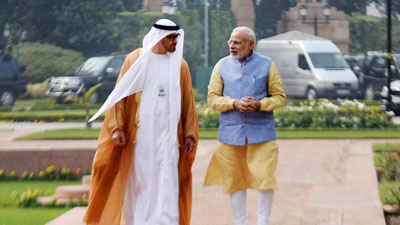 NEW DELHI, Jan 26: Sending a strong message to Pakistan, India and the United Arab Emirates (UAE) Thursday “condemned efforts, including by States, to use religion to justify, sustain and sponsor terrorism against other countries”. This is an oblique reference to Pakistan’s involvement in Kashmir, and holds significance since the UAE has, as part of the Organisation of Islamic Cooperation (OIC), supported Islamabad-backed resolutions on Kashmir.
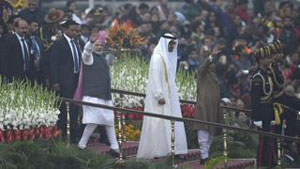 NEW DELHI, Jan 26: The elite Black Cat commandoes and the made-in-India Tejas combat aircraft made their Republic Day debut on Thursday as India showcased its military might and rich cultural heritage under an overcast sky at the ceremonial boulevard Rajpath.
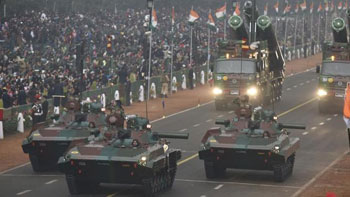 Alongside the Crown Prince, the ceremonial parade was watched by vice president Hamid Ansari, former Prime Minister Manmohan Singh, Congress chief Sonia Gandhi and the country’s top political and military brass, besides the diplomatic community.
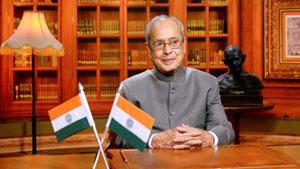 NEW DELHI, Jan 25: The government’s objective was the happiness of people and not the glory of the rulers, President Pranab Mukherjee said in his Republic Day eve address in which he also pitched for simultaneous Lok Sabha and assembly polls.
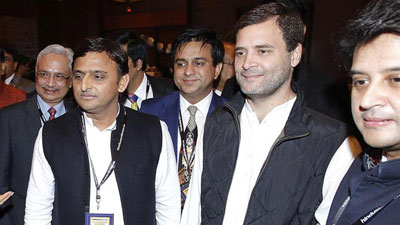 NEW DELHI, Jan 15: Uttar Pradesh chief minister Akhilesh Yadav is likely to meet Congress vice-president Rahul Gandhi this week to form an alliance before the February-March assembly elections, pushing through a political deal that has been stirring despite a Samajwadi Party family feud.
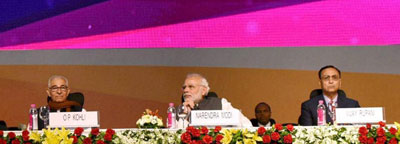 GANDHINAGAR, Jan 10: Prime Minister Narendra Modi lured investors with the promise of progressive policies while inaugurating on Tuesday the eighth edition of the Vibrant Gujarat Global Summit, a biennial business meet he had launched as the state’s chief minister in 2003.
Aviation
| Business | Defence | Foreign
Affairs | Communication | Health
| India | United Nations
India-US
| India-France | Entertainment
| Sports | Photo Gallery |
Tourism | Advertise with Us
| Contact Us
© Noyanika International, 2003-2009. All rights reserved.