


United States
US Ambassador Sergio Gor calls Jammu and Kashmir important part of India after meeting Omar Abdullah
Ambassador Gor calls for stronger India-US economic partnershipBy Deepak Arora
IOC USA Expands Footprint, Launches Connecticut Chapter Under Kamal SwamyBy Deepak Arora
Global Mayors Convened by Mamdani Set Out Shared Migration Priorities for G20 LeadersBy Deepak Arora NEW YORK, Sept 21: As world leaders gather in New York for the United Nations General Assembly, mayors and city leaders from more than 35 cities today advanced a shared vision on migration, one of the defining political issues of our time. Convened by New York City Mayor Zohran Mamdani as part of the 2026 Urban 20 (U20) Mayors Summit, city leaders from across the world made the case that migration can strengthen economies, respond to demographic change, and build more resilient communities—and that cities have a critical role to play in making it work. Their message comes as the United States prepares to host the G20 later this year. Through the U20, cities are bringing their own experience to that global conversation: not treating migration simply as a question of borders, but focusing on what happens in the places where people actually build their lives—finding work and housing, accessing services, responding to displacement, and becoming part of their communities. The U20 exists specifically to develop a collective city position that informs G20 discussions. “The global challenges we face cannot be solved in isolation," said New York City Mayor Zohran Mamdani during the opening of the U20 on Saturday, “our cities can and must be laboratories of innovation, places where new initiatives are tested, developed, and then expanded at larger scale, places that set new standards in how to serve the people of the world.” At Sunday’s Summit, participating mayors formally adopted the 2026 U20 Communiqué, which connects migration to jobs, housing, public services, demographic change, and climate resilience. It recognizes migrants and displaced people as part of the economic and social fabric of cities and contributors to prosperity, innovation, and demographic vitality. The communiqué sets out shared priorities for the G20, including expanding safe and regular labor pathways tied to workforce needs; better resourcing local reception and inclusion; ensuring cities can contribute meaningfully to migration policy design and implementation; preparing for climate-related displacement; and strengthening cooperation among cities of origin, transit, and destination. At the U20 Summit plenary Migration, Belonging & the Future of Cities, co-organized by the Mayors Migration Council (MMC), leaders from Chicago (United States), Denver (United States), Freetown (Sierra Leone), Milan (Italy), Toronto (Canada), and Turin (Italy) showed how this agenda looks like in practice across the migration journey—creating opportunity where people live, building safer pathways when people move, and making inclusion work when they arrive. Denver Mayor Mike Johnston reflected on what it takes for a destination city to absorb thousands of newcomers in a short period of time while continuing to deliver for all residents. “Denver didn’t have the luxury of debating politics, not with thousands of women and children arriving each month with little more than the clothes on their backs,” said Mayor Mike Johnston. “So, we did what we always do. We went to work. We put a roof over people’s heads and brought families out of the cold. We helped people apply for legal work so they could pay their own way. And through it all our city not only grew safer, but stronger than ever.” For Freetown Mayor Yvonne Aki-Sawyerr, whose city is experiencing rapid growth from internal migration while many young people still leave in search of opportunity, that agenda starts earlier in the journey—creating jobs and resilience so that people are able to choose whether to move. “In Freetown, migration is part of everyday life, and as climate risks grow, we’re seeing more clearly how closely climate, migration, and the future of our city are connected.,” said Mayor Yvonne Aki-Sawyerr of Freetown. “We want young people to have real opportunities at home, and we want climate change to never be the reason they have to leave. That means building a city that can withstand climate pressures and create opportunity, while making sure our voice is part of the broader global conversation on climate mobility.” Cities are also working across borders to make movement safer and connect migration more deliberately with economic need. Turin’s labor pathways initiative links refugees in Ecuador, Ethiopia, Lebanon, and Uganda with Italian employers seeking workers, while providing training and support before and after arrival. “This is the future of global solidarity, city to city,” said Turin Mayor Stefano Lo Russo. “Through our labor pathways work, Turin is connecting refugees seeking opportunity with employers who need their skills. For countries facing demographic decline and labor shortages, well-managed migration is a strategic resource. City-to-city cooperation can make movement safer and more regular while creating opportunity on both sides.” “Affordability, climate and migration are part of the same story: whether people can build stable, dignified lives in the cities they call home,” said Vittoria Zanuso, Executive Director of the Mayors Migration Council. “By putting migration at the heart of this year’s U20 agenda, mayors are sending a clear message: cities are not waiting for global debates to catch up — they are already delivering solutions and shaping the conversation. We’re proud to work with Mayor Mamdani, New York City, C40, and UCLG to carry that leadership forward and back it with the partnerships and resources needed to scale what works.” The Summit also underscored the need to match political leadership with investment. Through the Global Cities Fund for Migrants and Refugees, the Mayors Migration Council and philanthropic partners have mobilized more than $35 million to support city-led solutions for migrants, refugees, and local communities. On Sunday, the MMC announced the fund’s newest cohort of ten cities, backing solutions that connect migrants and refugees to economic opportunity, help communities prepare for climate risks, and use sport to strengthen health and belonging. “Cities are often the first to respond when refugees and migrants arrive, but too often resources fail to reach the local leaders responsible for meeting the challenges they face," said Peter Laugharn, President and CEO of the Conrad N. Hilton Foundation. "We are proud supporters of the Global Cities Fund because it starts from a simple idea: local leaders are closest to the issues at hand and best positioned to develop solutions that work. Philanthropy can play an important role by trusting cities and backing that leadership, helping effective approaches take root, and creating opportunities for others to invest alongside them and sustain these solutions. Toronto, one of the ten grantees this year, will launch a free program that brings pop-up sports directly into neighborhoods using mobile vans to reach migrant and refugee children, young people, and families. “Toronto is making sport a front door to the city. No matter where you’re from, playing together with your neighbors is the perfect way to make friends and build a sense of belonging in your community.” Said Toronto Mayor Olivia Chow. The broader message adopted in New York goes beyond migration. In their communiqué, U20 mayors describe cities not as passive recipients of global policy, but as “active architects of the world they want”—using city diplomacy and cooperation across borders to turn global commitments into practical results for all residents. |
|
 SRINAGAR: US Ambassador to India Sergio Gor has described Jammu and Kashmir as an “important part of India” after meeting Chief Minister Omar Abdullah in Srinagar. Ambassador Gor, who arrived in Srinagar as part of his first visit to Jammu and Kashmir since assuming office, held discussions with Omar Abdullah on India-US relations and areas where Washington could engage with the Union Territory.
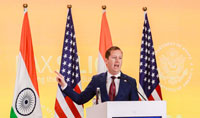 MUMBAI: US Ambassador to India Sergio Gor on Tuesday called for India and the United States to work together as “true partners” to address friction points and unlock the full potential of their economic relationship. Addressing the Indo-American Chamber of Commerce (IACC) National Convention in Mumbai, Ambassador Gor called for stronger India-US economic partnership. He stressed the need for predictable taxation and regulatory frameworks to provide businesses with greater certainty and encourage investment and innovation.
 CONNECTICUT (USA): The Indian Overseas Congress USA has strengthened its political and community presence in the Northeast with the launch of its Connecticut Chapter, led by Kamal Swamy, as the organization moves to expand its grassroots network among Indian Americans. The new chapter was formally inaugurated in Connecticut in the presence of senior IOC USA leaders, community members and supporters. The launch marks another step in the organization's nationwide expansion under President Mohinder Singh Gilzian.
India-US | India-France | Entertainment | Sports | Photo Gallery | Tourism | Link Partners | Contact Us
© Noyanika International, 2003-2024. All rights reserved.