


United States
US Ambassador Sergio Gor calls Jammu and Kashmir important part of India after meeting Omar Abdullah
Ambassador Gor calls for stronger India-US economic partnershipBy Deepak Arora
IOC USA Expands Footprint, Launches Connecticut Chapter Under Kamal SwamyBy Deepak Arora
Rubio wraps up India visit, says stronger economic and energy ties benefit both nationsMUMBAI, Oct 23: US Secretary of State Marco Rubio on Thursday said that strengthening economic ties and energy security cooperation would benefit both India and the US as he concluded his three-day visit to the country, which included stops in Mumbai and Jamnagar in Gujarat. During his visit, Rubio held bilateral talks with External Affairs Minister S Jaishankar in Mumbai on Tuesday and visited Reliance Industries Ltd's Jamnagar Refinery to explore avenues for deeper energy and commercial cooperation. "Just departed India having advanced our economic and strategic priorities in the region. Continuing to build our economic partnership and energy security cooperation makes both our nations stronger," Rubio posted on X. He also shared a photo of him and US envoy Sergio Gor, with the iconic Gateway of India in Mumbai in the background. The Secretary of State had landed in Mumbai on October 20 to advance bilateral ties in energy, trade and investment, defence, and critical technologies, and exchange views on the West Asia crisis. In a post on X, Rubio said "Just departed India having advanced our economic and strategic priorities in the region. Continuing to build our economic partnership and energy security cooperation makes both our nations stronger." The US Mission in India, in a statement on Thursday, said that Secretary Rubio visited Mumbai and Jamnagar from October 20-22 to "advance the US-India strategic partnership, strengthen commercial and investment ties, and reaffirm the United States' commitment to a prosperous and secure Indo-Pacific". In Mumbai, Secretary Rubio met with External Affairs Minister Jaishankar to discuss trade, investment, energy security, defence cooperation, and emerging technologies, and joined him in laying a wreath at the 26/11 Memorial to honour victims of the 2008 Mumbai terrorist attacks and reaffirm counterterrorism cooperation. "At the Taj Mahal Palace Hotel, I laid a wreath honouring the victims of the horrific November 26, 2008 terrorist attacks, including six American citizens. We remember those lost, honour the courage of those who responded, and reaffirm the enduring U.S.-India partnership and our shared commitment to combating terrorism," Rubio had posted on X on day one of his visit. Secretary Rubio had also met Maharashtra Chief Minister Devendra Fadnavis, and engaged with business leaders from the Adani and Tata groups to discuss opportunities to expand trade, investment, and economic cooperation, the Mission said. On Tuesday, Rubio had visited the iconic Gateway of India in Mumbai and was apprised of its historical and cultural significance by Chief Minister Fadnavis. One of the defining architectural and cultural landmarks of Mumbai and India at large, the over 100-year-old ceremonial arch facing the Mumbai harbour on one side and the heritage Taj Mahal Palace Hotel on the other, was inaugurated in 1924. Secretary Rubio participated in a Freedom 250 reception as the guest of honour commemorating the 250th anniversary of American independence and celebrating the enduring bonds between the American and Indian people, the Mission added in its statement. He met with personnel and families of the US Consulate General in Mumbai, recognising their contributions to advancing US interests and strengthening bilateral relations. In Jamnagar, Secretary Rubio visited Reliance Industries Ltd-owned Jamnagar Refinery and met with company leadership to discuss opportunities to deepen US-India energy and commercial cooperation. Trump Asks Elon Musk To Lift Ukraine Starlink Restrictions: ReportsWASHINGTON, Oct 22: US President Donald Trump called Elon Musk and asked him to lift restrictions on Ukraine's use of Starlink, the Wall Street Journal reported on Thursday, citing US officials. The Starlink system was working more normally on Thursday, shortly after the Trump-Musk conversation, according to US and Ukrainian officials cited by the Journal. Some Ukrainian officials told the newspaper the system was not restored to full functionality but was working at higher speeds than under the cap. President Volodymyr Zelenskiy said earlier on Thursday that Starlink speed had not been restored for Ukraine, adding that he hoped for talks with US Secretary of State Marco Rubio in the coming days. Trump told Musk he was frustrated the system's speeds remained capped at around 100 mph (160 kph), the Journal said, citing officials. Rubio said on Wednesday that decisions regarding Ukraine's access to Starlink were up to its parent company SpaceX and its CEO Musk, not the White House. Ukraine uses Starlink for battlefield communications and drone operations. Restricting the satellite service hampered the country's attack and air defense drone missions against Russia. US embassy orders staff to leave Saudi Arabia as drone debris kills two near oilfieldWASHINGTON, Oct 22: The United States on Wednesday ordered non-emergency government employees and their family members in Saudi Arabia to leave the country amid escalating attacks by Yemen’s Houthi rebels. In a post on X, State Department spokesperson Tommy Pigott wrote, "The U.S. Department of State issued an ordered departure for non-emergency U.S. government employees and their family members in Saudi Arabia." ‘India diversified imports, but hard to pivot in one day’: Marco Rubio explains why US waived some Russia energy tariffsWASHINGTON, Oct 17: US Secretary of State Marco Rubio has said that while India had diversified energy imports, it would be hard for New Delhi to “pivot” from Russian imports in a day. Rubio's remarks come even as US President Donald Trump waived some tariffs that could have targeted India and four nations for purchasing Russian oil and gas in an executive order on Friday. The US Secretary of State said New Delhi was an “important ally” for Washington, but was still importing a significant amount of Russian energy imports. Rubio said the “problem” was that the sanctions did not just target Russia, but also other countries, including India. “They include tariffs on a number of countries, India, for example, and others. And so I think the president wants to take the 60-day period of time to sort of analyse what imposing both sanctions and tariffs will mean to the global economy and even to the US economy...” Rubio said. Rubio said that countries like India had “voluntarily diversified their energy portfolio”. “But it's still getting a substantial amount of energy from Russia because it's hard to pivot from one day to the next,” Rubio said. The US Secretary of State further said, “But they're (India) also an important ally and partner of the United States. So the president, we need that period of time to sort of study all this and figure out what the right combination is.” US President Trump invoked Section 115, which is the waiver clause of the Lindsey O Graham Sanctioning Russian and Iran Act. The Act gave the US President legal authority to increase tariffs on Russian exports to the US by up to 500% and by up to 100% on the top five countries that help Russia evade oil sanctions. India, China, Azerbaijan, Slovakia, and Hungary were the five countries identified as the top purchasers of Russian energy, likely to be targeted by the Act’s provisions. To be sure, the secondary sanctions under the Act have just been deferred, leaving Trump free to use the law against these countries whenever he chooses. The Act had also included new sanctions targeting Russian financial institutions and their international partners in an effort to pressure Russia into ending its war with Ukraine. Trump's waiver of a number of sanctions targeting Russia and its economic partners on national-interest grounds until further notice followed Washington's diesel supply deal with Moscow announced last week. Trump waives some Russia-related sanctions that threatened 100% tariffs on India, ChinaWASHINGTON, Oct 16: United States President Donald Trump has waived the application of “sanctions, restrictions, and duties” related to Russian energy exports under a law that he signed last month, saying it was in the “national interest” of America. The US President invoked the waiver clause under the law, championed by late Senator Lindsey O Graham as a way to bring punitive measures against Russia for its invasion of Ukraine. The Lindsey O. Graham Sanctioning Russia and Iran Act of 2026 had proposed tariffs of up to 100 per cent on goods from the top five purchasers of Russian oil and gas – which include China and India – within 30 days after its enacting. To be sure, the law did not name any country as a target. Further, it did not automatically impose tariffs, leaving the decision of imposing it, its rate and timing to the President. The recent waiver directive will suspend the implementation of the tariffs, but does not stop their formal imposition, which means that Trump can apply them at any other time of his choosing. “I am hereby waiving the application of such sanctions, restrictions, and duties provided for in the Graham Act. I have submitted to the Congress a certification that the issuance of such a waiver at this time is in the national interests of the United States,” Trump said in the executive order regarding the waiver, Bloomberg reported. This comes a week after the US President had, in a surprise move, said America had agreed to buy diesel from Russia in order to attempt to push down global energy prices. The Act grants Trump expanded authority to place tariffs up to 100% on imports from the top five purchasers of Russian oil and gas. The law's primary motivation was to cripple Russia's energy export revenues and force Moscow to negotiate an end to the Ukraine war after over four years of fighting. It tasks the US Trade Representative, in consultation with the Secretary of State and Secretary of Energy, to identify the five largest importers of Russian crude and gas by total volume over the preceding 12 months, with the list reassessed every 180 days. The tariff rate ceiling under the law is100 per cent, and remains at the President's discretion. Therefore, the President is not compelled by law to place tariffs on purchasers of Russian energy. The law provides for the President to waive tariffs on any country by certifying to Congress that the waiver serves the national interests of the US, a caveat which was used by Trump in the recent directive. U.S. reportedly considers use of ‘mother of all bombs’ on IranWASHINGTON, Oct 15: The U.S. military is considering use of the GBU-43/B Massive Ordnance Air Blast bomb if it resumes strikes inside Iran, CNN reported Thursday, citing U.S. officials. Trump said Oct. 8 that he would not resume U.S. strikes on Iran before the Nov. 3 midterm elections, while attacks on shipping near the Strait of Hormuz and deadly Houthi strikes in Saudi Arabia have raised regional tensions. Iranian Parliament Speaker Mohammad Bagher Ghalibaf said Tehran will combine military capabilities and negotiations to press its demands. The U.S. military has drawn up options for renewed strikes on Iran that include the potential use of one of the biggest nonnuclear bombs in its arsenal, CNN reported Thursday, as Tehran vowed to continue fighting for its demands. An official told CNBC the Defense Department “plans for a wide range of operational scenarios to execute Presidential and Secretary level direction and to ensure mission success in any operational environment.” The 21,600-pound airburst weapon is designed to affect surface targets over a wide area and has so far not been deployed by the U.S. in previous strikes on targets inside Iran. It was used in Afghanistan in 2017 during the previous Trump administration. U.S. President Donald Trump said last week that he would not order a resumption of military strikes before the midterm elections on Nov. 3. India says first phase of US trade deal nearly done, insists on edge over rivalsNEW DELHI, Oct 15: The first phase of an India-US trade deal is in the final stages of drafting, India's trade minister said on Thursday, but reiterated that New Delhi would proceed only if it secures an advantage over competing exporters. New Delhi and Washington agreed to a framework for the deal in February which brought down to 18% from 50% the punitive tariff on most Indian goods imposed in August last year after a previous round of talks collapsed. Since then, negotiations have run into hurdles, with officials on both sides signalling that efforts to reach a final agreement have slowed. Indian trade minister Piyush Goyal said the "first tranche" of the deal would be finalised soon. "It's going through the final contours, the legal drafting, and we hope to be able to finalise that soon and operationalise that once we get comparable advantage or competitive advantage over our peer countries," a statement from his office quoted him as saying at an event in New Delhi. Goyal was referring to New Delhi's efforts to secure a tariff advantage for Indian exporters over competing economies such as Bangladesh, Vietnam and Indonesia in the US market. India wants to ensure its exporters face tariffs no higher than those imposed on competing economies. Trade Secretary Rajesh Agrawal echoed Goyal's comments. "We anticipate concluding and signing the trade deal at the earliest possible time," Agrawal said, adding that India was seeking preferential market access and greater tariff stability under the proposed agreement. India's goods exports to the United States rose to $42.79 billion in April-August from $40.39 billion a year earlier. In the fiscal year 2025/26, India recorded a trade surplus of nearly $34 billion with the United States. Neither side has publicly detailed the reasons for the delay, but one recent complication has been a new US law that could pave the way for tariffs of up to 100% on Indian goods because of New Delhi's continued purchases of Russian oil. The trade talks have unfolded against a backdrop of increasingly strained ties between India and the United States, complicating efforts to steady their trade partnership. Indian envoy rejects US lawmaker's ‘purging 130 million from voter rolls’ remarkWASHINGTON, Oct 15: India's ambassador to America Vinay Mohan Kwatra on Thursday criticised US Congresswoman Pramila Jayapal for her “unacceptable interference” on India's electoral processes and in the country's internal affairs. Jayapal, an Indian-origin Democratic representative from Washington state, expressed concern over reports that around 13 crore names had been removed from India's electoral rolls during the Election Commission's Special Intensive Revision (SIR). “The remarks by [Jayapal] on India’s electoral and political processes are unacceptable interference in India’s internal affairs,” Kwatra said on X. “India is a vibrant democracy, with robust, independent constitutional institutions and a longstanding record of free and fair elections. Always open to constructive conversation with the Congresswoman to dispel her misconceptions,” he wrote. Jayapal said she was “deeply concerned” as she alleged efforts to remove 130 million people from voter rolls in India, drawing a comparison with efforts by US President Donald Trump's administration to undermine voting rights. “I am deeply concerned about the actions of the Indian government to purge 130 million people from the voting rolls. This appears to be a similar playbook to what the Trump Administration is doing here at home to undermine voting rights in a democracy,” she wrote on X. The controversy centres on the ECI's SIR, a nationwide exercise to verify electoral rolls and remove entries considered ineligible. The ECI says the revision is necessary to update voter lists by identifying deceased voters, duplicate registrations and people who have permanently shifted or cannot be traced. Opposition parties have questioned the scale of the exclusions, claiming over 13 crore people were removed by chief election commissioner (CEC) Gyanesh Kumar to favour PM Narendra Modi's BJP in winning elections. The poll panel rejected the opposition's description of the entire figure as confirmed voter deletions, saying eligible electors could apply for inclusion in the rolls. The controversy intensified after The Indian Express reported in September that Election Commissioners Sukhbir Singh Sandhu and Vivek Joshi had formally raised objections at least 14 times over 10 months on issues linked to the revision, registration procedures and digital electoral-roll systems. The report said the commissioners had raised concerns about decisions taken by Gyanesh Kumar without their knowledge. 4 killed in Oregon school shooting; suspect also dead: US mediaOREGON, Oct 15: At least four people, including three children, were killed in a shooting at Silver Rail Elementary School in Bend, Oregon, CNN and CBS News reported on Thursday, citing law enforcement sources familiar with the incident. Police earlier confirmed that there were “multiple victims”, including children, and that the suspected shooter was also dead. Initial emergency radio traffic from the scene reportedly indicated that two victims had been classified as red-tagged, meaning critically injured, while four were black-tagged, indicating they were dead or not expected to survive. According to CBS News, the suspected shooter was believed to be a teenager who was shot and killed by a Good Samaritan. Authorities have not released further details about the suspect or confirmed the reported casualty figures. Marco Rubio to visit Mumbai, Jamnagar next week to strengthen India-US tiesWASHINGTON, Oct 14: United States' Secretary of State Marco Rubio will visit Mumbai and Jamnagar later in October after finishing his trip to Uzbekistan. This would be his second official visit to India this year after he came for four-day visit in May. During the visit, Rubio will meet with senior government officials to strengthen the strategic partnership between India and the US and also exchange views on regional and global dynamics, according to the US state department. He will also discuss prospects for enhanced energy cooperation with Indian officials during his visit. “Secretary Rubio will also meet with business leaders to promote opportunities for commercial investment and economic cooperation,” the state department said. Before coming to India, Rubio will visit Uzbekistan and participate in the C5+1 Ministerial. There, he will hold bilateral engagements with senior officials from all C5 countries – Uzbekistan, Kazakhstan, Tajikistan, Turkmenistan, and the Kyrgyz Republic. During his diplomatic visit to India in May, Rubio went to Kolkata, Agra, Jaipur and New Delhi. He focused on strengthening strategic ties, boosting cooperation under the Quad alliance, and advancing discussions on trade, defence and energy security. Ahead of Rubio’s visit to India next week, a delegation of top officials from the US National Security Council is also expected to arrive in the country to lay the groundwork for a rejuvenation of the bilateral advanced technology partnership. According to people aware of the matter, the US delegation and its Indian counterparts will focus their efforts on the TRUST initiative, which was launched in February 2025 to drive cooperation on semiconductors, artificial intelligence, space, biotechnology and other crucial tech sectors. Rubio's second official visit to India comes days after Montana Governor Greg Gianforte visited the country and drew a wave of online abuse amid a broader rise in anti-Indian sentiment in the US. Gianforte brushed off the backlash and said the visit had made significant progress despite the noise. “We were there for one purpose, and that's to further Montana's interests in a way that benefits both Indian India, Montana and the US. The benefits are very clear. When we work together, we get groundbreaking research. We get jobs in Montana. We feed and provide protein to India. So everybody benefits. And frankly, in today's environment, you can't do anything without getting a little bit of pushback,” said Gianforte. Trump announces Russia-Ukraine ‘energy ceasefire’WASHINGTON, Oct 11: US President Donald Trump has claimed that Russia and Ukraine have agreed to an “energy ceasefire”, under which both sides would stop attacking each other's energy infrastructure. “Effective immediately, there is an ENERGY CEASEFIRE in the War between Russia and Ukraine. Both parties have agreed. Do not break it! Thank you for your attention to this matter,” Trump posted on Truth Social. However, Ukrainian President Volodymyr Zelensky told Axios that Trump's announcement of an energy ceasefire was ‘news to him’, but said Kyiv would agree if Moscow committed to the truce. However, Russia is yet to confirm this development so far. This announcement has come a day after Trump blamed Zelensky for attacking diesel facilities in Russia and contributing to a global shortage. Russia and Ukraine have repeatedly attacked each other's energy infrastructure during the war. Zelensky earlier on Sunday said that Kyiv would be ready to stop striking Russian oil refineries if Moscow ceased attacks on Ukrainian energy infrastructure, amid criticism from his US counterpart. "Ukraine will be ready to stop striking Russian oil refineries if Russia stops striking our energy infrastructure. Any de-escalation steps must be reciprocal and backed by real guarantees," Zelensky said in a post on X. Trump has also been facing strong criticism for a deal he struck with Russia on Moscow’s exports of diesel. He announced a major energy supply agreement with Russia on Friday that could see Moscow supply nearly 5 million tons of diesel fuel to global energy markets. Criticising the deal, Zelensky said the move could help Moscow fund its war against Ukraine. He called the agreement a weak decision, warning that it could undermine efforts to end the conflict. Trump strikes major diesel deal with Russia in bid to lower US fuel prices ahead of midtermsWASHINGTON, Oct 10: US President Donald Trump announced a major energy supply agreement with Russia on Friday that could see Moscow supply nearly 5 million tons of diesel fuel to global energy markets. The deal was unveiled after a phone call with Russian President Vladimir Putin and was swiftly followed by the US Treasury issuing a temporary general license allowing the purchase of Russian diesel until April 7 next year. The move comes as part of Trump’s effort to reduce domestic energy prices ahead of the crucial midterm elections in the US, in which the President’s Republican party is expected to fare poorly due to widespread concerns about high inflation and affordability. “I have just concluded a highly successful discussion with President Putin of Russia, wherein it was agreed that Russia will immediately supply over 300,000 Tons of Diesel Fuel to the American and Global Marketplace, another 500,000 Tons during the month of November, and 1,000,000 Tons immediately thereafter. Additionally, based on the condition of their Diesel Refineries, Russia will then deliver, within a short period of time, 3,000,000 Tons of Diesel Fuel,” Trump said in a post on Truth Social, his social media platform. The Republican also asserted that the announcement would lead to a speedy reduction in diesel prices for American and global consumers. It is unclear how the energy deal with Russia impacts the Lindsey O. Graham Sanctioning Russia and Iran Act of 2026, which was signed into law by President Trump last month. The act was explicitly designed to cripple Russia’s energy export earnings by directing President Trump to place tariffs up to 100% on goods from the top five purchasers of Russian oil and gas in the 12-month period prior to the date the act was signed into law. India, China, Azerbaijan, Slovakia and Hungary were expected to be the five nations impacted by this legislation. This is particularly important because the legislation requires the President to impose tariffs on Russian oil purchasers within 30 days, which would fall on October 18. To be sure, the act also gives President Trump the authority to grant national interest waivers, exempting a country from the tariffs. The announcement of the US-Russia energy deal has led to some uncertainty about whether the tariffs will be levied. US suspends Microsoft from green card programme; Tata, Cognizant, HCL, Infosys also targetedWASHINGTON, Oct 8: In another move targeting the H-1B visa programme, the US administration under President Donald Trump has suspended tech giant Microsoft from a programme that allows companies to apply for green cards for foreign workers as it cited an alleged fraud. Other companies in H-1B trouble include Cognizant Technology Solutions Corp., Infosys Ltd., Tata, Wipro Ltd., HCL Technologies Ltd., and Capgemini SE. Announcing the decision at a White House briefing on Thursday, Vice President JD Vance said the company should put “Americans first”. “Our message to Microsoft is: You're a great American company, but you've got to hire great American workers,” Vance said. Escalating the Trump administration's criticism of the company, Vance claimed that no US firm had “abused” the green card system more than Microsoft. The vice president said the programme from which Microsoft has been suspended requires companies to advertise jobs in the United States before applying to the Department of Labor for green cards, demonstrating that qualified American workers are unavailable for those positions. He alleged that Microsoft laid off 6,000 American workers last year while securing 6,300 H-1B visas and nearly 3,000 green cards. “If you do the math, for every worker that Microsoft laid off, they replaced that worker with one and a half foreign indentured servants,” Vance said. The H-1B visa program allows US employers to help sponsor foreign workers for permanent residency. In the process to acquire green card for foreign workers, employers seek certification from the Department of Labor that there is no qualified, willing or available US worker for a specific job. This step is required before filing petitions for most employment-based green cards. US labor secretary Keith Sonderling said other companies that would be suspended from the Permanent Labor Certification Program included Cognizant Technology Solutions Corp., Infosys Ltd., Tata, Wipro Ltd., HCL Technologies Ltd., and Capgemini SE. He said there were multiple active federal investigations ongoing into the matter. "We will not accept any new or process any pending permanent labor certification applications involving these companies," Sonderling was quoted as saying. Two Mumbai-based firms, 5 Indian nationals face US sanctions over Iran oil tradeWASHINGTON, Oct 8: The US on Thursday imposed sanctions on two Mumbai-based firms and five Indian nationals associated with them over allegations of being involved in the trade of petroleum products from Iran. The US Department of State action targeted SSPL Solutions Private Limited and Samudra Marine Services Private Limited for facilitating the import of petroleum products from Iran. Two persons associated with SSPL Solutions – Dhwani and Nisarg Vora, and three persons related to Samudra Marine Services – Ketan Kochikar, Bhupendrasingh Sahu and Harishyam Hariharan Chundakattil have also been blocked from performing any transactions related to their respective firms. The action against the Indian entities and individuals is part of the US crackdown against Iran under Operation Economic Outcast. "The Department of State is sanctioning ten entities, six individuals, and five vessels in connection with trade in Iranian-origin petroleum, petroleum products, and petrochemical products," an official statement said. The State Department said these entities channelled millions of dollars to the Iranian regime, bolstering one of its most critical revenue streams and enabling its continued illicit conduct. "The US government is imposing sanctions on both the buyers and sellers driving this trade in Iranian petrochemical products," the department said. At the same time, the US also authorised wind-down transactions by Samudra Marine Services till October 23. A wind-down of transactions is a temporary, authorised grace period allowing parties to safely finish existing business and exit operations before new sanctions or liquidations take full effect. Additionally, the Treasury Department also sanctioned 17 entities and their shadow fleet vessels to deprive the Iranian regime of funds. "Treasury is starving the tyrannical regime in Tehran of the money it uses to wage war in the region, and we will continue exposing those who enable the regime's oil sales," said Treasury Secretary Scott Bessent. "No enabler of Iranian sanctions evasion is safe from the full force of Treasury's authorities," he said. Trump claims Iran’s economy is ‘gone,’ says war will end soonWASHINGTON, Oct 6: President Donald Trump said Monday that he expects the Iran war to end shortly before or after the midterm elections. U.S. Central Command also said Monday that its forces have redirected 130 ships since the start of its blockade of Iranian ports. Washington moved 12 American bombers from RAF Fairford in the U.K. on Sunday amid concerns about a potentially complex drone attack ordered by the IRGC, The Wall Street Journal reported Monday. The Treasury Department is continuing its campaign to economically cut off Iran, now telling financial institutions that any continued business with Tehran could trigger immediate sanctions. President Trump said Tuesday that the U.S. is doing “extremely well” against Iran, declaring that the country’s military is “shot” and suggesting a decision is coming soon on how to bring the conflict to an end. “We’re doing extremely well in the Islamic Republic of Iran,” Trump said in Sparrows Point, Maryland. “They have no military. It’s shot. The whole place is shot.” “And they were the evil one. They were the bully of the Middle East and not so much the bully anymore,” Trump said. “But we have to finish up, and it’s only a question of which way do we want to do it: the nice way or the not-so-nice way? And pretty soon you’ll find out.”
Qatar confirms US-Iran talks ongoing as Doha pushes for diplomatic progress DOHA, Oct 6: Qatar confirmed Tuesday that talks and its mediation efforts between the United States and Iran are ongoing, with Doha actively working to help both nations achieve meaningful diplomatic progress. In a statement shared on X, Ibrahim bin Sultan Al Hashmi, director of the Media and Communication Department at Qatar’s Ministry of Foreign Affairs, said the diplomatic push aims to build momentum "covering all issues of concern to both parties," while Qatar acts as a key mediator. Al Hashmi emphasized resolving long-standing tensions "requires making every effort to find negotiable solutions while taking into account the concerns of all parties involved." He added that Qatar remains committed to maintaining open channels of communication to ensure steady progress toward stability in the region.
Trump to speak to Putin on plague as US steps up pressure WASHINGTON, Oct 6: US President Donald Trump said Tuesday he would speak very soon with Russian President Vladimir Putin over the reported plague death of a laboratory technician, as Washington pressured Moscow for transparency. Russian authorities denied that they were imposing anti-plague measures and played down the reports of an incident at an anti-plague institute in Siberia's Irkutsk region last week. But Washington is showing growing concern, with Secretary of State Marco Rubio calling on Russia to be open about the situation. "We encourage Russia to be transparent and share more information with the world so that all of us could react accordingly and appropriately," Rubio said during a trip to Iceland. Trump later said he would be speaking to Putin about what happened. "I have a call scheduled, yes," Trump told reporters at the White House when asked if he had spoken to Putin on the issue yet, adding that it would happen "very soon." The Wall Street Journal reported that the US State Department had sent Russia a confidential diplomatic communication known as a demarche warning Moscow that failure to disclose details runs counter to its international health obligations. Russian news outlet People of Baikal reported Friday that the dead woman named as 28-year-old Darya Shipilova may have contracted pneumonic plague from a broken test tube. Other media reported a possible link between her death and a lab accident at the facility. The People of Baikal outlet also said up to 200 people with whom she may have had contact were under quarantine. But Russian authorities say the cause of death is not confirmed and health watchdog Rospotrebnadzor has denied claims circulating in a document online that special measures had been put in place. "We wish to clarify that the document and information in question do not originate from official sources and are untrue," it said on Telegram. Russian officials said postmortem tests had not detected the disease. Irkutsk Regional Governor Igor Kobzev said Monday that a Rospotrebnadzor inspection had found the woman died of pneumonia and the cause was "undetermined". "No microorganisms linked to the young woman's professional work were found in her biological samples," he said, adding that no other staff at the institute had sought medical attention since her death. The World Health Organization said that an update received Tuesday from Russia stressed that "no case of this dangerous disease has been recorded in the city of Irkutsk." The update said Russia had launched an epidemiological investigation into a "case of community-acquired pneumonia" in an employee at the Irkutsk institute, and had identified contacts and made arrangements for medical monitoring and laboratory testing. "Test results showed no presence of dangerous infectious disease pathogens in any of the contacts," the update said, according to WHO. The United Nations health agency meanwhile said there was a "moderate to low" risk for Irkutsk based on the available information, spokesman Christian Lindmeier said in Geneva, adding it was monitoring the situation closely. Plague is a bacterial disease that can occur in several forms, including pneumonic plague, which is the most contagious type and can be transmitted by respiratory means. Bubonic plague is transmitted by infected fleas. Pneumonic plague, which causes lung failure, can be fatal if not treated early, according to WHO. Trump had said Monday he was ready to help Russia if needed. But in an apparent response to Trump's offer, the Russian watchdog said Tuesday that Moscow was prepared to assist the United States in combating its own outbreaks of infectious diseases. It highlighted among other things a "significantly worsened" measles situation in three US states, and a "fatal case of plague" recorded in New Mexico in June. Measles cases have increased under the Trump administration, in which vaccine skeptic Robert F. Kennedy Jr serves as health secretary. Trump claims Iran is responsible for flydubai incidentWASHINGTON, Oct 5: US President Donald Trump said Monday he "personally" believes Iran was responsible for the September 30 flydubai incident where Indian pilot Smit Machchar was stabbed by Omani co-pilot, Hamam al-Hammami. Trump's comments came even as US Vice President JD Vance told reporters on his way to Alaska Monday that there is "nothing conclusive" linking the incident to Iran. UAE authorities, who are investigating the incident, have not given a conclusive verdict on who was behind the attack as the probe continues. al-Hammami has been handed over to the UAE after initial interrogation by authorities in Saudi Arabia. As Trump boarded Air Force One Monday afternoon, a reporter asked him about Iran's involvement in the flydubai incident. "I do. I personally do," Trump said. However, when reporters asked Vice President JD Vance about it as he and Second Lady Usha Vance departed for Alaska Monday, the Ohio Republican was much more cautious. Instead of commenting directly, he said he would defer it to the CIA Director, as the latter is better equipped to comment. "That's something that I defer to John Ratcliffe and some of the intelligence folks on," JD Vance said. "I don't want to get ahead of any announcements there, but it's certainly something that we're looking at. But I wouldn't say I've seen anything conclusively just yet." Officials in Israel, UAE and Saudi Arabia have characterised the flydubai incident as a "terror attack." But questions remain about whether the attacking co-pilot acted alone or was part of a larger terror plot. NBC News reported, citing US officials briefed on the probe, that investigators believe the Omani co-pilot acted alone rather than as part of a larger organisation. The report cautioned that the probe is in its "early stages." UAE Attorney General and Prosecutor General Hamad Saif Al Shamsi had said on October 3 that a preliminary probe indicated that Hamam al-Hammami had planned to carry out a terrorist attack. "Investigations into the incident involving flydubai flight FZ1073 found that the co-pilot had attempted to carry out a terrorist attack," he said, noting that they are working to establish the “full circumstances, motives, and any links.” 3rd Aircraft Carrier, 10,000 Troops Head To Middle East After Trump's WarningWASHINGTON, Oct 2: The United States is sending a third aircraft carrier to the Middle East along with another 9,000 to 10,000 more troops after US President Donald Trump warned Iran of possible new strikes after the midterm elections on November 3. The USS Theodore Roosevelt and its strike group carrying the service members would arrive in the Middle East by the end of November. Currently two other aircraft carriers are stationed in the region -- the USS George HW Bush and the USS George Washington. Although the USS George Washington is usually deployed in the Pacific Ocean, it has reached the Middle East to relieve the USS Abraham Lincoln after its long deployment. The deployment would bring the US naval presence to an unusually high number of more than 20,000 sailors and Marines as well as hundreds of aircraft. Trump rejected Iran's peace proposal that was announced by the Islamic Republic last week at the UN General Assembly in New York. Iran said that the proposal was transmitted to the US through Qatari mediators. "They want to make a deal to open the Hormuz Strait immediately because they're losing so badly," Trump told reporters at the White House. While speaking to reporters on Wednesday, Trump also suggested that Iran is linked to the co-pilot who stabbed the captain and tried to crash an Israel-bound flight. When asked if there was a connection between the pilot who attacked the captain and Iran, Trump said, "I would say the answer, based on what I'm hearing, is 'yes,' but we're working on it right now." On whether the US would retaliate against Iran if it was responsible for the attack, Trump replied, "Oh, they'll be hit very hard, don't worry." The reporter then asked if the man might have been placed on the plane by the IRGC, or radicalised in some other way before deciding to bring the aircraft down. "Could have been, yeah," Trump replied. There has been no official evidence of Iranian involvement yet. Goyal meets US Trade Representative Greer, holds ‘productive talks’ on proposed pactMILWAUKEE, Oct 2: Today’s fertiliser shortage could become tomorrow’s food crisis, commerce minister Piyush Goyal said at the G20 trade ministers’ meeting in Milwaukee, and on its sidelines he also held a “productive” discussion with US Trade Representative Jamieson Greer on early conclusion of the proposed India-US trade deal. “Met USTR Jamieson Greer, @USTradeRep, on the sidelines of the G20 Trade Ministers’ Meeting in Milwaukee. Had a productive discussion with USTR Greer towards early conclusion of a mutually beneficial interim agreement under the India-US Bilateral Trade Agreement,” Goyal said in a post on X. India and the US are engaged in talks to finalise the proposed interim bilateral trade agreement (BTA) in line with the joint statement issued on February 7. Although the two had reached a framework for an interim BTA in February, they could not sign the agreement after the US Supreme Court invalidated the legal basis for the preferential tariff mechanism Washington had offered. India is now awaiting a preferential tariff framework that provides competitive access for its exporters vis-a-vis competing countries. “We also exchanged views on G20 deliberations under US Chairship,” Goyal said in the post. He also participated in the opening day of the G20 trade ministers’ meeting, hosted under the United States G20 Presidency. Speaking at the session on food and trade, Goyal thanked the Presidency for placing food at the centre of the discussions. “Ensuring food security for all and creating greater opportunities for farmers are central to India’s policy and food must never be used as an instrument of pressure against any country,” a commerce ministry’s statement quoted minister as saying on Thursday. Trump claims flydubai co-pilot who stabbed Indian captain Smit Machchhar 'linked to Iran'WASHINGTON, Oct 1: On Thursday, US President Donald Trump claimed that the Omani co-pilot who stabbed Indian captain Smith Machchar aboard the flydubai plane Wednesday, intending to crash the aircraft, could be linked to Iran. Authorities are investigating the motivation of the attacking co-pilot behind crashing the flydubai plane. The plane had 174 passengers on board, 170 of whom were Israelis. Israel's Defence Minister Israel Katz described the attack as "attempted jihadist terror attack." Meanwhile, the United Arab Emirates, from where flydubai operates, said that they are investigating whether the incident was indeed a terror plot. Trump was asked by reporters Thursday about the flydubai incident. One reporter specifically asked the President what he thought about a potential Iran involvement in the attack. He had earlier said that the attack could be "a terrorist or perhaps a whack job". "Has anybody briefed you on whether the FlyDubai pilot is linked to Iran?" the reporter asked Trump. “I would say the answer, based on what I'm hearing, is yes, but we're working on it right now,” Trump replied. The Omani co-pilot attacked Smit Machchar when the Boeing 737 MAX was flying at an altitude of 36,000 feet. A cockpit confrontation followed in which Machchar opened the locked cockpit door. Passengers rushed in and subdued the attacking co-pilot. Captain Smit Machchar, who worked with Indian carrier SpiceJet for 11 years, earned praise worldwide for the heroic act of opening the cockpit door on time, averting a major crash. Among those who paid tribute to Captain Machahar were Netanyahu and Trump. "My salute to the Indian pilot Captain Smit Machchhar for his extraordinary bravery," Netanyahu said in a X post Wedensday. “Despite being stabbed and seriously injured, he fought back, resisted, opened the cockpit door, and enabled passengers and crew to overpower the attacker — preventing a catastrophic mid-air disaster.” Trump, meanwhile, said Machchar was " in very bad shape... but he had the sense to, amazing, to, in a way he was a hero to open the door." |
|
 SRINAGAR: US Ambassador to India Sergio Gor has described Jammu and Kashmir as an “important part of India” after meeting Chief Minister Omar Abdullah in Srinagar. Ambassador Gor, who arrived in Srinagar as part of his first visit to Jammu and Kashmir since assuming office, held discussions with Omar Abdullah on India-US relations and areas where Washington could engage with the Union Territory.
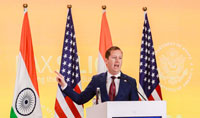 MUMBAI: US Ambassador to India Sergio Gor on Tuesday called for India and the United States to work together as “true partners” to address friction points and unlock the full potential of their economic relationship. Addressing the Indo-American Chamber of Commerce (IACC) National Convention in Mumbai, Ambassador Gor called for stronger India-US economic partnership. He stressed the need for predictable taxation and regulatory frameworks to provide businesses with greater certainty and encourage investment and innovation.
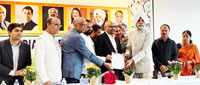 CONNECTICUT (USA): The Indian Overseas Congress USA has strengthened its political and community presence in the Northeast with the launch of its Connecticut Chapter, led by Kamal Swamy, as the organization moves to expand its grassroots network among Indian Americans. The new chapter was formally inaugurated in Connecticut in the presence of senior IOC USA leaders, community members and supporters. The launch marks another step in the organization's nationwide expansion under President Mohinder Singh Gilzian.
India-US | India-France | Entertainment | Sports | Photo Gallery | Tourism | Link Partners | Contact Us
© Noyanika International, 2003-2024. All rights reserved.