


United States
US Ambassador Sergio Gor calls Jammu and Kashmir important part of India after meeting Omar Abdullah
Ambassador Gor calls for stronger India-US economic partnershipBy Deepak Arora
IOC USA Expands Footprint, Launches Connecticut Chapter Under Kamal SwamyBy Deepak Arora
‘Iran a failed nation…it is dead’: Trump threatens ‘hard’ response to attacks on US forcesWASHINGTON, Aug 31: United States President Donald Trump on Monday vowed a response to Iranian attacks on American forces, while referring to the country as a “failed nation.” Speaking to Fox News, the US President said America would “hit Iran hard” after Tehran's retaliatory strikes on US targets in the Middle East. Iran carried out the strikes after American strikes on an Iranian island in the Strait of Hormuz. “President Trump says the United States will respond to the Iranian missile attack on US forces overnight,” Fox News correspondent Trey Yingst said in a post on X. “We're going to hit them hard…There will be a response,” he cited Trump as saying. The United States further denied the Iranian claim that an oil tanker had hit mines near the Strait of Hormuz. In a post on Truth Social on Monday, Trump referred to Iran as a “failed nation”. “IT IS DEAD! They have no Navy, they have no Air Force, they have no currency, they are not paying their soldiers or police," the US President said, claiming that Iran's inflation was at 300 per cent. He further alleged that the Iranian leadership “is in disarray and incapable of properly representing the country.” “The only thing they have is FAKE NEWS from the USA, a willingness to kill their protesters (now over 100,000 people dead. They must be tried for war crimes against humanity!), and a good line of “BULLSHIT,”” Trump further said. US strikes Iranian rocket launchers on the Strait of Hormuz in first military action in weeksWASHINGTON, Aug 31: U.S. forces struck Iranian rocket launchers on the Strait of Hormuz in their first military action in a month on Sunday, breaking a lull in fighting during an intermittent war that has lasted more than six months. Iran swiftly vowed to retaliate for what it called a deadly attack. Forces with the Revolutionary Guard Corps were observed preparing to launch rockets with sea mines into the strait, according to Tim Hawkins, said a spokesperson for the U.S. Central Command. The U.S. military last week completed clearing sea mines from the strait's international shipping routes. Semiofficial news outlets in Iran reported sounds of explosions near Larak island on the strait. The Guard in a statement carried by Iran's state broadcaster noted "the martyrdom and injury of several of our fighters and compatriots." Later, Iranian state television showed what it said were ballistic missiles being fired by Iran at U.S. bases in Jordan in response to the American strikes. Jordan's armed forces said they intercepted eight missiles that penetrated the country's airspace early Monday. A return to open conflict would be dangerous for the region, where Iran has targeted U.S. military bases and infrastructure in Gulf countries since the war began on Feb. 28. The last time the U.S. military confirmed targeting Iran was on July 29, when it announced a "heavy wave of strikes" on dozens of Revolutionary Guard targets including coastal surveillance and defense sites. On Aug. 1, President Donald Trump said he would order the military to hold off on new strikes at the urging of Gulf allies Qatar, Saudi Arabia and the United Arab Emirates. Trump Announces 'Biggest Oil Deal In World History' With VenezuelaWASHINGTON, Aug 29: President Donald Trump said Friday that his administration has entered a sweeping agreement with Venezuela that, if realized, could give the U.S. access to vast amounts of the South American country's untapped oil reserves, at cost. Trump in a social media post announcing the agreement said it was negotiated by Secretary of State Marco Rubio, Defense Secretary Pete Hegseth and Venezuela's acting President Delcy Rodriguez. "The United States of America has just entered into an Agreement with the Country of Venezuela on, THE BIGGEST OIL DEAL IN WORLD HISTORY!" Trump wrote. Rodriguez's government in a statement said the deal involves the development of 17 fields with a proven potential of 65 billion barrels. It said the agreement could draw $100 billion in investment into Venezuela's oil industry and yield over $209 billion in taxes for Caracas. Rodriguez in a posting on Telegram predicted the deal "will have a significant impact on our nation's revival." The agreement allows for the United States to partner with an unnamed private operator in Venezuela to create a new private company to take hold of the reserves, according to a U.S. official familiar with the contours of the deal. The official, who was not authorized to comment publicly and spoke on the condition of anonymity, added that Rodriguez granted the company 100-year rights to develop the oil fields. The deal gives the United States 55% effective output of the new private company -- including an ownership stake and rights to buy oil at cost. The company would be the second largest corporate holder of proven reserves after Saudi Aramco, according to the official. The announcement comes nearly nine months after the U.S. military at Trump's direction carried out an operation to capture Venezuela's then-President Nicolas Maduro and spirit him to the United States to face federal narcoterrorism and drug trafficking charges. US announces new Iran sanctions; Tehran hits back, calls them 'state terrorism'WASHINGTON, Aug 28: The United States on Friday imposed additional targeted Iran-related sanctions, days after Treasury Secretary Scott Bessent threatened further action as Washington’s ongoing war with Iran entered its sixth month. The Trump administration plans to impose restrictions on an Egyptian bank over its business dealings with Tehran and revoke US financial access to Banque Misr’s branches in the United Arab Emirates. The Financial Times earlier reported the planned action. The official said the proposed rule, if finalised, would revoke Banque Misr UAE’s correspondent banking access to US financial institutions. Separately, Treasury officials imposed sanctions on one Hong Kong-based entity and one person linked to Iran’s Bank Melli, according to a notice posted on the Department of Treasury’s website. Iran condemned the United States' new economic sanctions on Friday as "state terrorism" and said other countries were legally obliged not to implement them, while the US Treasury Department announced additional targeted Iran-related measures, according to a report. The Iranian foreign ministry's statement came as mediators stepped up efforts to reopen the Strait of Hormuz, which handled 20% of world oil supplies before the war began six months ago and whose status remains the biggest obstacle to a peace deal. President Donald Trump's administration on Monday warned countries to cut their business ties with Iran or face secondary sanctions as part of what it billed as an "economic D-Day," though the Treasury Department stopped short of actually imposing penalties. Trump reiterated on Thursday that the US was not talking with Iran, while the White House said Washington's economic campaign would continue until Tehran decided to "come to the table in a meaningful way". Iran’s Foreign Ministry said in a statement on Friday that all countries were obligated under international law to refrain from implementing US sanctions against Tehran, adding that participation in them amounted to complicity in imposing one state’s unlawful will on independent states. It branded the new US measures a "crime against humanity" that put the health and livelihood of millions of civilians at serious risk, and called on other nations and United Nations bodies to uphold the rule of law. Trump says Strait of Hormuz open as tanker traffic resumesWASHINGTON, Aug 28: US President Donald Trump has said the Strait of Hormuz is open, describing the Iranian response to the conflict as “very mild”. The strait has been Iran's most powerful card since the war began in late February. But over the past two months, according to Axios, citing US officials, the American military has steadily eroded Iran's leverage over the crucial waterway. “That sucker is open,” Axios quoted Trump as saying of the strategic strait. “The Iranian response is very mild. They don’t want us to go back at them. That’s the whole ball game. The rest doesn’t matter,” he added. The comments came after US Central Command chief Brad Cooper said in a video statement that “internationally recognised sea routes in the strait are free of Iranian sea mines,” describing the development as a “major milestone.” According to Axios, US officials estimate that between 20 and 30 tankers are currently passing through the Strait of Hormuz each night. However, that remains around half the level recorded before the war. An American official cited by the outlet said Iran had struck around 2% of the ships that passed through the strait over the past month. Tehran, however, continues to attempt attacks on vessels, with most of those attempts reportedly missing their targets. Meanwhile, preliminary shipping data showed that seven commodity vessels transited the Strait of Hormuz on Thursday, down from 17 the previous day and below the 10-day average of 15. The figures could change because some vessels switch off their transponders while travelling through the waterway, making it difficult to track all movements in real time. The Strait of Hormuz is a critical global shipping route through which a significant share of the world's oil supplies passes. Trump says Hormuz mines cleared, warns Iran against planting new onesWASHINGTON, Aug 25: United States President Donald Trump on Tuesday claimed that all mines in the Strait of Hormuz had been removed or detonated, saying he had been informed regarding the same by the American Navy. Trump, in a post on Truth Social, issued a warning to Iran, saying ships found to be “placing new mines” would be “immediately and systematically destroyed.” “I have just been informed by the United States Navy that all mines have been removed and/or detonated from within the International Waters of the Strait of Hormuz,” the US President said. He further added, “Iran has been notified that any ship or boat placing new mines will be immediately and systematically destroyed.” Trump claimed that the US was “watching every inch” of the waterway and the Pickaxe Mountain “through space force”. Pickaxe Mountain, formally known as Kuh-e Kolang Gaz La, is an under-construction Iranian nuclear site buried deep beneath a mountain near the country's Natanz nuclear facility, according to the Associated Press. The US President said American forces were also keeping a tab on the three Iranian nuclear sites, which they had struck earlier. “There is a Zero Tolerance policy on mine placement in full force and effect,” he said. Trump had, in a post on Truth Social earlier on Tuesday, claimed that Iran was facing a “humanitarian crisis of epic proportions.” He alleged that Tehran was not paying “large segments” of its military, and claimed the “killing” of protesters in Iran. “The failing Islamic Republic of Iran is not paying large segments of their military, while at the same time killing protesters, even when they are not protesting, at levels not seen before. It is a humanitarian crisis of epic proportions, and must be stopped, NOW,” Trump said. Trump's warning to Iran on Hormuz comes even as the US seeks to increase economic pressure on the country with the unveiling of new sanctions. The new measures expand the use of secondary sanctions, which can target countries, companies and other entities that do business with Iran. While some senior leaders of the Iranian regime have suggested ending the conflict “in a position of power and dignity”, the country's economy minister Ali Madanizadeh on Monday struck a defiant tone. He predicted “another defeat” for America, saying Iran had a “two-year plan” to deal with Washington’s new sanctions. “They have done everything they could to test the determination of the Iranian people and the country's officials, but they have failed every time. It seems they wished to suffer yet another defeat,” Iran's economy minister told state television. "We've been waiting for these plans for a long time, and the government is and was ready and has a two-year plan to manage these events," he added. CIA Chief On 'Secret' Trip To Moscow As US Asks Ukraine To Halt Strikes: ReportWASHINGTON, Aug 25: CIA Director John Ratcliffe has made an unannounced trip to Moscow for talks with Russian officials, CNN reported. Before his trip, the US requested Ukraine to temporarily stop drone and missile attacks on Moscow and other cities in northern Russia, according to the report. The request covered Monday through Wednesday, and Kyiv was informed that a senior US official would be travelling to Russia. The secret visit comes at a sensitive moment for Washington's efforts to get Moscow and Kyiv closer to a deal. Early on Tuesday a US Boeing C-17 Globemaster III military transport aircraft landed at Moscow's Vnukovo International Airport. Flight-tracking website Flightradar24 showed that the aircraft appeared to have departed from Joint Base Andrews in Maryland. A Latvian Defence Ministry spokesperson told CNN that the flight had been cleared to operate in the region. The spokesperson said the flight was “properly coordinated and authorised for operation within the airspace”. Ratcliffe's Moscow visit also comes just a day after US Treasury Secretary Scott Bessent unveiled “Operation Economic Outcast”, a new campaign aimed at cutting Iran off from the global economy. The strategy targets countries and entities that continue doing business with Tehran, and Russia is among Iran's key strategic trading partners. The CIA chief is also travelling to Moscow as fresh US intelligence assessments suggest Russian President Vladimir Putin could test NATO's unity with a limited attack on one of its member states within the next few years. Officials say the scenarios being examined range from cyberattacks and covert operations to a small-scale military incursion. The CIA has played a role in several recent detainee exchanges between Washington and Moscow. Ratcliffe personally negotiated the April 2025 release of Ksenia Karelina, a US-Russian dual national. The agency was also involved in the 2024 prisoner swap that brought home Wall Street Journal reporter Evan Gershkovich and former US Marine Paul Whelan. 'Sever Every Economic Lifeline': US Announces Explosive Sanctions Against IranWASHINGTON, Aug 24: US Treasury Secretary Scott Bessent has warned that countries that continue to allow Iran to launder money will 'be removed' from the US dollar system. Addressing a press conference on Monday, Bessent spoke about new US sanctions that aim to block all potential sources of revenue for Iran and claimed that sanctions will also be slapped on countries that do not cut economic ties with the Islamic Republic. Although he did not name what countries could face potential secondary sanctions from the US, Bessent said that it is "no longer acceptable to operate in the grey spaces" of the conflict. "Those who enable Tehran do not discount the cost of testing Washington's resolve. No nation should expect to enjoy the rewards of our system while helping those who seek to destroy it. It is now a time for world leaders to make a decision between prosperity and isolation, peace and terror, America and Iran," Bessent warned. "Let there be no ambiguity as to the position of the United States," Bessent told a news conference. "An economic engagement of any kind with this murderous regime will expose those responsible to the full reach of American power." China, Turkey and the United Arab Emirates are Iran's largest trade partners. The US' new pressure campaign aims to destroy Iran's economy six months into the war, in which Bessent said that countries not joining the sanctions will 'share in the isolation' of Iran. "Let me clear: Any entity that facilitates money laundering on behalf of Iran will be removed from the US dollar system. The clock just started ticking," Bessent said. In a response to questions about sanctions, Bessent said that any entity that facilitates transactions or helps Iran turn its oil into money will be "targeted". Washington has said the new sanctions aim to put more pressure on an economy already battered by previous sanctions and a US naval blockade. Meanwhile, earlier in the day, in a post on Truth Social, Trump claimed that Iran is "completely collapsing". In another post, Trump claimed that the Republicans are winning against Iran, a nation he described as one falling in an "economic and military death spiral". Iran's currency has hit a record low, with the rial dropping to 2.02 million to the US dollar as trading opened on currency markets. The currency had already been under pressure before the U.S. and Israel attacked Iran on Feb. 28, as Iran faced double-digit inflation and negative growth. The rial has repeatedly hit new lows as nearly six months of war have taken an even greater toll. Iranians find daily staples increasingly unaffordable. Since the war began, rice is up some 60 per cent, and beef prices are more than 150 per cent higher. The International Monetary Fund forecasts that gross domestic product will contract more than 5 per cent. Trump says Canada Ripping Off US; Escalates Trade War With 50% Tariffs From 2027WASHINGTON, Aug 24: US President Donald Trump said on Monday that he would raise tariffs up to 50 per cent on a range of Canadian products in the auto sector from 2027 after trade talks between the neighbouring countries collapsed. Trump threatened Canada and said that it will no longer be treated like a US "state". "On January first, 2027, tariffs on all cars, trucks, both large and small, automotive parts, and steel, will be increased to 50%. Build in the U.S. And there are zero tariffs," Trump said in a post on Truth Social. The current US tariff on autos stands at 25 per cent for non-US content, while imported steel to the United States generally faces a 50-per cent duty. The White House had alleged "discriminatory treatment" by Canada against US alcohol, automobile and dairy products in rolling out the duties. Last week, Trump delayed the implementation of the tariffs by three days last week after the two countries had stepped up talks towards a trade deal. The tariffs came into effect on Saturday after the negotiations collapsed, and it hits about 5.5 per cent of Canadian goods entering the US. The tariffs will affect about $20 billion worth of products ranging from hockey sticks to cement. In a long post, he accused Canada of "ripping off" the United States for years and claimed that the country's "ridiculously high tariffs" on US farmers and their farm products have made life difficult for them. The US leader alleged that such tariffs have created a "60 billion dollar deficit" between the two countries. Trump said that Canada is among the "worst" countries in the world to deal with. "They feel entitled, and yet, we don't need Canada, they need us! They do 95% of their business with the U.S., with us, the exact opposite!" Trump wrote. US Prevents 70 Ships From Reaching Iranian Ports; Disables 3; Boards 2: CENTCOMWASHINGTON, Aug 24: U.S Central Command said in a post on X that U.S forces redirected 70 merchant vessels, boarded 2 and disabled 3 since enforcing the blockade on Iran once again. The command shared another post on the same social media platform, showing a video of a US Navy MH-60S Sea Hawk conducting a vertical replenishment for USS Boxer (LHD 4) from the USNS Arctic (T-AOE 8) while the ships were sailing in the waters of West Asia. Iran’s Ports and Maritime Organisation (PGSA) issued a warning for ships violating its protocols for the Strait of Hormuz, saying they could face restrictions on future voyages, including fines, confiscation and detention. The authority also said that ships which cooperate with those already on the list of non-compliant ones would automatically be added to the list if they engage with them through ship-to-ship transfers, transshipments, etc. It has also urged cargo owners operating in the region to review the non-compliant list before chartering vessels to avoid issues in the future. PGSA also said that ships that find their name in the non-compliance list have to submit an application and give a justification for their actions which got them flagged. Iran also said that ships from ‘authorised’ countries wanting to sail through the Strait of Hormuz will now be required to pay service fees to Tehran. Iran’s National Security Spokesperson Ebrahim Rezaei said that the fee will cover an array of services which will be offered by Iran to the ships; this would include maritime, environmental and logistical services, including search and rescue operations. ‘Death to America’ then show up for US visa? US envoy Sergio Gor warns applicantsNEW DELHI, Aug 24: US ambassador Sergio Gor on Monday said people who publicly use slogans such as “Death to America” should not expect to seek a US visa “without facing scrutiny”. “The days of you tweeting 'Death to America' and then showing up asking for a US visa are over..India does the exact same thing. India asks all sorts of questions when you apply for a visa. Plenty of people get denied, and that is India's right,” Gor said while attending an event by Economic Times. His remarks came as he spoke about US visa policies and the right of countries to decide who is granted entry. Gor also said India could play a role in future US space missions, while referring to cooperation between NASA and ISRO. “NASA just invited ISRO to join our space missions to get back to the moon. We can invite other countries but it doesn't mean they can get there. India can actually get there,” Gor said. Gor also criticised what he described as inaccurate reporting in Indian media, saying he had initially believed the US had a bigger problem with fake news. “I'll be watching Indian news and I used to think we had a fake news problem back home in America. But some of the things that get reported here are just nowhere close to the mark,” he said. The US ambassador also addressed reports and commentary surrounding President Donald Trump and a proposed 100% tariff on India. “you will not see a single clip of President Trump pushing the 100% tariff bill on India. This is not something you have seen the White House advocating,” Gor said. Gor also shared what he described as a behind-the-scenes account of preparations for a meeting between Prime Minister Narendra Modi and US President Donald Trump. He claimed the Ministry of External Affairs (MEA) had requested that there be no questions from the media after the meeting. According to Gor, Trump agreed to the request but later opened the floor to questions himself. Gor said Trump had asked him what Indian officials were likely to raise during the meeting and whether they had any specific requests. He claimed the MEA's request was to allow the media into the meeting but avoid a full press conference. “I told the president, I said, the Indians prefer no questions. He said, sure, no problem. So the meeting starts, the press comes in, there must have been 50 cameras, the president is sitting here, the prime minister is sitting there, they both speak for a few minutes. As soon as they get done, the first thing the president does, he looks up at the camera and says, any questions?” Gor claimed. He said Trump's question changed the nature of the interaction and led to what he described as a 45-minute press conference U.S. imposes 50% tariffs on some Canadian goods after last-ditch talks failedWASHINGTON, Aug 22: Trade talks between the U.S. and Canada broke down on Friday, officials from both countries said, paving the way for the U.S. to impose 50% tariffs on about $20 billion worth of Canadian goods early on Saturday and risking escalation into an all-out trade war. The neighboring nations had been locked in intense negotiations after President Trump extended an earlier tariff deadline set for Wednesday and indicated a deal could be close to final. US says sanctions will 'squash' Iran's economy and 'collapse' its regimeWASHINGTON, Aug 20: Treasury Secretary Scott Bessent on Thursday warned allies that they would either be with them or against them when it comes to economically isolating Iran. He said the new push to ramp up sanctions against Iran would be the "greatest coordinated economic isolation" in the history of the world. Speaking to CNBC, in a message to allies, he said, "This is going to be the greatest coordinated economic isolation in the history of the world. And we are going to them and saying you are either with us or against us". Bessent said that the economic sanctions would "collapse" the government. Asked whether the US would pressure China, he claimed that they would have a "private" conversation with China "to get with the programme". "We are confident that everyone wants the Strait (of Hormuz) reopened, and for energy prices to come back down," he said. "Keep in mind that the Chinese get 50% (of their) energy from inside from the Gulf. So it would do them a big service to get with the programme," he said. Chinese President Xi Jinping is due to visit the White House on September 24, when the topic of Iran is sure to come up, as it did when Trump travelled to Beijing for a summit in May. Bessent said that economic sanctions would make it less likely for the US to have to return to heavy military operations against Iran. "If we are doing the maximum economic pressure, then that means that likely there will not be a large-scale kinetic restart, but I will emphasise that is for now," he told CNBC. He said that there would be a press conference on Monday where the administration would talk about what they plan to do about Iran. "I think oil markets are misinterpreting what this economic pressure means," Bessent told CNBC. Iranian Foreign Minister Abbas Araghchi dismissed US President Donald Trump's newly announced "Economic D-Day" pressure campaign as an attempt to divert American public opinion away from the United States' own escalating domestic financial crises. Trump To Meet Kim Jong Un This Year, Says North Korea Has 57 Nuclear WeaponsWASHINGTON, Aug 19: US President Donald Trump said Wednesday he would meet North Korean leader Kim Jong Un later this year, in what would be their first encounter of Trump's second term. Trump also said that North Korea had 57 "very powerful" nuclear weapons, in a rare and unusually specific assessment by a US president of Kim's atomic arsenal. "Yeah, I will be," Trump told reporters during a tour of a new helipad he is building at the White House, when asked if he planned to meet Kim later in 2026. Trump gave no details, but the Wall Street Journal reported that he was eying a meeting when he travels to China for an Asia-Pacific Economic Cooperation (APEC) summit in November. Trump defended planning to meet Kim at the same time as the US president wages a war with Iran that he has justified on the grounds of preventing Tehran from getting the bomb. "He has 57 very powerful nuclear weapons. Should have never allowed it to happen... If I were president, I wouldn't have allowed it," Trump said, referring to the North Korean leader. "But he's got them. I get along with him very well. I can't let Iran have a nuclear weapon. And I know Kim Jong Un very well, and he's going to be fine." Trump's announcement comes two days after he ordered the United States to scale back "inappropriate and hostile" military drills with South Korea. The US leader cited his "good relationship" with Kim in the decision. Trump and Kim met three times in his first spell in the White House, and at the time he said they "fell in love" after exchanging "beautiful letters." But they haven't met in his second term. In recent days Trump has dropped growing hints about communications with Kim, although he wouldn't confirm on Wednesday that the pair were exchanging letters. The powerful sister of Kim Jong Un said Wednesday she was "unaware" of reported communication between her brother and Donald Trump, but said ties between the two remained "excellent." 'Credibility Well-Established': Centre After Trump's Praise For Indian PollsNEW DELHI, Aug 19: India has reacted to US President Donald Trump's nod to the Indian electoral system, noting that its "credibility and robustness" are well established globally. Trump has cited India's voter card system to press for domestic citizenship verification, claiming the move would curb electoral fraud. Responding to Trump's comment, Foreign Minister spokesperson Randhir Jaiswal said, "I have no specific comments on these remarks. I can say, however, that the credibility and robustness of India's election machinery is a well-established fact globally." In a social media post, Trump said that over 646 million people participated in the recent general elections in India, yet fewer than 1 per cent voted by postal ballot. Making a strong case for stricter electoral laws in the US, he recalled Chief Election Commissioner Gyanesh Kumar questioning the lack of voter identification in American polls. Trump said India's chief election commissioner had spoken with officials from his administration earlier this month and asked how US elections can be held without a valid photo identification card. The US president made these remarks to drum up support for the SAVE America Act, which would require Americans to show proof of citizenship to register to vote, impose a nationwide voter identification requirement, and severely limit voting by mail. "Earlier this month, India's Chief Election Commissioner, Gyanesh Kumar, asked our Administration -- How can you have elections in the US without a valid photo ID," Trump wrote. "India's last election had 646,000,000 voters! Less than one per cent voted by mail, and every single Voter had to have a VALID photo identity document." "We need to pass THE SAVE AMERICA ACT, now," he asserted. Trump has been insisting on passing the Safeguard American Voter Eligibility (SAVE) America Act, which seeks stricter citizenship requirements to vote in US elections. Trump praises India's voter ID systemWASHINGTON, Aug 18: US President Donald Trump on Tuesday invoked India’s electoral system and Chief Election Commissioner (CEC) Gyanesh Kumar while renewing his push for mandatory photo identification for voters in the United States. Trump is pushing for Congress to pass a more stringent voter registration law known as the SAVE America Act. "Earlier this month, India's Chief Election Commissioner, Gyanesh Kumar, asked our Administration -- How can you have Elections in the US without a valid Photo ID? India's last Election had 646,000,000 Voters! Less than 1 per cent voted by mail, and every single Voter had to have a VALID Photo Identity Document. We need to pass THE SAVE AMERICA ACT, now!" Trump said in a post on Truth Social, his social media platform. Trump’s post comes one week after CEC Gyanesh Kumar met US Ambassador to India Sergio Gor, where the two agreed to work closely together to deepen collaboration on election management and the training of election staff. Gor, in a post on X, wrote on Tuesday, “President Donald J. Trump is absolutely correct! 646 MILLION voters, every single one required an ID in India’s last election. Congress should pass THE SAVE AMERICA ACT!” The Trump administration has made passing the SAVE America Act a key focus of its legislative programme. The act will require voters to provide documentary proof of citizenship when registering to vote as well as a photo ID when voting. The act was passed in the House of Representatives earlier this year but has repeatedly failed to make it past the Senate, which is America’s upper legislative chamber. However, the issue of voter ID requirement laws has long been contentious in the United States. Supporters argued that such laws will effectively ensure election integrity especially after heated political debate around the legitimacy of recent elections. Critics of the SAVE America Act point out that the non-citizens are already prohibited from voting under existing laws and that millions of registered voters lack the documentation that would be necessary under the act’s provisions. According to the Bipartisan Policy Center, 12% of registered voters in America lack common forms of documentary proof like a birth certificate or a valid passport. In addition, the Center argues that verifying the validity of voter documents will take resources that election officials and other authorities do not presently have. The introduction of more restrictive voter ID laws in the US state of Kansas prevented approximately 31,000 eligible US citizens from registering to vote, the Center goes on to add. Netanyahu, Trump envoy agree on US General's supervision on Hamas disarmamentTEL AVIV, Aug 17: Israeli Prime Minister Benjamin Netanyahu agreed on Monday with US envoy Jared Kushner that a US General should supervise Hamas's disarmament, a day after Donald Trump's son-in-law met the Palestinian militant group’s representative. According to an official, Netanyahu told Kushner that Israel would not pull troops from Gaza until the disarmament is complete. The two sides "agreed that the first step toward the demilitarisation of the Strip would be to require Hamas to hand over its weapons for decommissioning under the supervision of an American general," the Israeli official quoted in the report said. There was no immediate US confirmation of any agreement. Trump said in late July that a deal was reached for the complete disarmament of Hamas and other armed groups in Gaza. But Benjamin Netanyahu, who is seeking to get re-elected as Israeli PM in an election due in October, has publicly rejected Trump's plan. Jared Kushner held a rare meeting with Hamas officials in Cairo on Sunday, in a bid to push forward the US President Donald Trump's Gaza peace plan. ‘Will bomb the s*** out of Oman’: Trump's latest threat over Strait of Hormuz blockade rowWASHINGTON, Aug 17: US President Donald Trump threatened to bomb Oman if the country gets in the way of Washington's blockade of Iranian ships in the Strait of Hormuz, saying that he will “bomb the s*** out” of Tehran's neighbour. "If Oman gets in the way, we'll bomb the shit out of them," Trump told Fox News journalist Trey Yingst, referring to ongoing talks between Oman and Iran on control of the strait, while Washington is also pursuing its own talks. Trump also said that Iran should "put up the white flag of surrender," according to Yingst's post on X on his interview with the president. "I have no time schedule. I'm not in a hurry...the midterms have nothing to do with my thinking," Trump added. The conflict with Iran has caused oil and gas prices to spike, putting pressure on Trump’s Republican Party ahead of the November midterm elections. The war has dragged on for nearly six months with no resolution in sight. Talks between the US and Iran aimed at bringing about a lasting peace have stalled, and intermittent clashes keep flaring up, disrupting the flow of oil and other key commodities through the crucial Strait of Hormuz. Iran said Monday it has reached an agreement with Oman on a plan for ships to transit the Strait of Hormuz, which runs between the two countries, and that the sides are now working to finalise details of a joint statement. Iranian foreign affairs spokesperson Esmail Baghaei told reporters in Tehran that “an understanding has been reached regarding the map of the transit route.” He did not elaborate, but details that have previously emerged suggest the deal would reopen the strait, with ships entering through a route near Iran and exiting through one near Oman. Ships would transit without paying fees or tolls during the interim period. Iran effectively closed the Strait of Hormuz after Israel and the US attacked the country on February 28. It is a vital commercial shipping route, with roughly one-fifth of the world’s traded oil supplies passing through the waterway before the war threw a wrench in it. Baghaei conceded the talks with Oman have gone slowly, “but we had planned, and still plan, to finalise the understanding in the form of a package: the map plus a joint statement.” Trump urges Americans to pay ‘little bit more’ for gas as Hormuz crisis with Iran deepensWASHINGTON, Aug 15: US President Donald Trump had on Friday urged Americans to accept slightly higher gasoline prices as the US-Iran conflict continues. At a political rally in Garden City, New York, Trump said that paying “a tiny little bit more for your gasoline” would be worth the cost of ensuring “a very evil country” could not have nuclear weapons. He further alleged that he would be “declaring” Hormuz “a territory of the United States” after America defeats Iran. Progress towards a ceasefire has stalled even as Iran, over the past few days, reiterated that it has not resumed talks with the US. Owing to this, oil tanker traffic through the strait also remained halted. Iran on Saturday called on the United States to accept the “reality of defeat”, a day after Trump vowed to bring Strait of Hormuz under American control. The crisis over the waterway, critical to crude oil and natural gas shipping, deepened even as Iran said it “will be opened and closed only under” its command. “…So long as you do not accept the reality of defeat and stop indulging in fantasies, Iran will continue to enforce the blockade,” Iran's deputy foreign minister Kazem Gharibabadi said on X. Meanwhile, Iranian foreign minister Abbas Araghchi said Iran had not decided to resume talks with the US. He told Iranian news outlet Shahrara News in an interview published Saturday that US must meet conditions on the strait in order for shipping traffic to resume on the waterway. Trump and US treasury secretary Scott Bessent have vowed to inflict more financial damage on Iran, with the latter telling Newsmax that announcements of more measures against Tehran would be made next week. US Names India Among 40 Hubs Of China's Tariff EvasionWASHINGTON, Aug 14: The Donald Trump administration has flagged over 40 US trading partners, including India, Canada, and the European Union, for potential risks in aiding Chinese tariff evasion by operating a "shadow trans-shipment network". The United States vowed to tap artificial intelligence to help detect and penalise such illegal practices. The White House report, titled 'The Great Transshipment Scam', criticised the longstanding concern surrounding "illegal transshipment," where goods could be sent through a third country that faces lower US tariffs to avoid paying higher levies imposed by President Donald Trump. Other countries named in the report include Taiwan, Mexico, Japan, South Korea, and Vietnam. The report by Peter Navarro, the top trade advisor to President Donald Trump, said the transshipments became more prevalent after 2018, when the Trump administration imposed Section 301 tariffs on China to counter "unfair trade practices." "For years, the great transshipment scam has let Communist China launder its exports through more than 40 countries," Navarro told reporters. The report pointed to "more than 40 countries associated with elevated illegal transshipment risk." For some economies, transshipment risk is "embedded within broad legitimate trade flows," it said. Others were found to be more integrated with China-linked supply chains, while a third group had advantages such as preferential US access that make them "attractive opportunistic targets" for rerouting. "China began using these third countries for minor processing, relabeling, repackaging, reinvoicing, or routing changes that created the appearance of a new national origin while leaving the underlying Chinese content largely intact," Navarro said in the report. He said by routing around the tariffs, China and its state-supported manufacturers and trading firms could push goods into jurisdictions with cheap labour, weak customs oversight, permissive free zones, or preferential US trade access. The report said India's Pune–Gujarat–Chennai production belt absorbs pumps and compressors, affecting industrial supply chains in Cincinnati, Dayton, and Columbus. "A Chinese pump that leaves Pune as Indian is a pump not machined in Cincinnati, Dayton or Columbus," Navarro said. The report pegs the annual value of illegally transshipped goods anywhere in the range from approximately USD 40 billion to USD 303 billion, depending on the methodology and definition used. According to Navarro's report, the White House is working closely with US Customs and Border Protection on an AI-enabled "detective border" to help assess whether a shipment involves transshipped goods. This system would tap information like shipment data, routing histories, and other tools, the report said. Experts have long noted supply chain diversions from China since Trump's first presidency, when Washington and Beijing engaged in a tariffs war around 2018. Among those who benefited as businesses diversified their supply chains were countries like Vietnam, economists added. Since returning to the White House last year, Trump has imposed sweeping tariffs on US trading partners, adding to existing duties that Chinese imports face. India examining White House report on Chinese goods transshipmentNEW DELHI, Aug 14: India on Friday said it is examining a White House report that places the country in the top tier of nations allegedly being used for transshipment of Chinese goods to evade US tariffs, while defending the national framework of laws and regulations to prevent such practices. The report by the White House’s Office of Trade and Manufacturing Policy, seen as part of efforts to prevent Chinese products from circumventing US tariffs through third countries, listed India among more than 40 countries that are perceived to be exposed to China-linked transshipment risks. The report listed India among “China’s biggest enablers”. “We have seen some reports on this particular matter. We would like to study the findings and the methodology that has been adopted in detail,” external affairs ministry spokesperson Randhir Jaiswal told a regular media briefing when he was asked about the White House report. “We have robust laws and procedures governing customs, rules of origin and exports, and any instances of violation that may be there are dealt with in accordance with law,” he said. Jaiswal noted that the government had learnt of the US report on Friday morning and is still studying its findings and methodology. “Beyond that, I don’t have, at present, anything specific to add to what I’ve already said,” he said. Bessent says U.S. to apply measures never seen on IranWASHINGTON, Aug 14: U.S. Treasury Secretary Scott Bessent said on Thursday that the United States is going to apply measures that have “never been seen” on Iran. “It will be a combination of economic isolation like the world has never seen before, and the continued blockade in the Strait of Hormuz that will keep anything from going in or out of the Iranian ports,” Bessent said. The United States on Thursday threatened to maintain a naval blockade of Iran indefinitely, ratcheting up economic pressure on Tehran as ceasefire talks have floundered, global oil supply is dropping and regional tensions are rising. Defense Secretary Pete Hegseth told reporters that the U.S. military could keep a naval presence in the region to enforce its blockade of Iran, which has inflicted severe economic damage on the country. “Indefinitely the United States Navy can maintain a blockade like that because we’ll rotate ships in and out, as we have, and we’ll continue to,” Hegseth told reporters on a trip to Panama. With a tentative June deal to end the war in tatters, Iran has sought to control the Strait of Hormuz and has attacked some vessels trying to transit the strategic waterway, through which a fifth of the world’s oil and liquefied natural gas traveled before the war began in February. JD Vance Says Lower Oil Prices, Not Iran's Nuclear Program, Now Top Goal In WarWASHINGTON, Aug 14: The top US priority now in the Iran war is no longer its nuclear program but to bring gasoline prices down for American consumers, the vice president said Thursday, with the treasury secretary adding that new economic punishment to wear down Tehran is imminent. The comments by Vice President JD Vance and Treasury Secretary Scott Bessent illustrate the powerful leverage Tehran has gained by shutting down the Strait of Hormuz. Preventing Iran from obtaining a nuclear weapon consistently touted by President Donald Trump as his main reason for the war now takes a back seat to getting oil flowing again freely through the strait, Vance said on Fox News. Vance's comments underscored the stark reality that the war now centers on control of the Strait of Hormuz, the critical fuel supply conduit that was open before Trump started the war along with Israel in late February. "I know that oil is down today and it's way down from the highs in the early days of the conflict," Vance said on Fox News. "That's goal number one keep oil and gas cheap for Americans all over our country." "And then obviously goal number two is ensure that Iran never gets a nuclear weapon," he added. The vice president has been among the members of the administration most skeptical of the offensive launched against Iran in late February. These remarks, however, appear to confirm the more cautious approach now favored by the US president, which involves maintaining strong economic pressure on Iran by blockading its ports and preventing it from selling oil. Heralding more economic punishment, Bessent threatened to subject Iran to economic isolation "like the world has never seen before." He said new measures are expected next week. "Sometimes we're focused on the energy piece of it because we want Americans to be able to afford the price of oil and gas. Sometimes we're obviously focused on the military... on the nuclear program," Vance also said. US can keep naval blockade on Iranian ports 'indefinitely,' Pentagon chief saysPANAMA CITY, Aug 13: The U.S. military has enough assets to maintain a naval blockade of Iran indefinitely, Defense Secretary Pete Hegseth said on Thursday, adding ships could be rotated in and out of the region as needed. Hegseth's comments suggest he is advising U.S. President Donald Trump that the U.S. military can keep applying economic pressure on Iran for as long as needed to help so-far failed negotiations to end the conflict, begun in February. "Indefinitely the United States Navy can maintain a blockade like that because we'll rotate ships in and out, as we have, and we'll continue to," Hegseth told reporters. He spoke in Panama after addressing the crew aboard the USS Gridley, a guided-missile destroyer, which had previously deployed to the Middle East. Trump on Wednesday said the United States is in control of the Strait of Hormuz. "The U.S.A. has total control over the Strait of Hormuz. I THINK WE WILL KEEP IT! Our Naval Blockade is being called, by everyone, “A WALL OF STEEL,” and there is nothing Iran can do about it," he wrote on his Truth Social platform. Trump claims ‘total control’ of Hormuz, says Iran has ‘no money’ leftWASHINGTON, Aug 12: US President Donald Trump on Wednesday claimed America had “total control” over the Strait of Hormuz, while saying there was “nothing Iran can do about it.” In a post on Truth Social, Trump said that the US “will keep” the strait, adding that their naval blockade was being called “A Wall of Steel.” “The USA has total control over the Strait of Hormuz. I THINK WE WILL KEEP IT! Our Naval Blockade is being called, by everyone, “A WALL OF STEEL,” and there is nothing Iran can do about it,” the US President said. In his post, Trump alleged that Iran had “no navy” and “no air force”, further claiming that their leadership was “uncertain.” “They have no Navy, they have no Air Force, their remaining soldiers are unpaid, the IRGC is decimated and fleeing, and their “Leadership” is uncertain, at best!” the US President said. He further claimed that Tehran has “no money” and “their country is “shot (sic).”” “All they have is FAKE NEWS and 300% INFLATION, and getting worse!” Trump alleged. He referred to Iran as the “bully of the Middle East”. “Iran is all talk and no action, the Bully of the Middle East No Longer. Praise be to Allah! President DONALD J. TRUMP,” he said. Trump's post comes even as Iran has allegedly reorganised its military to be more aggressive abroad amid stalled talks with the US. According to Mohammad Reza Naqdi, adviser to the Islamic Revolutionary Guard Corps commander, said in an interview with state TV late Tuesday that there has been a raft of top military appointments by Supreme Leader Mojtaba Khamenei, marking the shift to an “offensive doctrine”, Bloomberg reported. “Whenever the conditions are favorable and the order is issued, we must be able to take the operation into enemy territory,” Naqdi, also a generation of the IRGC, said. This is in contrast to Iran's earlier approach, which was based on "defense and the preservation of the country." Trump rejects Iran’s compensation demand, says Tehran must instead pay for ‘all the people they killed’WASHINGTON, Aug 10: Donald Trump on Monday rejected Iran’s demand for compensation over damages caused during the US-Israeli war on the country that assassinated their Supreme Leader Ayatollah Ali Khamenei. Tehran should instead be held responsible for the deaths and injuries caused by its attacks, the US President has said. Iran demands $300 billions in compensation from Washington for damage caused by the US and Israeli strikes, along with the release of up to $100 billion in frozen assets. This is one of several conditions Tehran has linked to a possible reopening of the Strait of Hormuz. On Truth Social, Trump said Iran's demand for compensation was an “interesting idea” and said he would make a counter-demand in future negotiations. Trump said Iranian representatives were seeking compensation for damage caused during the “last five month military conflict,” which he said began because Iran would not agree to give up nuclear weapons. The US-Israeli war on Iran began on February 28. He also said compensation should also cover people killed or wounded in attacks and conflicts involving Iran, including the 2000 USS Cole bombing and other incidents. “I am likewise demanding compensation from Iran, for all of the people that they have killed and gravely wounded,” Trump said. Trump specifically referred to Iran's late military commander Qassem Soleimani and alleged that Tehran had been involved in conflicts that led to thousands of deaths. Soleimani was assassinated in a targeted drone strike ordered by Trump in 2020 in Baghdad, Iraq. Trump also demanded compensation for families of protesters who, he alleged, were killed by the Iranian government over the past five decades. He also claimed that 52,000 people had been killed in the last five months. “I have instructed my representatives to put this firmly into any, and all, future negotiations,” Trump said. '20 Warships Near Iran': US' Hormuz Warning Amid Trump's 'Semi-Negotiations'WASHINGTON, Aug 10: The United States has reiterated that more than 20 of its warships remain deployed across the Middle East, enforcing a naval blockade against Iran even as President Donald Trump said Washington is only "semi-negotiating" with Tehran to end the war in the Middle East. US Central Command (Centcom), in a post on X, said that US forces have redirected at least 55 commercial vessels, disabled two of them, and boarded two others since the blockade came into force. "US Sailors stand watch on the bridge of USS Ross (DDG 71). Ross is one of over 20 US warships deployed to the Middle East supporting military missions, including strict enforcement of the US blockade against Iran. As of August 9, CENTCOM has redirected 55 commercial vessels, disabled 2, and boarded 2 to ensure compliance," the post read. The post came amid heightened tensions around the Strait of Hormuz, with Tehran maintaining its demands that must be met before it removes its chokehold from the strategic waterway for commercial shipping. The narrow waterway connecting the Persian Gulf to the Gulf of Oman and the Arabian Sea -- through which about one-fifth of global crude and natural gas passes in peacetime-- has emerged as one of the major flashpoints in President Trump's war of choice. Trump said in an interview with Axios that the US was "low-keying" it with Iran. "We are only semi-negotiating with them. We are just watching Iran with its huge inflation and the fact that they have no money." Trump ready to drop Iran nuclear deal push if Tehran reopens Hormuz: ReportWASHINGTON, Aug 9: US President Donald Trump is willing to end the West Asia conflict without a deal on Tehran’s nuclear programme if the Strait of Hormuz is fully reopened, The Wall Street Journal reported The report suggests that Trump has been laying the groundwork to declare victory in the West Asia conflict if Iran reopens the waterway. The US President has reportedly indicated that he is willing to end the war without a deal on Iran's nuclear programme, and has earlier floated the idea privately to his senior aides, the report cited US officials as saying. However, Tehran's renewed demands, which include billions of dollars in US payments to permit the free flow of marine traffic through the Strait of Hormuz, have added to the challenge. Iran has also asked for the removal of American troops from the region and the end of the US naval blockade on Iran, among other things. The White House had, since the start of talks with Iran to end the conflict, maintained its ultimatum on Tehran's nuclear programme. Trump later attempted to postpone the caveat as part of broader negotiations with Iran, but the sticking point of Hormuz remained. Tehran's latest demands suggest that Trump's options of walking away from the conflict have narrowed even further, WSJ reported. This could be owing to Iran's strategic leverage – it's ability to essentially choke of the critical Hormuz waterway through sporadic missile and drone attacks. Through these, it can stall commercial traffic, which further impacts the global markets. In recent weeks, the US President has declared repeatedly that the strait remains open, but the waterway has remained shut. Trump has also made threats, warning of a “massive bombing campaign” against Iran. However, Tehran looks ready for a "long and grinding conflict, according to the report. The US President's haste to end the conflict may also be owing to the upcoming midterm elections in America, scheduled to be held in less than three months' time. The price of gasoline, which is much higher than it was before the war started in late February, might be a cause of concern for Trump. Iran's Revolutionary Guards on Sunday said they would not reopen the strait, until the US agreed to its list of demands, including the payment of compensation for war damage. This came after Iran's security chief Mohammad Bagher Zolghadr laid out a list of conditions on Saturday for the reopening of the waterway, which includes an end to the “war and aggression against Iran and its allies in Lebanon, Palestine, Yemen and Iraq.” Iran's Guards said their strategy was to maintain the closure, claiming that “until the enemy accepts all our conditions... the strait is now actually a theatre of war for us and not just a waterway.” JD Vance says US weighing safe Hormuz route for ships as Iran reiterates demandsWASHINGTON, Aug 8: US Vice President JD Vance said on Saturday that Washington was ‘in the middle of the game’ in the Iran situation, trying to establish ‘a safe route’ in the Strait of Hormuz, even as Iran reiterated conditions for its reopening. In an interview that aired on Fox News, Vance said that the US was applying 'a host of diplomatic, economic and military tools' to ensure America gets the best outcome. Vance said that he felt quite confident, adding that “some progress” has been made in the Iran talks. “Our expectation is you're going to see the same amount of oil and gas come out of the Gulf that you saw before the conflict started, and that is what the Iranians have told us that they are going to do. But you know, we don't trust. We verify,” Vance said. “We actually look not at people's words but people's deeds” he said “What we're really working through now is how you can actually set up a traffic scheme so that the ships that pass can pass through safely. That includes, of course, demining,” Vance added. Iran said on Saturday that it’s “very close” to a deal with Oman on a new maritime transit route in the Strait of Hormuz, but also put conditions for the reopening of the key waterway. The Supreme National Security Council said the Strait of Hormuz will not open until the United States "corrects its behaviour," issuing new demands that could shake up talks on a deal to manage the waterway and its traffic. Iran's state broadcaster published the statement by the council's secretary, Mohammad Bagher Zolghadr, who is also a commander in the Islamic Revolutionary Guard. The US must never threaten Iran again, the statement said, and must permanently end the war with Iran and its armed allies in the region. The US must lift the naval blockade of Iranian ports and withdraw its military from the area. It also must "completely compensate" Iran for war damage, lift sanctions and "unconditionally" release frozen assets. Iran’s foreign minister, Abbas Araghchi, said that negotiators are closing in on temporary lanes for ships entering and exiting the Persian Gulf. He cautioned that any agreement would not result in an immediate reopening of the strait, signalling that any respite for energy supplies may be limited. Oman's foreign ministry said on Saturday that "ongoing negotiations regarding navigation arrangements in the Strait of Hormuz are proceeding in a positive and constructive atmosphere", and urged against any actions that might jeopardise the progress. The statement condemned "repeated attacks on vessels transiting the Strait of Hormuz", without naming Iran. Abu Dhabi National Oil Company (ADNOC) said one of its vessels was targeted by missiles while transiting the Strait of Hormuz early on Saturday, the United Arab Emirates’s state-run WAM news agency reported. The attack caused no injuries, and the situation has been brought under control, it added. Three other ships from the UAE’s biggest oil producer were attacked this week. The incident highlights the ongoing risks for shippers attempting to cross during the conflict, as Iran insists on asserting control over the Strait of Hormuz. Vance dials Modi, discuss deepening India-US strategic tiesWASHINGTON, Aug 8: US vice president JD Vance dialled Prime Minister Narendra Modi on Saturday to discuss ways to strengthen the bilateral strategic partnership and to exchange views on regional and global issues. The two leaders agreed to deepen cooperation in areas such as trade, defence, critical technologies and energy security, according to a readout from the Indian government. “Received a phone call from US Vice President JD Vance. We discussed ways to further deepen India-US Comprehensive Global Strategic Partnership across key areas,” Modi said on social media. Modi and Vance reviewed progress in the bilateral comprehensive global strategic partnership, and noted the “sustained momentum in the high-level engagements”, the readout said. They also exchanged views on regional and global developments, it said without going into details. They “reaffirmed their commitment to further strengthening cooperation in trade, defence, critical and emerging technologies, energy security and critical minerals." The phone call came against the backdrop of continuing negotiations between India and the US to conclude an interim bilateral trade agreement and differences over the tariff policies of the Trump administration. Modi has also spoken to President Donald Trump on phone several times this year and the two leaders met on the margins of the G7 Summit in France in June. Modi said in his social media post that he had congratulated Vance and Second Lady Usha Vance “on the birth of their son and conveyed best wishes to the entire family”. Vance and Usha announced the birth of their fourth child – Alec Neel Vance – on July 19. This is the first child born to a sitting US vice president in more than 150 years. US Senate passes Russia sanctions bill; India risks tariffs over Russian oilWASHINGTON, Aug 8: The US Senate on Friday passed a Russia sanctions bill that authorises tariffs of up to 100% on countries continuing significant purchases of Russian energy. The bill puts India among the nations that could face the measure if the legislation is enacted. The bill is aimed at increasing economic pressure on Russia over its war in Ukraine by targeting not only Moscow but also countries that continue buying Russian oil and other energy products. The legislation seeks to tighten economic pressure on Russia by expanding sanctions on Russian officials and increasing the cost for countries that continue trading in Russian energy. One of its most significant provisions authorises tariffs of up to 100% on imports from countries that continue purchasing Russian crude oil and other energy products. India, China, Slovakia, Hungary and Azerbaijan are among the countries that could be affected under the proposal. The bill was introduced in April 2025 and was authored by the late Senator Lindsey Graham. It has received backing from US President Donald Trump and has emerged as one of Washington's key legislative efforts to increase pressure on Moscow. The Senate earlier advanced the legislation in a procedural vote by 86 votes to 12. India has become one of the world's largest buyers of Russian crude oil since the Ukraine war reshaped global energy markets. After China, India is the second-largest importer of Russian crude. Discounted Russian oil has helped Indian refiners manage costs and ensure stable fuel supplies. India's reliance on Russian crude increased further after the conflict in West Asia disrupted shipping through the Strait of Hormuz. With Gulf supplies affected during the US war on Iran, Indian refiners turned more heavily towards Russian oil as an alternative source. If the bill becomes law in its present form, the US President would be authorised to impose tariffs of up to 100% on imports from countries continuing significant purchases of Russian energy. The legislation does not automatically impose tariffs immediately. It provides the legal framework for the US administration to take such action, with implementation depending on executive decisions and the final version of the law. Trump Says Hormuz 'Sort Of Open', Reiterates Iran Nuclear WarningWASHINGTON, Aug 7: US President Donald Trump said the Strait of Hormuz is currently "sort of open" and acknowledged that mines continue to pose risks to shipping in the strategic waterway. Defending US action against Iran, Trump said the world cannot allow Tehran to acquire nuclear weapons, warning that an Iranian nuclear arsenal would be "catastrophic" and insisting that the United States will prevent it from happening. Iran and Oman agree on coordinates of route through Hormuz, Iran's Foreign Ministry saysWASHINGTON, Aug 5: U.S. President Donald Trump said a deal on the Strait of Hormuz could come as early as Wednesday or Thursday, while Iran and Oman inched toward an agreement to reopen the critical waterway and potentially help bring an end to the war. “It could happen. Tomorrow or the next day,” he said, adding “a lot of progress has been made.” Iran and Oman agreed on coordinates of route through Hormuz, Iran's Foreign Ministry says Baghaei added that any such agreement between Iran and Oman would not, by itself, guarantee security in the strategic waterway. Meanwhile, the United States has removed counterterrorism sanctions from two aircraft and three airlines with links to Iran’s Islamic Revolutionary Guard Corps, according to details posted to the U.S. Treasury Department’s website on Wednesday. Hormuz Strait may open 'in a day or two': Trump official says talks underway with Iran, breakthrough 'shortly'WASHINGTON, Aug 4: The United States is in talks with Iran and an agreement to reopen the Strait of Hormuz will be reached in a day or two, US treasury secretary Scott Bessent has said. Efforts to de-escalate tensions in West Asia are underway. The Strait of Hormuz, a key oil artery, was shut off by Iran following the US and Israeli assassination of Supreme Leader Ayatollah Ali Khamenei on February 28. “We’re in talks with the Iranians and I think there is a chance we may have a deal today or tomorrow to open the strait,” Bessent told CNBC on Tuesday. Asked if ships would have to pay a toll to use the Strait of Hormuz, Bessent said vessels would be allowed to pass freely. “I think it would be freedom of movement,” he said. Qatar's foreign ministry, one of the main mediators between Washington and Tehran, said a proposed de-escalation resolution was currently being circulated among the parties. “The proposed de-escalation resolution is being circulated between the parties,” the ministry said, as per a Bloomberg report. US crude oil prices fell about 3% to below $78 a barrel on Tuesday. Prices could fall even more when ships stranded in the Persian Gulf are able to leave, Bessent said. “It’s not just energy. It’s fertilizer, it’s refined products, it is the various industrial gasses,” he said. “We could see a big relief trade as those prices go down.” 'Deal Or Total Surrender': Trump Slams Iran's 'Duplicity' In Denying TalksWASHINGTON, Aug 3: US President Donald Trump on Monday accused Iran's leadership of being "unbelievably duplicitous" and claimed that Tehran was privately seeking talks with Washington while publicly denying that any negotiations were taking place. On Truth Social, Trump alleged that Iranian leaders requested a meeting and begun discussions, even as they publicly insisted they were only engaging with Oman. "Iranian Leadership is unbelievably duplicitous! They ask for a meeting, some would say 'beg,' talks begin, with more scheduled in the immediate future, and they say, openly and proudly, that they're not having any discussions, that nothing is being talked about, and they're only dealing with 'Oman,'" Trump wrote. "Nothing gets through to Iran, unless we want it to, and nothing will get through, unless a deal, or total surrender, is accomplished," he said. The US president also claimed that Washington was embroiled in efforts to resolve the a long-running problem caused by Iran, regardless of Tehran's public position. "Whether Iran wants to admit it or not, we are, in fact, talking of a solution to a problem that they have caused, for decades," Trump said. Trump reveals US planned 'biggest attack since World War II' against Iran, but called it offWASHINGTON, Aug 3: Days after the United States announced it would halt strikes against Iran, President Donald Trump stated that the country had planned a “massive attack” against the Islamic Republic. Speaking to reporters on Air Force One, the US president added that if carried out, the US's attack would have been the “biggest since World War II.” "It was going to be a massive attack. It was going to be an attack that would have been by far the biggest attack since World War II," Trump told reporters. He added that the US decided to halt its attacks after Gulf nations and Iran called on Washington to stop its attacks in order to reach a deal. "I was asked to by Saudi Arabia, by UAE, and by Qatar, and by Iran. We were all set to go, just about at this time right now, and it would've been a massive attack... The reason they asked [to call it off] is they think there's a deal. There's a deal on Hormuz and then there will be a deal on the denuclearization of Iran," Trump said further. However, the US president added that he will "see" where the negotiations go, and the US is "holding off" on the attack for the time being. The US President also said that he would prefer to reach a deal with Iran, adding that he is not "looking to kill people." During the Second World War, the US carried out at least three massive attacks. The first was in June 1994 under 'Operation Overlord,' where US, British and Canadian forces landed on the beaches of Normandy in France. The second key attack was the bombing of Tokyo in March 1945, which killed around 90,000 to 100,000 people, marking the deadliest air raid of the war. And the most devastating was the atomic bombings of Hiroshima and Nagasaki on August 6 and August 11, 1945, respectively. The US deployed atomic bombs called 'Little Boy' and 'Fat Man' on the Japanese towns of Hiroshima and Nagasaki, which resulted in the immediate loss of tens of thousands of people. 'Parameters Reached For Deal To End War': Trump, Netanyahu Hold Off New Iran StrikesWASHINGTON, Aug 2: President Donald Trump on Saturday said that the US and Israel had agreed to "hold off" on planned strikes on Iran at the request of Tehran and other countries in the region, claiming that the Middle East allies have reached the parameters of a deal to end the war. In a post on his Truth Social platform, he said that the emerging deal "would include the immediate, complete, and total opening" of the Strait of Hormuz, the world's most vital energy conduit which has mostly been closed by Iran since the war broke out on February 28. "The U.S.A. is locked and loaded and ready to go against the Islamic Republic of Iran, at levels of Military Terror, Strength, and Power not seen since World War II. Despite this, we have just been asked by Iran, and other Middle Eastern Countries, to hold off any attack in that the perimeters of a deal has been agreed to. This would include the Immediate, Complete, and Total OPENING OF THE HORMUZ STRAIT, and an end to Iran's nuclear threat," he said. "Based on this request, I have agreed, for the future benefit of the WORLD and, likewise, the survival of a successful and prosperous Iran, to cancel the attack, subject to being able to rapidly make a DEAL," he added. Trump said that Prime Minister Benjamin Netanyahu-led Israel -- which had conducted joint strikes with the American military in February, killing Iran's supreme leader Ali Khamenei -- has agreed to join the US in the commitment to try to complete the agreement with Iran that would bring about an end to the war. "Get to work, everybody, and get it DONE," he said. US tells citizens in West Asia to ‘be ready to leave' amid escalation fearsWASHINGTON, Aug 1: Embassies of the United States in several countries in West Asia have urged American citizens to “consider departing” the region amid fears of an escalation in the conflict with Iran. “Americans in the region should consider departing, or be prepared to depart should there be escalation,” said a security alert, versions of which were posted by the US missions in Amman, Jerusalem and Baghdad on social media. The messages urged Americans in the region to check flight details and follow the safety advice by local authorities. “Americans currently in the Middle East should exercise caution and heightened vigilance and should be prepared for flight cancellations, periodic airspace closures, and potential travel disruptions,” the alert said. This comes even as US and Iran resumed overnight exchanges of fire this week after a brief halt in fighting. |
|
 SRINAGAR: US Ambassador to India Sergio Gor has described Jammu and Kashmir as an “important part of India” after meeting Chief Minister Omar Abdullah in Srinagar. Ambassador Gor, who arrived in Srinagar as part of his first visit to Jammu and Kashmir since assuming office, held discussions with Omar Abdullah on India-US relations and areas where Washington could engage with the Union Territory.
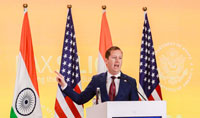 MUMBAI: US Ambassador to India Sergio Gor on Tuesday called for India and the United States to work together as “true partners” to address friction points and unlock the full potential of their economic relationship. Addressing the Indo-American Chamber of Commerce (IACC) National Convention in Mumbai, Ambassador Gor called for stronger India-US economic partnership. He stressed the need for predictable taxation and regulatory frameworks to provide businesses with greater certainty and encourage investment and innovation.
 CONNECTICUT (USA): The Indian Overseas Congress USA has strengthened its political and community presence in the Northeast with the launch of its Connecticut Chapter, led by Kamal Swamy, as the organization moves to expand its grassroots network among Indian Americans. The new chapter was formally inaugurated in Connecticut in the presence of senior IOC USA leaders, community members and supporters. The launch marks another step in the organization's nationwide expansion under President Mohinder Singh Gilzian.
India-US | India-France | Entertainment | Sports | Photo Gallery | Tourism | Link Partners | Contact Us
© Noyanika International, 2003-2024. All rights reserved.