


India
8 SIMI men killed in encounter; but video clips raise doubts
The police said the eight members of the banned Students Islamic Movement of India (SIMI) were cornered on the outskirts of the state capital and shot dead when they fired on securitymen. A video clip purportedly showing policeman shooting at an apparently injured fugitive lying on a flat-topped rock raised doubts about the authenticity of the encounter, prompting rights groups and opposition parties to seek a probe. Another purported clip of the encounter surfaced later, showing the SIMI fugitives waving at the policemen from a rocky outcrop amid a scrub forest lowland. After a break, the video resumes to show one of the policemen firing a round from his rifle at the group on the rock. The police said the veracity of the clips was yet to be ascertained. “We acted on intelligence and located the inmates. They fired on us and all eight were killed in crossfire,” Yogesh Chaudhury, the Bhopal inspector general of police, told reporters, adding that three cops suffered pellet injuries. He said four country-made guns and three sharp weapons were found on the SIMI men. Sanjeev Shami, inspector general of the anti-terror squad who led the operation, however, said the fugitives were unarmed and no cop was injured in the encounter. Three of those killed had escaped earlier from a jail in MP’s Khandwa district but were re-arrested. The police said all eight were accused in several terror cases including the 2008 Ahmedabad serial blasts, and explosions in Karimnagar, Pune and Chennai. Chief minister Shivraj Singh Chouhan described the lapses that led to the jailbreak as “criminal negligence” and said the incident will be probed by the National Investigation Agency (NIA). The government also suspended five jail department officials. Padam Singh Meena, convenor of a village defence group in Eithkhedi village, said that farmers came across the eight “unidentified people” at around 7.30 am. The village is around 12 km from the jail. By that time, police said, the fleeing prisoners had shaved and also discarded their prison clothes. It was not immediately clear how and where they procured razors and the fresh clothes. Already aware of the jailbreak, the villagers tried to intercept the youths who allegedly whipped out pistols and threatened to kill the farmers. After the SIMI men allegedly snatched food from the farmers and left, the villagers informed a police patrol. The villagers also guided the police team towards the direction the SIMI activists had left, he said. The SIMI activists, now perched on top of a hillock, allegedly fired at the police team, who were soon joined by commandos of the special task force, anti-terror squad and the counter-terror group. The police said that the SIMI members were asked to surrender but they responded with gunfire. The commandos retaliated, killing the SIMI cadres on the spot. Three sniffer dogs also assisted police in the search operations. An NIA official said in Delhi that its probe will look at the video clip. “If the veracity of video is established, we may also probe whether excessive force was used during the encounter,” said the official on condition of anonymity. Meenakshi Ganguly, South Asia director for Human Rights Watch, expressed doubts over police claims that the prisoners were armed. “The entire incident should be properly investigated. A take-no-prisoners approach to policing is dangerous and harms efforts to create a rights-respecting police force.” A jail official on condition of anonymity said the SIMI activists deliberately chose the night of Diwali to escape when “some of staff would be on Diwali vacation”. The suspected SIMI men used knives fashioned out of prison-issue spoons, plates and tongue-cleaners to kill guard Ramashankar Yadav in the isolated B Block where they were lodged, sources said. Investigations have revealed that the jailbirds used tongue cleaners and other material to fashion master keys and duplicate keys, which they used to unlock the cells before killing jail head warder Ramashankar Yadav. They then held another guard hostage between 2 and 3am before using bedsheets and wood lying around to make a ladder and escape after scaling two walls. The Congress and other opposition parties demanded a judicial probe into the encounter while the BJP accused them of undermining the morale of security forces by raising questions over its authenticity. “I am demanding a judicial probe… People of the state and country must know how terrorists with such a record were able to escape from such a high-security jail and within hours caught and shot dead,” said Congress leader Kamal Nath, a Lok Sabha MP from Madhya Pradesh. The CPI(M)’s Brinda Karat called the official version of the incident “highly dubious and suspicious”. BJP spokesperson GVL Narasimha Rao, however, accused the Congress of batting for “terrorists… like they questioned the cross-LoC surgical strike”. SIMI was launched in 1977 for the welfare of Muslim youth but gradually adopted a more hardline ideology, especially after the Babri Masjid demolition in 1992. It was banned in 2001. 22 killed in Bhubaneswar hospital fireBHUBANESWAR, Oct 18: At least 22 patients were killed and over 20 others injured in a fire that broke out at the Sum Hospital in Bhubaneswar on Monday evening, in one of the worst such incidents involving a medical facility in Odisha. While 14 patients were received ‘brought dead’ at the Capital Hospital, eight were ‘brought dead’ to AMRI Hospital from the fire-struck private medical facility, officials said. The Capital Hospital superintendent Dr Binod Kumar Mishra said, “We have received 14 dead bodies, while five other patients have been shifted from Sum Hospital.” Meanwhile, AMRI Hospital (Bhubaneswar) unit head Dr Salil Kumar Mohanty said, “A total of 37 patients were received at our casualty ward. Our doctors have declared eight persons as brought dead.” “Most of the victims were in the first floor ICU of the ill-fated Sum Hospital,” a doctor at the Capital Hospital said. Voicing “serious” concern over the fire incident at the Sum Hospital, chief minister Naveen Patnaik described the mishap as “very tragic”. He directed the government hospitals to provide necessary treatment to patients shifted from Sum Hospital and requested all private hospitals to extend treatment to the patients from ill-fated medical facility. The blaze was suspected to have been triggered by an electric short circuit in the dialysis ward on the first floor of the private hospital which spread to the nearby Intensive Care Unit (ICU). The fire rapidly spread to other areas on the same floor of the four-storeyed hospital building. The commissionerate of police and fire brigade personnel along with volunteers and hospital staff launched a massive rescue operation as more than 500 indoor patients were trapped in the building, hospital officials said. At least seven fire tenders were pressed into service to control the blaze and over a dozen ambulances deployed to shift the critical patients to other hospitals. Many patients were rescued by breaking window panes, an eyewitness said. Meanwhile, the state government has ordered a high-level probe by the Director, Medical Education and Training, into the incident. Indian PM Modi reviews Indus Waters Treaty with PakNEW DELHI, Sept 26: Prime Minister Narendra Modi met senior officials on Monday to review the “pros and cons” of the India-Pakistan Indus Waters Treaty amid growing pressure on New Delhi to scrap the agreement. Sources said the meeting would discuss “legal, political and diplomatic” options related to the 56-year-old treaty that binds India and Pakistan into sharing the water of six major rivers and has survived three wars and repeated strains in bilateral ties. The NDA government is contemplating reviewing the treaty in the aftermath of a militant attack in Kashmir’s Uri that killed 18 soldiers. India blames Pakistan-based Jaish-e-Mohammad for the worst strike against the army in decades and many believe scrapping the treaty – which would lead to millions of acres of parched farmland in Pakistan – will force Islamabad to mend its ways. Experts, however, say it would be difficult for India to renegotiate the treaty signed in September 1960 that is among the most liberal water-sharing pacts in the world and is seen to be generous to Pakistan. Any attempt at revoking the agreement – which gives lower riparian Pakistan more “than four times” the water available to India – might invoke similar actions from China on the Brahmaputra. “Indus Waters Treaty is international treaty and we are a responsible country. Can’t behave irresponsibly at the international level,” said former foreign secretary Kanwal Sibal. Under the treaty signed by then prime minister Jawaharlal Nehru and then Pakistan president Ayub Khan, the water of six rivers - Beas, Ravi, Sutlej, Indus, Chenab and Jhelum - were to be shared between the two countries. The pact was brokered by the World Bank. 8 infiltrators killed in two separate Kashmir encountersSRINAGAR, Sept 20: An Indian soldier was killed and at least eight suspected intruders were shot dead as the army battled two groups of militants along the border with Pakistan on Tuesday, two days after an attack on a military camp in Kashmir. Troops also exchanged fire with Pakistani soldiers in the Uri sector, close to the army’s 12 Brigade headquarters which was attacked by militants on Sunday. The attack left 18 troopers dead and more than 20 injured. “Two infiltration bids by militants from across the Line of Control (LoC) have been foiled in Uri and Naugam sectors today (Tuesday),” an army spokesperson said, adding the gunfights were on. One soldier was killed in the Naugam sector, he said. The Indian offensive came amid a bitter war of words between New Delhi and Islamabad following the Uri attack, blamed on the Pakistan-based Jaish-e-Mohammad (JeM) by New Delhi. The army also said Pakistani troops were “distracting” Indian soldiers with cover fire to help the militants along the LoC, the de-facto border, sneak into the country. An official in Srinagar said the firing from across the border lasted half an hour from 1.10pm. There was no damage from the firing that the army described as a violation of a 2003 ceasefire agreement. In New Delhi, Union home minister Rajnath Singh reviewed the security situation in Jammu and Kashmir with top officials, including national security adviser Ajit Doval and foreign secretary S Jaishankar. Prime Minister Narendra Modi will lead a meeting of the cabinet committee on security on Wednesday to discuss the Uri attack. Sources said the three service chiefs are likely to participate. Pakistan has denied India’s allegations of Islamabad’s complicity in the Uri attack, though the Indian army said it had recovered arms, ammunition, food and medicine packets with Pakistani markings. Islamabad accuses New Delhi of using the attack to deflect attention from continued street protests in Kashmir following the killing of militant commander Burhan Wani by security forces two months ago. More than 80 civilians have been killed in those protests. Meanwhile, the bodies of the four militants killed in the Uri camp attack were buried on Monday, apparently to prevent public sympathy for them. The quick burials were in contrast to standard practice. The militants were buried close to the garrison in Uri, though foreign militants in north Kashmir are usually buried at Kitchama graveyard, 25 km from the town. The National Investigation Agency began its formal probe into the attack by registered a case on Tuesday. India plans diplomatic isolation of PakistanNEW DELHI, Sept 19: India moved on Monday to diplomatically isolate Pakistan as part of retaliation to a militant attack on an army base in Kashmir, but the plan appeared set to run into a wall of resistance from a defiant Islamabad. After a two-hour meeting Prime Minister Narendra Modi and some of his top ministers decided against any “knee-jerk reaction” and, instead, backed moves to present evidence of Pakistan’s “complicity” at global fora. Foreign minister Sushma Swaraj was absent from the meeting to draft a response to Sunday’s attack that saw heavily armed militants sneak into the base in Uri and kill 18 soldiers before security forces shot them. The head of military operations of the Indian army, Lieutenant General Ranbir Singh, said India had the desired capability to respond, without elaborating. “We reserve the right to respond to any act of the adversary at a time and place of our own choosing,” Singh told reporters. While India weighed its options, Pakistan seemed readying to pre-empt the diplomatic offensive. In signs of estrangement, Pakistan Prime Minister Nawaz Sharif wrote letters to the leaders of the five permanent members of the UN Security Council – China, France, Russia, the UK and the US – about “grave human rights violations” in Kashmir by Indian forces. Islamabad made no offer of cooperation to investigate the Uri attack, as was done by it in the aftermath of a similar deadly raid on an air base in Punjab in January. The only civilian Pakistani leader to respond – foreign policy chief Sartaj Aziz – did not even condemn the attack. Aziz dwelt more on the situation in Kashmir, especially the unrest triggered by the killing of militant commander Burhan Wani. Its army chief Raheel Sharif hit out at India’s “hostile narrative”, saying his country was “fully prepared to respond to entire spectrum of direct and indirect threat”. At a session of the UN human rights council in Geneva on Monday, India asked Pakistan to stop supporting “violence and terrorism” and vacate its “illegal occupation of Pakistan-Occupied Kashmir. New Delhi also brought up alleged human rights violations in Balochistan the persecution of minorities, including Hindus. As calls grew for a counter-strike against Pakistan and militant group Jaish-e-Mohammad, which India believes orchestrated the attack, New Delhi also decided to push for more “terror elements” based there to be brought under UN sanctions. Foreign minister Swaraj will also bring up the attack at United Nations general assembly later next week. Although New Delhi’s options to hit back at nuclear-armed Pakistan appeared limited, government sources said a “strong message” to Pakistan could include surgical strikes against “inimical assets” along their de-facto border. Granting political asylum to exiled Baloch leader Brahamdagh Bugti, who spearheads a campaign for independence from Pakistan, is also being considered. “The action has to be taken without getting influenced by emotions, anger. It has to be taken coolly and with proper planning,” VK Singh, junior foreign minister said. Past attempts by India to bring Pakistani elements under the sanctions regime has so far been unsuccessful, because of opposition from China, among others. China said on Monday it was “shocked” by the attack on the Uri base. It also expressed concern over the escalation of violence in Kashmir. France also referred to “the disputes in the region of Kashmir”. 17 soldiers killed in terror attach on Army base in JK
The attack was part of a fresh infiltration attempt from across the Line of Control, they added, to foment further unrest in the Valley that has been rocked by two months of violent protests that have killed 86 people and injured thousands. The base housed troops stationed in temporary tents and shelters that caught fire in the encounter and caused the high number of casualties, a statement released from the army northern command headquarters of Udhampur said. “We salute the sacrifice of 17 soldiers who were martyred in the operation,” the statement read. The blaze killed 12 soldiers and the rest died in the gunfight, sources added. Defence minister Manohar Parrikar said he will visit Uri. Home minister Rajnath Singh cancelled scheduled trips to Russia and the United States and called an emergency meeting to discuss the situation. Army chief Dalbir Singh and northern command head DS Hooda also rushed to Uri. “Army chief Gen Dalbir Singh is also reaching Srinagar and from 15 Corps headquarters, he along with Gen Hooda will be flying to Uri,” said an army officer. The attacks is likely to roil an already volatile Kashmir that army sources say has seen scores of infiltration attempts since protests broke out against the killing of insurgent leader Burhan Wani in July. The government has repeatedly said that militants from across the border were instigating Kashmiris and were behind the current unrest in the Valley. The extremists sneaked into the camp in Uri at 5.30am and used guns and grenades to target soldiers, triggering a fierce gunbattle that raged on for hours. The camp is inhabited by soldiers who mostly guard the LoC. The garrison can be approached from the LoC from three sides, one of which is just six kilometers away from the de-facto border with Pakistan. Police sources said there were intelligence inputs regarding a possible attack. Army sources said one battalion was being moved after their tour of duty and another was taking over – with many soldiers staying in transit tents that caught fire in the initial stage of the encounter. A militant raid in December 2014, also near Uri, had killed eight soldiers and three policemen. In February, the army lost three soldiers in the deadliest suicide bomber attack in Srinagar in many years. Home Minister Rajnath postpones visit to Russia, USBy Deepak Arora NEW DELHI, Sept 18: Home Minister Rajnath Singh on Sunday postponed his scheduled visit to Russia and the United States in the wake of the terror attack on Army camp in Uri. He also held an emergency meeting to review the situation arising out of the terror strike. Singh also spoke to the Jammu and Kashmir governor and chief minister Mehbooba Mufti on the situation in Uri and both of them apprised him of the overall situation in Jammu and Kashmir. The home minister was scheduled to leave for Russia on Sunday night for a four-day bilateral visit and later to the US on September 26 for a six-day tour to attend the Indo-US Homeland Security Dialogue. “Keeping the situation of Jammu and Kashmir in mind and in the wake of terror attack in Uri, I have postponed my visits to Russia and the US,” he said in a statement in New Delhi. “I have given instructions to home secretary (Rajiv Mehrishi) and other officers in the home ministry to closely monitor the situation in Jammu and Kashmir,” he added. Indian Minister Rajnath to visit Russia, US with focus on Pak-sponsored terrorNEW DELHI, Sept 11: India's Home Minister Rajnath Singh will visit Russia and the United States next week to highlight the issue of the neighbouring country sponsoring terrorism in India and discuss efforts to counter ISIS activities in the region. Singh will visit Russia for five days beginning September 18 where he will have bilateral talks with Russian Minister for Internal Affairs Vladimir Kolokoltsev and discuss issues related to Indo-Russia joint anti-terror cooperation. They will also discuss cross-border terrorism in Jammu and Kashmir and growing activities of ISIS in the country and its neighbourhood. The home minister will travel to Washington on September 26 for a seven-day visit for the Indo-US Homeland Security Dialogue with his American counterpart Jeh Charles Johnson. Singh will raise the issue of Pakistan-sponsored terrorism and activities of ISIS in India and other South Asian countries. "In both the bilateral visits to Russia and the US, the Home Minister will highlight Pakistan's direct involvement in cross-border terrorism and growing activities of the Middle East terror group in India and its neighbourhood," a Home Ministry official said. The Home Minister will have threadbare discussions with his Russian and the US counterparts on how to enhance anti-terror cooperation, especially checking the growing activities of ISIS and sharing of intelligence inputs. Other issues to be discussed in the two visits include extradition of each other's wanted criminals, liberalisation of visas etc. The visit by Singh, one of the top leaders of the Modi government, to the two global powers within a week is considered significant as India has raised the pitch on the issue of "terror export" from Pakistan. Prime Minister Narendra Modi raised the issue at the G20, BRICS meet and East Asia Summit , where he called on the international community to isolate and sanction this instigator of terrorism. Rahul Gandhi visits Ayodhya, first by Nehru-Gandhi member since 1992AYODHYA, Sept 9: In a bid to woo Hindu votes ahead of the Assembly polls in UP, Rahul Gandhi on Friday offered prayers at the Hanuman Garhi Temple in Ayodhya, becoming the first member of the Nehru-Gandhi family to visit Ayodhya since the demolition of the disputed structure in 1992. Hanuman Garhi is about a kilometre away from the Ram Temple at the disputed Ramjanmbhoomi-Babri Masjid site but Rahul stayed away from the place of ‘shilanyas’, the foundation stone that had been laid there in 1989 for construction of the Ram Temple. Before having ‘darshan’ at the Hanuman Garhi Temple, the 46-year-old Congress Vice President met Mahant Gyan Das, who is known for his anti-Vishwa Hindu Parishad (VHP) stance. After his 15-minute closed door meeting, the Mahant said, “Rahul came to seek blessings. If a leader goes to a priest, it is not a big issue. “Moreover, when one seeks blessings, one definitely comes for fulfilment of some wish…They seek blessings…come with some expectations…we have given blessings…we pray for his welfare,” he said. The Mahant is a member of the Akhil Bharatiya Akhara Parishad (All India Akhara Council) — the apex organisation of Sikh and Hindu sants and sadhus (ascetics). Sources said Rahul did not speak about any compromise on the Ramjanmbhoomi-Babri Masjid dispute, but gave an assurance that Congress would stand by whatever the Supreme Court decided. Rahul also did not discuss the upcoming Assembly elections with the Mahant, they said. No member of the Congress’ first family has visited Ayodhya since the demolition of the Babri Masjid 24 years ago, in December 1992. Rahul’s move on Friday is apparently aimed at blunting a perceived negative image for Congress among Hindus. Old timers recall that 26 years ago, Rahul’s father and former prime minister Rajiv Gandhi had planned to visit the Hanuman Garhi Temple on a trip to Ayodhya during his ‘Sadbhavna Yatra’ in 1990, but he could not make it because of paucity of time. Rajiv was assassinated the next year, on May 21, 1991 when Rahul was 20 years old. As a convoy of cars, buses and open trucks rolled into the temple town, people rushed out of their houses to have a glimpse of the Congress leader, who is out on a ‘mahayatra’ during which he will cover 39 districts spread over 55 of the 80 Lok Sabha constituencies in Uttar Pradesh. Much significance is being attached in political circles to Rahul’s visit to Hanuman Garhi. Observers see a soft Hindutva agenda in the Ayodhya visit at a time when Congress appears to follow a Brahmin-centric campaign in Uttar Pradesh prescribed by election strategist Prashant Kishor, who is scripting every move of the Congress scion. After his brief visit to Hanuman Garhi Temple, Rahul returned to the Circuit House before staring his road show to culminate with a visit the Kichaucha Sharif Dargah, a Muslim shrine in adjoining Ambedkar Nagar, apparently to play a balancing act. Kishor is of the view that Congress must win its original constituencies of Muslims, Brahmins and a section of the non-Dalit Other Backward Castes (OBCs) as it makes a serious attempt at an impact in UP, which it had last won 27 years ago. In the 2014 Lok Sabha polls, Congress had secured only two seats from UP with Sonia and Rahul emerging victorious from their family strongholds of Rae Bareli and Amethi respectively. The party is trying to regain its lost moorings in the state where it currently has only 29 MLAs in the 403-member Assembly. Congress has been in political wilderness in UP since 1989 following the emergence of ‘Mandal-Mandir’ politics and rise of BSP which took away its crucial Dalit vote base. Restore Normalcy; Initiate Unconditional Political Dialogue With All Stake-Holders in J&KBy Sitaram Yechury
"The members appeal to the people of the state to shun the path of Violence and resolve all the issues through dialogue and discussion. The members requested the central and state government to take steps for a dialogue with all stake-holders. The members asked the Central and State Government to take steps to ensure that educational institutions, Government offices and commercial establishments start functioning normally at the earliest. They requested the government to take effective steps to ensure security for all citizens and provide medical treatment to citizens and security personnel injured in the agitation." It is now incumbent upon the Central government to implement this understanding in right earnest and start the process of the political dialogue immediately. Prime Minister Modi’s slogan of ‘vikas aur vishwas’ sound hollow and meaningless if they are not backed by concrete actions. Both vikas (development) and vishwas (trust) cannot drop from the skies. They have to be created through concrete planned actions. It must be remembered that when the then PM, Vajpayee, gave the slogans of ‘jamhooriyat, insaniyat and Kashmiriyat’, this was accompanied by a unilateral ceasefire announced by the government of India. This was then known as the `Ramzan ceasefire’. Similarly, the government of India today must take concrete steps on the lines that we have suggested.
|
|
||||||||
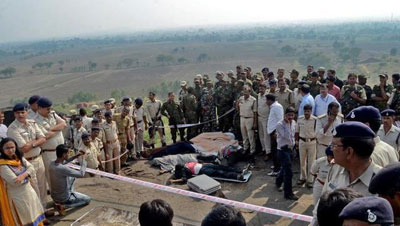 BHOPAL, Oct 31: Eight suspected members of a radical Islamist group were killed by the police in Madhya Pradesh on Monday, hours after they allegedly escaped from a high-security jail by slitting the throat of a prison guard and scaling the walls with knotted bedsheets.
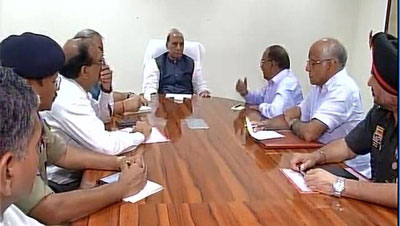 SRINAGAR, Sept 18: Heavily armed militants attacked a strategically important military base in north Kashmir’s Uri on Sunday morning and killed 17 soldiers, the worst single strike on the army in 26 years. Four militants were gunned down and combing operations were on at the time of filing the report, sources said.
 NEW DELHI, Sept 9: The All Party Delegation to Jammu & Kashmir returned to Delhi after spending two days in J&K. Our meetings with all sections of the society in the state helped us get a first-hand understanding of the seriousness of the situation in the Valley. This came two months too late; had this come six weeks ago, several innocent lives that were lost, could have been saved.
Aviation
| Business | Defence | Foreign
Affairs | Communication | Health
| India | United Nations
India-US
| India-France | Entertainment
| Sports | Photo Gallery |
Tourism | Advertise with Us
| Contact Us
© Noyanika International, 2003-2009. All rights reserved.