


India
Telangana formation cleared, Hyderabad joint capital for 10 yrs
The new state – that culminates a bloody agitation that cost hundreds of lives -- will have 10 districts including the city of Hyderabad. Andhra Pradesh and Telangana will, however, have to share Hyderabad as a joint capital for 10 years. Tuesday’s decision by the Congress Working Committee is the first step forward after the midnight dramatic announcement by former home minister P Chidambaram on 9 December 2009 promising to start the process. The Congress, however, developed cold feet. As it ended the uncertainty on Tuesday with what could be a political masterstroke to check-mate its opponents ahead of the 2014 general elections, the developments went according to the script. The UPA coordination committee first unanimously endorsed the move to divide Andhra Pradesh and the Congress Working Committee (CWC), the highest decision making body of the party, followed it up by unanimously passing a resolution, requesting the central government to “take steps in accordance with the Constitution of India to form a separate state of Telangana”. Congress president Sonia Gandhi opened the meeting giving historical perspective of the issue. Prime Minister Manmohan Singh endorsed Gandhi’s views and said the move will help in the equitable development of all the regions of the state. Union health minister Ghulam Nabi Azad, who as party general held the charge of the state for more than two years, and his successor Digvijaya Singh gave details about their interactions at state and central levels. Only three other CWC members spoke at the meeting. Mukul Wasnik raised the issue of Vidarbha, which is also one of the long-pending demands. His views were endorsed by his Maharashtra colleague Gurudas Kamat. Ambika Soni too spoke about her experiences in AP as in-charge general secretary. The formation of Telangana will take some time but the bill to create the new state is expected to reach parliament in next 4-5 months, probably in winter session. But the decision has not been smooth. The issue had vertically divided the Congress both in the state and the Centre and even security and intelligence agencies had raised concerns over the proposed move. When it appeared that the Congress was reconciled to put the Telangana issue on the back-burner to give itself a breathing space till the 2014 Lok Sabha elections, the party sprang a surprise a few months ago by stepping up its discreet preparation. The top leadership came to the conclusion that Telangana is “emotionally disintegrated” and “only division could save” the party in the 2014 polls. Till then, the broader thinking in the Congress was that the party stands to lose in the Telangana region even if it announced a separate state, but would gain in Andhra and Rayalseema parts of the state if it rejected or even delayed a decision. Hyderabad, considered the crowning jewel of the Telangana region, will be the joint capital of the newly-proposed state and the other regions--Rayalaseema and Andhra--for a period of 10 years. A new capital for Andhra will be identified Seemandhra region within this period. "It is resolved to request the Central government to take steps in accordance with the Constitution to form a separate state of Telangana within a definite timeframe," said a resolution passed at an hour-long meeting of the CWC. The CWC meet followed a meeting of the UPA which also unanimously favoured formation of Telangana. The CWC acknowledged that it "has not been an easy decision" but it was taken after the widest possible consultations and taking into account the chequered history of the demand for a separate state. The decisions by the CWC and the UPA came after hectic consultations for the last over a week on creation of the 29th state of the country that will have a geographical area of 10 of the 23 districts of undivided Andhra Pradesh. The Union Cabinet will meet on Thursday, apparently to consider formation of a Group of Ministers to go into economic issues on creation of the new state. This is the first decision of the UPA to form a new state in the last nine years. Contrary to speculation that the new state could be named Rayala Telangana, including a couple of districts of Rayalaseema, the districts that will be part of the new state will be Adilabad, Karimnagar, Khammam, Mahaboobnagar, Medak, Nalgonda, Nizamabad, Rangareddy and Warangal besides Hyderabad. At the moment the idea is to have 10 districts in Telangana but it will be for the Group of Ministers to consider demands for inclusion of more areas, AICC General Secretary Digvijay Singh, incharge of Andhra Pradesh affairs in Congress, told a press conference after the CWC meeting. Out of 42 Lok Sabha seats and 294 Assembly seats in Andhra Pradesh, Telangana is likely to have 17 Lok Sabha seats and 119 Assembly seats. Kudankulam nuclear plant reactor attains criticalityCHENNAI, July 13: The Kudankulam nuclear reactor, which has seen several delays and protests, finally attained criticality and began nuclear fission process late on Saurday night, officials of the Nuclear Power Corporation of India Ltd (NPCIL) said. "At 23:05, the first reactor attained criticality and all the parametres are normal," a jubilant site director R S Sundar said. "After a long time, the mood here is good," he added. Top officials of the Indian nuclear establishment, including Atomic Energy Commission (AEC) Chairman R K Sinha, and chairman and managing director of Nuclear Power Corporation of India (NPCIL) K C Purohit, were at Kudankulam to see the first of the two Russian-made units attain criticality in a smooth manner. NPCIL, India's atomic power plant operator, is setting up two 1,000 MW reactors with Russian technology and equipments at Kudankulam, around 650 km from Chennai. The Rs. 17,000 crore project, which generated widespread protests from the locals, has started generating heat and steam from the 163 uranium fuel bundles loaded in the reactor. The reactor was loaded with fuel assemblies containing about 80 tonnes of uranium oxide. After receiving clearance from the AERB, the process of criticality was started on Thursday. According to officials, several low power tests will be carried out in order to verify the conformance of the reactor characteristics to design objectives. If the reports are satisfactory, then the AERB will give its clearance for the next stage, which is phase-wise increase in reactor power level. At the first stage, the plant will be synchronised with the southern grid when power generation touches 400 MW. That is expected to happen in 30-45 days. After necessary regulatory clearances the power generation will be increased gradually to 50 percent, 75 percent, 90 percent and finally 100 percent. When that happens, the total installed nuclear power capacity in the country will go up to 5,780 MW. KNPP is India's first pressurised water reactor belonging to the light water reactor category. While the power from KNPP will be shared by the southern states, the lion's share will be for the home state Tamil Nadu, which is suffering from power deficit. "Tamil Nadu's share of the 1,000 MW will be 463 MW. As and when the power comes to our grid, it will certainly ease the power shortage to some extent," a senior official at Tamil Nadu Generation and Distribution Corporation Ltd (TANGEDCO) said. "The utility sources power from various central power generating units at varied rates but less than Rs. 3 per unit whereas the power from KNPP will be over Rs. 3 per unit," he added. According to Mr Sinha, the total outlay for the third and fourth units would be Rs. 40,000 crore. The KNPP is an outcome of the inter-governmental agreement between India and the erstwhile Soviet Union in 1988. However, construction began only in 2001 but was delayed mainly due to non-sequential supplies of components from Russian vendors. Fearing for their safety in the wake of the nuclear accident at Fukushima in Japan in 2011, villagers in the vicinity of the Kudankulam plant, under the banner of People's Movement Against Nuclear Energy (PMANE), have been opposing the project. City-based environmental activist G Sundarrajan had filed a case in the Supreme Court demanding that the project be scrapped. The court dismissed the case in May and laid down 15 directions for the NPCIL, the AERB, the Union Environment and Forest Ministry, the Tamil Nadu government and the state pollution control board to follow. Convicted MPs, MLAs to lose seat right away: SCNEW DELHI, July 10: An MP or MLA convicted of any criminal offence attracting a punishment of two years and above will be disqualified immediately, the Supreme Court ruled on Wednesday. The judgment declared as unconstitutional a provision in the Representation of the People Act that says a convicted legislator can continue in office if he/she appeals in a higher court within three months of the conviction. It upheld the argument of the petitioner, advocate Lily Thomas, that disqualification parameters under law applied not only to those who wanted to contest elections but to sitting legislators as well. The court, however, said its decision would not apply retrospectively to those convicted legislators who have filed appeals in higher courts. Also, a sitting legislator can continue in office if his/her conviction order gets stayed by the higher court. The top court clarified that the stay should not only be on the punishment but also on the judgment declaring the person guilty. The judgment is silent on what would happen if the conviction is overturned on appeal. With 1,448 of the country’s 4,835 MPs and MLAs reportedly facing criminal charges, the ruling could well be the first big step towards cleansing the political system. Hunt on for 6 for Bodh Gaya blastsNEW DELHI, July 8: Remnants of an exploded bomb were found and another one was defused 1.5 km west of the Bodh Gaya temple complex on Monday, even as the NIA and NSG joined state police investigations into the serial bomb blasts which took place on Sunday. The recovery of two bombs took the number of explosions to 10 while three unexploded bombs were recovered. The connection of blasts to Buddhist-dominated Myanmar’s crackdown on Rohingiya Muslims is being investigated. Bodh Gaya has a Myanmar monastery which is often visited by tourists and military brass from the country. A suspect identified as Vinod Mistri from the Maoist-affected Barachatti area was detained on the basis of an Aadhar card found among the debris. He was being interrogated by the central agencies while look-out notices have been issued for six people who were identified from the CCTV footage. Gaya SSP, Chandan Kushwaha, confirmed that 16 of the 22 CCTV’s were functional and their recordings can provide crucial leads. However, none of the blasts took place in the direct view of the cameras, revealing bombers may have been aware of camera locations. While confirming the use of ammonium nitrate and analog timers in the bombs, DGP Abhayanand said further investigation depends on what the central agencies find. The NSG investigators have reported to MHA that ammonium nitrate, potassium and sulphur were used with projectiles, shrapnel and analog timers. Small LPG cyclinders were used as bomb carriers. The analog clocks carried the brand name ‘Lotus’ and their manufacturer has been identified. Investigators found nails and ball-bearings packed into the bombs, a common practice of the Indian Mujahideen as well as Maoists. However, investigators admitted to have been stumped by why blasts happened early in the morning when causalities were bound to be less and why LPG cylinders were used. It is significant that one bomb was planted in a stationary bus, timed to go off before dawn when no passengers would have been there. Also, IM, which in other cases has eagerly claimed responsibility, has chosen to stay silent this time. The NSG team has revealed that all the bombs were timed to go off at 5.30 am but they went off early, perhaps due to the damp weather. Also, the forensic team’s preliminary report said that the first blast at the temple complex might have significantly interfered with the other IED’s, altering their time and blast yields. It said the devices were “crude but significantly sophisticated and primed for larger damage”. The ease with which the bombs were planted despite a three-tier security system clearly sends the message that extremists can attack at will. There were reports that chits of paper have also been recovered which mention the names of blast sites in Urdu. The NIA team, lead by Vikas Vaibhav, has confirmed the blasts happened within 25 minutes of each other. The team is also examining three Cheevers, wind cheaters worn by Buddhist monks, which were found abandoned at the temple premises after the blasts. The local police is also looking for three persons who were working around the temple complex for the last six months and are now absconding. Their backgrounds were not vetted by any agency in the area. The Bodh Gaya temple was opened for public on Monday with thousands of people standing in queue. "The visitors are allowed to enter the temple after thorough search by Bihar police and temple management committee security staff," Arvind Singh, member of Bodh Gaya Temple Management Committee (BTMC), said. Thousands of people thronged to the temple immediately after the gate was open at 6 PM, he said. Monks of 50 nations hold special prayer Buddhist monks from 50 countries on Monday held a special prayer inside the temple for return of peace after the explosions. Buddhist monks from Sri Lanka, Thailand, Myanmar and other countries participated in the one-hour prayer this evening, Arvind Singh, member of Bodh Gaya Temple Management Committee (BTMC), said. Head of monasteries of different countries also attended the prayer. The Bodh Gaya has Buddhist monasteries of 50 countries. Singh, who took part in the prayer, said the temple remained open for monks and would be opened for general public today. The condition of the two monks, who were injured in the explosions, is stated to be out of danger. "Both of them are out of danger," Superintendent of Anugrah Narayan Magadh Medical College & Hospital (ANMMCH), Gaya, Sita Ram Prasad said. He said both had been kept in Intensive Care Unit (ICU) of the hospital and senior doctors were attending them. Prasad said the Tibetan monk Tenzing Dorjee had received bomb injuries in right knee joint and right ankle. The second monk Vilas Ga from Myanmar suffered wounds in right arm, abdomen and both legs, the ANMMCH Superintendent said. One person was detained by the NIA on Monday in connection with the terror attack on Buddhism's holiest shrine here even as authorities released the CCTV footage of the serial blasts at the historic Mahabodhi temple and adjoining areas. As a team of investigators from NIA, NSG and other agencies searched for clues at Bodh Gaya that left two monks injured and chief minister Nitish Kumar said the state government will make a proposal to the Centre to ask CISF to take over the security of the shrine. The Rashtriya Swayamsevak Sangh (RSS) has condemned the terror attack at the Mahabodhi temple and said terrorists were succeeding because the government lacked the will to decisively deal with them. RSS spokesperson Manmohan Vaidya, in a statement, said the need of the hour was to deal decisively with terrorism. "RSS condemns in strongest terms the explosions carried out by terrorists at the Bodh Gaya temple of Lord Buddha, who was the harbinger of universal peace and who gave the world the message of peace, compassion and non-violence," the statement said. "(As a result of) The lack of will on the part of the government to deal conclusively with the activities of terrorists with a heavy hand, the terrorists are succeeding in their nefarious designs. The need of the hour is for all to rise above partisan politics to deal with this menace decisively," it added. Indian Govt to feed 800 million people at highly subsidised ratesNEW DELHI, July 3: The Indian Government has decided to promulgate an ordinance to give nation's two-third population the right to 5 kgs of foodgrain every month at highly subsidised rates of Rs 1-3 per kg. The Cabinet, which had on last month deferred a decision on the issue, on Wednesday, approved promulgating an ordinance to implement the Food Security Bill. Opposition forced govt to go in for ordinance on food security: CongressNEW DELHI, July 3: The opposition's failure to help passage of the Food Security Bill forced the government to go in for an ordinance to give the country's two-third population the right to foodgrain at subsided rates, Congress said today. "If the opposition parties desired, they could have helped passage of the Bill in the last session of Parliament, but they did not feel the need for it and this led to the decision on ordinance," party general secretary Ajay Maken told reporters. At the same time, he said the government is ready to have discussions in Parliament on the Bill and the Congress is for creating a consensus on the ambitious measure. Maken insisted that the Bill could see the "light of the day" due to concerted efforts of Sonia and Rahul Gandhi. He said the government decision to come out with an ordinance was to provide the country's two-third population the right to five kgs of foodgrain every month at highly subsidised rates of Rs 1-3 per kg. After deferring its decision last month, the Cabinet today approved promulgation of an ordinance to implement the Food Security Bill. With this, India will join select league of countries in the world that guarantee foodgrain to majority of its population. At Rs 1,25,000 crore of government support, the food security programme will be the largest in the world. Rescue work over, 1.1 lakh evacuated from UttarakhandDEHRADUN, July 2: Seventeen days after India's worst natural disaster ravaged Uttarakhand, the mammoth multi-agency rescue operations to evacuate all stranded pilgrims and tourists concluded on Tuesday even as Delhi sought financial assistance from the World Bank and Asian Development Bank (ADB) for rebuilding damaged infrastructure in the flood- ravaged Himalayan state. In all, around 1.1 lakh people stranded by flash floods and landslides after monsoon rains pounded the hill state on June 15 were evacuated by thousands of personnel of the Army, IAF, Indo-Tibetan Border Police (ITBP) and National Disaster Response Force (NDRF), who braved all odds. "All the remaining pilgrims stranded in Badrinath dham have been evacuated," said Chamoli's district magistrate SA Murugesan. The IAF, which concluded its air sorties, has, however stationed 10 choppers in the state for about a week or so for use in any operations, an IAF official said in Delhi. Though the rescue mission has concluded, authorities faced a daunting task of cremation of badly decomposed bodies in Kedarnath area with bad weather hampering this process for the fourth day. The Finance Ministry said in a statement that "in view of the emergency situation, both ADB and the World Bank have been requested to fast track the processes of needs assessment, project preparation and approval". In view of the gravity of the situation, Prime Minister Manmohan Singh had last month announced financial support of Rs. 1,000 crore to Uttarakhand for disaster relief, of which Rs. 145 crore was released immediately. India's first ever dedicated navigation satellite launchedSRIHARIKOTA, July 2: In a landmark journey into a new era of space application, India successfully launched its first dedicated navigation satellite using the PSLV which blasted off from the Satish Dhawan Space Centre in Sriharikota. The country's workhorse Polar Satellite Launch Vehicle (PSLV) blasted off at 11.41 PM on Monday night and it ejected IRNSS-1A satellite and placed it in orbit a little past midnight, technically on Tuesday. The satellites will be equipped with high precision atomic clocks to continuously transmit navigational signals. By launching these satellites India will be one among US, China and some European countries. This is the fourth time that an XL configuration has been flown, earlier satellites under the configuration were Chandrayaan, PSLV C11,17,19,GSAT 12 and RISAT 1. The applications in the satellite can also provide data on disaster management, guiding hikers and travellers and also voice navigation for divers. PM, Sonia flag off first train connecting Jammu to Kashmir ValleyJAMMU, June 26: Prime Minister Manmohan Singh along with UPA Chairperson Sonia Gandhi on Wednesday flagged off the first train connecting Banihal in Jammu region with Qazigund in Kashmir Valley. The newly constructed station in Banihal, 125 km from summer capital Srinagar, was decked up with flowers and garlands to receive the VVIPs for flagging off the first train which will pass through 11 km tunnel through Pir Panchal range. The eight-coach train carrying school children and officials of IRCON and Railways reached Qazigund in 25 minutes. The Banihal-Qazigund section, which includes an 11-km long tunnel, the country's longest, reduces the 35 km distance to 18 km. It has been constructed at a cost of Rs 1,691 crore. The Prime Minister and Gandhi boarded the train before its departure and interacted with the school children. They returned to Banihal from the new tunnel. The Udhampur-Banihal section is expected to be completed by 2017 connecting the Valley to the rest of the country round-the-year without any hindrance. The train will make regular operation from Banihal to Baramulla in north Kashmir from 27th June. The Banihal-Baramulla -Banihal train will make five trips daily beginning at 7.10 AM from Banihal and 7.35 AM from Baramulla. Besides the Prime Minister and Gandhi, others present on the occasion were Governor N N vohra, Chief Minister Omar Abdullah, Railway Minister Mallikarjun Kharge and Health Minister Ghulam Nabi Azad. Train service is already operational within Kashmir Valley on the 118-km-long route between Qazigund and Baramulla in north Kashmir. This was inaugurated by Prime Minister Manmohan Singh on 11th October, 2008. The tunnel has been constructed using New Austrian Tunnelling Method, which has been used for the first time on such a large scale in India. This method optimises the tunnel design by mobilising the inherent ground strength in adopting a curved section, providing primary support system immediately after excavation and monitoring the ground behaviour while permitting it to develop its inherent strength. A three-metre wide road has been provided inside the tunnel for maintenance and emergency rescue and relief operations. The tunnel has been made water-proof by providing continuous PVC membrane between primary and secondary lining. Prez for community-based system to check drug abuseNEW DELHI, June 26: President Pranab Mukherjee has called for developing a nationwide community-based system for prevention of alcoholism and drug abuse, which can connect various stakeholders at every level. Presenting the first National Awards for Outstanding Services in the field of Prevention of Alcoholism and Substance (Drug) Abuse at a function in New Delhi on Wednesday, Mukherjee said alcoholism and drug abuse are a matter of serious concern for a nation like India, given its young demographic profile. Terrorists will not succeed in their designs: PMSRINAGAR, June 25: A day after the militant strike in Srinagar left eight soldiers dead, Prime Minister Dr. Manmohan Singh on Tuesday said the entire country is standing united against terrorists and they will not succeed in their designs. "I want to pay my tributes to the soldiers who laid down their lives while fighting the terrorists," Dr. Singh said in his speech after inaugurating 850 MW Rattle power project here along with UPA chairperson Sonia Gandhi. The Prime Minister said the entire country is standing united against the terrorists. "The terrorists will not succeed in their designs." Security is a pre-requisite for development, the Prime Minister said as he paid tributes to the soldiers killed in militant strike on Monday, asserting such attacks would not deter efforts to bring normalcy in the state. Gandhi also condoled the death of army personnel in the militant attack. "Our analysis is that the security situation in Jammu and Kashmir has shown considerable improvement. The terrorist- related violence in 2012 had shown a sharp decline and was the lowest in last two decades," the Prime Minister said. However, Dr. Singh said there was a need to keep a constant vigil to prevent attacks like the one that took place on Monday at Hyderpora. On the power front, the Prime Minister said the Centre will provide all help to Jammu and Kashmir in overcoming the power shortage and announced several steps in this direction, including additional 150 MW supply from the Northern Grid. Dr. Singh said that J-K was drawing 1664 MW from the Northern Grid which did not suffice the needs of the state. "I announce an additional 150 MW for the state to meet its power requirements. I also hope that other projects like Uri II project in Baramulla will be completed soon and the state will receive power from it," he said. Dr. Singh said a transmission line costing Rs 1629 crore between Srinagar and Leh is being laid, which will meet the electricity needs of people in Ladakh region throughout year. The Prime Minister said the National Hydroelectric Power Corporation has taken five ITIs and plans to take two more for imparting training to the youth for working in power projects. He said the Power Grid Corporation will also set up a training institute at Kangan in Ganderbal district. PM lays foundation stone of 850 Mw Hydel project in J&KSRINAGAR, June 25: Prime Minister Dr. Manmohan Singh and UPA Chairperson Sonia Gandhi on Tuesday laid the foundation stone of 850 Megawatt hydel power project in river Chenab at Drabshala in Jammu and Kashmir. Kharge made Railways Minister, eight inducted as MinistersNEW DELHI, June 17: In perhaps the last reshuffle and expansion of the Union Council of Ministers, Mallikarjun Kharge was made the Railways Minister as eight more were inducted with veterans Sis Ram Ola and Oscar Fernandes making a comeback. After Sunday’s reshuffle in the party, senior woman leader from election-bound Rajasthan Girija Vyas and K S Rao from Andhra Pradesh were brought in as Cabinet Ministers in Monday’s exercise which was an all-Congress affair. Nitish 'secular', Rahul Gandhi 'natural leader': PMNEW DELHI, June 17: Prime Minister Manmohan Singh on Monday called Nitish Kumar "a secular leader" reaffirming the possiblity of a Congress-Janata Dal United alliance, after JD(U) parted ways with BJP on Sunday. "In politics there are no permanent friends or enemies. We decide as the situation evolves," he said at Rashtrapati Bhawan where eight new minsters were inducted into the Cabinet. Talking to reporters at the event Prime Minister Singh also called Congress Vice-President Rahul Gandhi "a natural leader" addressing speculation of him being UPA's prime ministerial candidate for the 2014 Lok Sabha polls. "I have always said, as far as I am concerned, I would be very happy to see Rahul step into my shoes," he said. "Rahul Gandhi is a national leader. He has all the right qualities that a leader should have." Addressing chances of Congress's third term in power he said, "we will have a third go as UPA and the people will again repose their faith in us." |
|
||||||||
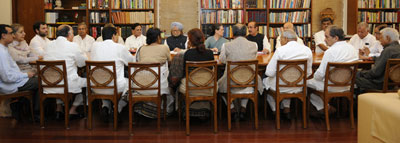 NEW DELHI, July 30: Less than four years after the UPA almost went back on its pledge to create Telangana, the Congress on Tuesday accepted one of the oldest demands in independent India for a separate state and asked the government to split Andhra Pradesh.
Aviation
| Business | Defence | Foreign
Affairs | Communication | Health
| India | United Nations
India-US
| India-France | Entertainment
| Sports | Photo Gallery |
Tourism | Advertise with Us
| Contact Us
© Noyanika International, 2003-2009. All rights reserved.