


India
Manish Tewari urges CAG to clear air in 2G spectrum allocationCHANDIGARH, Nov 24: Amid allegations and counter-allegations over figure of presumptive losses in the 2G allocation, Union Minister Manish Tewari on Saturday asked the the CAG to clear the air over the matter which had impacted "India's story in the public domain" in the past two years. "The nation needs to know how Rs 2,645 crore of loss (in 2G spectrum allocation) turned a presumptive loss of Rs 1.76 lakh crore. Questioning the "mythical" loss figure of Rs 1.76 lakh crore, the Information and Broadcasting minister said "the CAG needs to answer to people as India's story has been impacted by such discourse within the public domain during the last two years." "Let there be a public debate. Let CAG come and answer because these mythical and sensational figures have derailed India's story in last two years. The 2G report has made public discourse extremely vitiated," Tewari said. Noting that public has the right to know the truth, he claimed the former CAG official in his draft report had written that the loss on 2G spectrum allocation because of first come first serve basis was only Rs 2,645 crore. "Since in principle, it was decided that the spectrum allocation was not to be auctioned the loss estimation was not possible," the Congress' Lok Sabha MP from Ludhiana said. "Now the question arises, how Rs 2,645 crore loss ballooned to Rs 1.76 lakh crore," he asked. Aam Aadmi is synonymous with Congress: Manish TewariChandigarh, Nov 24: The Congress on Saturday played down launching of a political outfit by Arvind Kejriwal saying there were 1453 political parties registered in India and one more would strengthen the democratic fabric. "If a person or group of people have decided to float a political party, it is their right," Congress leader and Information and Broadcasting minister Manish Tewari told reporters here. "There are 1,453 political parties registered with the Election Commission. So, if one more is added, this will only strengthen our democratic fabric," he said. "The more the merrier," Tewari quipped when asked to comment on one more party "Aam Aadmi", floated by activist Kejriwal, coming into existence. "The Aam Aadmi (common man) is synonymous with the Congress since 1885 when the party came into existence. "Therefore, nobody can either hijack or skyjack or bicycle-jack the intrinsic relationship between the Congress and the people of this country," Tewari said. Kejriwal's party has been named 'Aam Aadmi Party' at a meeting of its founder-members in the national capital. Govt takes a dig at former ally TMC for bringing no confidence motion
Information and Broadcasting Minister Manish Tiwari said that Mamata Banerjee was a part of the government till few days back and did not find any irregularity in government's functioning but after withdrawing support she is now raising questions against the government. Nation pays tributes to Indira on her 95th birth anniversary
The leaders offered floral tributes at her memorial Shakti Sthal on the banks of Yamuna. UPA Chairperson Sonia Gandhi, Union Ministers Sushil Kumar Shinde and Kamal Nath were among those who visited the memorial. On the occasion, tricolour balloons were released by Mukherjee, Ansari and Sonia. Patriotic music was also played along with a speech of Indira Gandhi. Gandhi, who was born on 19th November 1917 in the politically influential Nehru family, was the first woman Prime Minister of India. 70 per cent of Punjab youth on drugs: Rahul GandhiCHANDIGARH, Oct 11: “Out of every 10 youths in Punjab seven are into drugs,” Congress general secretary Rahul Gandhi told a gathering of students on the Panjab University campus here on Thursday, blaming the SAD-BJP government for the tragic situation facing unemployed youths in the state. Winding up his two-day tour of Punjab, Rahul spoke on a variety of issues of national importance amid hooting as well as cheers from students at a function organised by the National Students Union of India (NSUI). “India is the Saudi Arabia of the 21st century and the youth are responsible for this,” he said, referring to India’s vast human resource that is comparable to the Gulf country’s oil wealth. Strongly defending the UPA government’s decision to bring foreign direct investment (FDI) into multi-brand retail in the country, the Congress leader said regardless of what the opposition does to oppose it, the Centre would not take any step backwards on the issue. “The Opposition can try as hard as they want to but we are not going to stop and FDI will happen,” he said, adding, “FDI is for the benefit of the farmers. We want FDI to happen so that a farmer gets his full due for his crops. It is the youth who can assert themselves and allow FDI into India”. Taking a dig at the SAD-BJP government, Rahul said all the money sent by the Centre to Punjab for scholarships was returned without being utilised. Before leaving, Rahul shook hands with a few youths and welcomed four students from the university who had decided to join the NSUI. He encouraged women students to join politics and said that he would like to see a woman becoming chief minister of Punjab some day. The Congress general secretary interacted with students for 10 minutes and left many a trifle disappointed for not spending more time talking to them. Cabinet clears proposal to direct transfer of cash subsidy to farmersNEW DELHI, Oct 11: Union Cabinet on Thursday cleared a proposal that will eventually lead to transfer of direct cash subsidy to the farmers for procuring fertilizers. Cabinet Committee on Economic Affairs, CCEA has approved the modifications in procedure of releasing fertilizer subsidies so as to make them available directly to beneficiaries. Briefing the media persons, official spokesperson said that the government will carry out a pilot project in this regard in 10 districts for information visibility on sale of fertilizers to the farmers. The identification of farmers will be done through the Kisan Credit Card, Aadhar number or Bank Account number. The move will contain corruption and enhance transparency in the transactions. The payment of fertiliser subsidy to companies will be based on the receipt of fertilisers and the acknowledgement of receipts of fertilisers by the retailers. The official spokesperson also said that maximum retail price of urea is being increased by 50 rupees per metric ton which will effect only 10 to 15 percent of total fertilizers. The Cabinet meeting chaired by Prime Minister in New Delhi, also gave its nod to the introduction of Amendments to the Indecent Representation of Women Prohibition Act, 1986 in Parliament. These amendments seek to ensure that more effective protection is provided against indecent representation of women by covering newer forms of communication like internet and multimedia messaging, beyond the print and audio-visual media. To provide quality education in rural areas, the CCEA gave its approval for setting up of 6,000 model schools at block level as benchmark of excellence. For the year 2012-13, an amount of Rs 1080.00 crore has been allocated for theScheme. We should solve problems mutually: Rahul GandhiGUWAHATI, Sept 11: AICC General Secretary Rahul Gandhi on Tuesday called on the victims of recent violence in lower Assam to solve outstanding problems mutually. "We are all Indians and we should stay together. We should solve our problems mutually," Gandhi told reporters after visiting the Basugaon high school relief camp in Chirang district. Interacting with refugees at Basugaon and several other camps in the troubled area, the AICC leader assured them help from both the Centre and the state. "We are there with you," said Gandhi after he diverted from his original schedule of visiting only four relief camps. Breaking the security cordon, Gandhi spoke with the refugees and heard their problems. Earlier in the day, Rahul Gandhi met victims of the violence in relief camps and held discussions with Bodoland Territorial Council leaders on the prevailing situation. Gandhi, who arrived in Kokrajhar on a day-long visit to violence affected Bodoland Territorial Administered District (BTAD) and Dhubri, visited Kathalguri and Gambaribeel relief camps. The Congress leader accompanied by Chief Minister Tarun Gogoi and APCC president Bhubaneswar Kalita visited several other relief camps most of which was not there in his original schedule which delayed his departure. Indian PM calls for faster economic growthNEW DELHI, Aug 15: Addressing the nation from the ramparts of the Red Fort, Prime Minister Manmohan Singh said the India's national security will be affected if steps are not taken to increase economic growth and encourage new investments in the country. Addressing the nation from the ramparts of the Red Fort on the occasion of 66th Independence Day, the Prime Minister said that his government will work hard to shield Indian economy from the impact of global economic slowdown. Dr Singh hoped that all political parties will help the government in passing the Lokpal and Lokayuktas Bill in Parliament. "We will continue our efforts to bring more transparency and accountability in the work of public servants and to reduce corruption," Singh said. While doing so, steps will be taken to see that the morale of public functionaries taking decisions in public interest is not affected because of baseless allegations and unnecessary litigation, he said. On economic growth, the Prime Minister said that lack of political consensus was coming in its way. "As far as creating an environment within the country for rapid economic growth is concerned, I believe that we are not being able to achieve this because of a lack of political consensus on many issues," Singh said. He said time has now come to view the issues which affect the development processes as matters of national security. Observing that India has been affected by "adverse" external conditions, he said, "Also there have been domestic developments which are hindering our economic growth. Last year, our GDP grew by 6.5 per cent. This year, we hope to do a little better." Singh said his government would make every possible effort to secure the livelihood of "our poor brothers and sisters, our workers and our farmers." He said the government will leave no stone unturned to encourage investment in the country so that entrepreneurs can make a substantial contribution to the economy. "I believe that this period of difficulties will not last long. Even as we face these problems, we should be encouraged by the fact that we have achieved extraordinary successes in many areas in the last 8 years. We now need to replicate these successes in newer areas," Singh said. During his 35-minute speech in Hindi, the Prime Minister spoke about the government's efforts to deal with corruption, inflation and a number of developmental programmes. "Our commitment to make the work of the government and administration transparent and accountable stands. On the last Independence Day, I promised you that we would take many steps for this purpose," he said. Singh said in the last one year, the government had achieved good progress in this area. "The Lok Sabha has cleared the Lokpal and Lokayukta Bill. We hope that all political parties will help us in passing this Bill in the Rajya Sabha," he said. Dr Singh said a number of other Bills have also been presented before Parliament and the Cabinet has cleared a Public Procurement Bill. "But we will also take care that these measures do not result in a situation in which the morale of public functionaries taking decisions in public interest gets affected because of baseless allegations and unnecessary litigation," he said. Describing the recent incidents of violence in Assam as unfortunate, Singh said the government would do everything possible to provide relief to those affected. "I also promise to you that our government will make every effort to understand the reasons behind the violence and work hard with the state governments to ensure that such incidents are not repeated in any part of the country," he said. The Prime Minister said success has been achieved in many areas of internal security. "In Jammu and Kashmir, people participated in large numbers in the Panchayat elections. There has been a reduction in violence in the North Eastern States and we are engaged in dialogue with many groups there so that they can join the mainstream of development," he said. Singh said the government had initiated new schemes of development in areas affected by Naxal violence to ensure that the grievances of the people residing there, especially those belonging to Scheduled Tribes, can be removed. "However, we need to be constantly vigilant as far as internal security is concerned. Communal harmony has to be maintained at all costs. Naxalism is still a serious problem," Singh said. He said the incidents which occurred in Pune in the beginning of this month point to the need for much more work to be done in the area of national security. "We will continue to do this work with sincerity in the future also," he said. On the preparedness of the armed forces, the Prime Minister said that the soldiers have made biggest sacrifices whenever needed and defended the security of the country during war and peace with valour and honour. "Today I would like to reassure our countrymen that our armed forces and paramilitary forces are prepared to face any challenge," Singh said, adding that the government will continue to work for modernising these forces. He said the government had also set up a committee to examine issues related to pay and pensions of the armed forces personnel and promised prompt action on its recommendations. Singh announced that a new housing loan scheme will be launched for the poor residing in urban areas. Under the Rajiv Housing Loan Scheme, people belonging to economically weaker sections would be given relief on interest on housing loans of less than Rs five lakh, he said. Singh said a scheme was being formulated for distribution of free medicines through government hospitals and health centres. He said after the success of the National Rural Health Mission (NRHM), the government wanted to expand the scope of health services in towns also. The NRHM will now be converted into National Health Mission which would cover all villages and towns in the country, he said. The Prime Minister said when the UPA government came to power in 2004, it had promised to provide electricity to all villages. He said under the Rajiv Gandhi Rural Electrification Scheme, more than one lakh villages have been provided with electricity connections. "Our next target is to provide electricity to each and every household in our country in the next five years and to also improve the supply of electricity," Singh said. He said the establishment of a National Skill Development Authority was under consideration to train the youth for new job opportunities in the coming years. Dr Singh said the government was formulating a scheme to ensure that people belonging to Scheduled Tribes can get fair and remunerative prices for the forest produce they collect. Manmohan announces India's Mars missionMaking the first formal announcement on the country’s Mars mission, Prime Minister Manmohan Singh on Wednesday said India will send a mission to the Red Planet that will mark a huge step in the area of science and technology. “Recently, the Cabinet has approved the Mars Orbiter Mission. Under this Mission, our spaceship will go near Mars and collect important scientific information,” he said addressing the nation from the ramparts of the Red Fort on the occasion of the 66th Independence Day. “This spaceship to Mars will be a huge step for us in the area of science and technology,” Dr. Singh said. India will be the sixth country to launch a mission to the Red Planet after the U.S., Russia, Europe, Japan and China. If the mission is successful, India will be the first Asian country to do so as probes sent by China and Japan had to be abandoned en route. As per the proposal drawn up by the Indian Space Research Organisation (ISRO), the Rs. 450 crore Mars Orbiter Mission is expected to be launched in November next year with a 25 kg scientific payload. The mission, to study the Martian atmosphere, will be launched by an extended version of ISRO’s warhorse rocket — the Polar Satellite Launch Vehicle (PSLV) from the spaceport in Sriharikota in Andhra Pradesh. The spacecraft is expected to take nearly 300 days to reach the Martian orbit. The spacecraft will be placed in an orbit of 500 x 80,000 km around Mars and has a tentative scientific objective for studying the climate, geology, origin, evolution and sustainability of life on the planet. Scientific payloads for the Mars Orbiter Mission have been short-listed by ISRO’s Advisory Committee for Space Sciences (ADCOS) review committee. Baseline, solar array and reflector configuration of the satellite have been finalised, officials said. If the ISRO fails to launch the Mars Mission next year, other opportunities are available in 2016 and 2018. The Prime Minister also congratulated scientists and technologists who have enhanced the prestige of the country by successfully testing the Agni V Missile and launching the RISAT-I Satellite in space this year. The Union Cabinet, at a meeting on August 4, 2012 had approved the Mars Orbiter Mission, but an official announcement was not made then as it was to be part of the Prime Minister’s Independence Day address. Endemic protests could lead to flirting with chaos: PresidentNEW DELHI, Aug 14: President Pranab Mukherjee cautioned against "endemic" protests against corruption warning that the country would be "flirting with chaos" if its democratic institutions come under an assault. Mincing no words in underlining the dangers in undermining institutions like Parliament, he said legislation cannot be wrenched away from legislature or justice from judiciary. He described Parliament as "the soul of the people, the 'Atman' of India". The President's comments against the backdrop of anti-corruption protests of Anna Hazare and Ramdev came in his maiden address to the nation on the eve of 66th Independence Day on Tuesday. In a speech that covered India's emergence as a stable democracy and its economic growth post-Independence, the new President also warned that if progress fell behind rising aspirations of the youth "rage will manifest". Earlier last month in his acceptance speech after his election to the post, Mukherjee had said that trickledown theories do not address the legitimate aspirations of the poor. He said if Indian economy has achieved critical mass, then it must become a launching pad for the next leap. "We need a second freedom struggle; this time to ensure that India is free for ever from hunger, disease and poverty." President said that even though there is tremendous pressure on the economy due to adverse external environment, the economy has probed to be more confident. He said that however, there is a need for a second green revolution, and high quality infrastructure related investments need to be ensured. Expressing deep concerns over the violence in Assam, President Pranab Mukherjee said that violence will only invite greater violence. He said government has taken concrete attempts to heal the wounds of Assam, including the Assam accord. 45 passengers charred to death in fire in Tamil Nadu ExpressNELLORE, July 30: At least 45 passengers were charred to death when a fire broke in a coach of the Chennai-bound Tamil Nadu Express near Nellore in the wee hours on Monday due to a short circuit. Twenty-six passengers were rescued from the coach S 11 which was completely gutted, Nellore Collector Sridhar said. As the train was passing through Nellore, which is about 150 kms from Chennai, some people noticed the fire and informed railway authorities. The coach had around 70 seats. "There was a short circuit near the toilet and the train was moving at a speed of 110 kms per hour. It was going to Chennai from Delhi. All the passengers were asleep when the fire broke out at 4:30 AM. People were not able to come out immediately," he said. "The fire spread fast and the passengers could not come out through one of the doors because of the fire. So the other edge of the coach was to be used. Some people could come out and others succumbed to death," he said. The bodies have been charred so it is difficult to identify them, Sridhar said. Terrorism is 4th World War; Remove Hunger, Poverty: Prez PranabNEW DELHI, July 25: Pranab Mukherjee on Wednesday became the 13th President of India capping a five-decade career that saw him play significant roles in government, Parliament and party. 76-year-old Mukherjee was administered the oath of office to "preserve, protect and defend the constitution and law" by Chief Justice of India Sarosh Homi Kapadia at an impressive ceremony in the historic Central Hall of Parliament. The veteran leader took the oath in English in the name of God to a thunderous applause and thumping of desks by those in the packed Central Hall that included Vice President Hamid Ansari, Speaker Meira Kumar, Prime Minister Manmohan Singh and outgoing President Pratibha Patil. The gathering also included Cabinet Ministers, leaders of opposition, UPA Chairperson Sonia Gandhi, Governors, Chief Ministers, MPs and diplomats. Just after he took oath, he was offered a 21 gun salute marking the assumption of office of the highest Constitutional post in the country. In his brief acceptance address, he said the principal responsibility of this office is to function as the guardian of the Constitution. "I will strive to preserve, protect and defend the Constitution not just in words but in spirit," Mukherjee said. He also said word poverty should be eliminated from the dictionary of modern India but felt tickle down theory would not work. He said hunger is a humiliation for the mankind. Referring to the change of equations post Cold War, he said the world was in the midst of fourth World War fighting terror of which India had the early experience. Mukherjee ended his speech saying "there can be no greater reward for a public servant than becoming the First Citizen of the country." Fight against terrorism is 4th world war: PranabFight against terrorism is the fourth world war and India has been on the frontlines of this, President Pranab Mukherjee on Wednesday said while hailing the valour and conviction of the Indian armed forces. Prez Pranab vows to protect ConstitutionAssuming office as the 13th President, Pranab Mukherjee has pledged to protect the Constitution not just in word but also in spirit as the office demands he rises above personal or partisan interests. Omita Paul appointed Secretary to PresidentNEW DELHI, July 25: Omita Paul, a long time aide of Pranab Mukherjee, was on Wednesday appointed Secretary to the 13th President of India, Pranab Mukherjee. The Appointments Committee of Cabinet approved the appointment of sixty-three-year-old Paul on a contract basis in the rank and pay of Secretary. Her tenure would be on co-terminus basis with the tenure of the President from the date of joining or till she ceases to function or until further order, whichever is earlier, an official release said shortly after Mukherjee assumed office. Paul, who was with the Indian Information Service, had been with Mukherjee in his earlier positions as Deputy Chairman of Planning Commission, Commerce and External Affairs Minister in the early 1990s. She later became advisor to Mukherjee when he had held the portfolios of Defence, External Affairs and Finance Minister from 2004 till he resigned to contest the Presidential election last month. Paul also had a brief stint as Information Commissioner in the Central Information Commission in 2009. There will be no arbitrariness in tax matters: Manmohan
The statement assumes significance in the context of a raging controversy over the Income Tax amendment to re-open tax demands with retrospective effect from companies like Vodafone over acquisition of companies having operations in India but registered abroad to avoid taxes. The amendment and another provision GAAR (General Anti Tax Avoidance Rules) have been blamed for the reluctance of foreign investors to invest in India. "The India Growth Story is in tact. We will continue to work, as we have been doing for eight years, to keep the story going," he said. Dr. Singh said he wanted to show his government would be fair and that he was keen to cut the red tape. "We will work towards improving the response time of government to business proposals, cut down infructuous procedures and make India a more business-friendly place," he said," he said. Dr. Singh said "it is necessary that we change the discourse from a critique of an open economy to a critique of what is needed to make an open economy work better for the welfare of the people." The Prime Minister also called for a "political consensus" on some policies acknowledging that there are "genuine differences in opinion". "More important is that we need political consensus in the government on some policies. These are genuine differences in opinion. So, in a democracy, consensus building is the key to long-term economic success and we are steadily moving ahead in doing that," he said. Noting that a lot of investment avenues are opening up in railways, roads, ports and civil aviation, Singh said "the doors are open for the world to strengthen our hands and contribute to these vital sectors which will give a further push to the economy." The Prime Minister, who now has the additional responsibilty of Finance after the resignation of Pranab Mukherjee, said his officials were working on a set of measures to rein in the fiscal deficit. Dr. Singh said the absence of investment avenues has pushed Indian savings into gold. "We need to open new doors so that savings can be recycled into productive investments that create jobs and growth, not into gold," he said. Pointing towards the investment plans by soft-drink maker Coca-Cola and furniture group IKEA as proof that things had not deteriorated greatly, Dr. Singh said "the chairman of GE captured the picture correctly when he said 'the mood in the market is worse than the mood on the ground'. I agree with that." Asked about corruption, Singh said he does not think "there has been any explosion in corruption under his watch." "Just as the pessimism over the economy is more in the markets and less on the ground, even in the case of corruption, I do not think there has been any explosion in corruption under my watch," the Prime Minister said. Dr. Singh also expressed his concern with the distribution of the fruits of development in society. "Lastly, there is the issue of distribution. We have lifted millions out of poverty. But I worry that the fruits of an open economy will be increasingly captured by fewer people. I worry that a large segment of our population will be left out of the benefits of economic growth. We need to correct that fast," Dr. Singh said. Floral tributes paid to Jagjivan Ram on death anniversaryNEW DELHI, July 6: Floral tributes were on Friday paid to freedom fighter and former Deputy Prime Minister Babu Jagjivan Ram at his memorial 'Samta Sthal' in New Delhi on the occasion of his 26th death anniversary. Lok Sabha Speaker Meira Kumar, who is the daughter of late Jagjivan Ram, Union Minister for Social Justice and Empowerment Mukul Wasnik and Minister of State for SJ&E D Napoleon were among those who paid homage to the leader. A prayer was also organized at the memorial. Born in 1908 in Bihar, Babu Jagjivan Ram held various positions and headed several ministries in his more than 40 year-long political career. He was the Defence Minister during the 1971 Indo-Pak war which resulted in creation of Bangladesh. Jagjivan Ram joined Janata Party alliance in 1977 and served as the Deputy Prime Minister of the country from 1977 to 1979. Following his footsteps, his daughter Meira Kumar also joined politics and became the Social Justice and Empowerment Minister in 2004. She became the first woman Speaker of the Lok Sabha in 2009. A 'Sarvadharm Prayer' was also organized at the Babu Jagjivan Ram Smriti Sansthan to pay homage to him. MPs to bid farewell to Pratibha Patil on July 23NEW DELHI: Members of Parliament will bid farewell to President Pratibha Patil at a function in the historic Central Hall on July 23, a day before her term is set to expire. Lok Sabha Speaker Meira Kumar called on the President yesterday to extend an invitation to her. The outgoing President has consented to attend the programme, officials said. Besides members of both the Houses, the function will be attended by Vice-President and Chairman of Rajya Sabha Hamid Ansari, Prime Minister Manmohan Singh and the Lok Sabha Speaker. The next President will be elected on July 22 and will assume office on July 25. Pranab is UPA's Prez candidateNEW DELHI, June 15: Congress President Sonia Gandhi on Friday announced Pranab Mukherjee as its candidate for President of India and appealed to all political parties to support him. When Mrs Gandhi made the announcement, she was flanked by all the UPA allies. Trinamool Congress chief Mamata Banerjee however did not attend the meeting at the Prime Minister's house. The decision to nominate the Finance Minister was made much against her wishes. And despite Mr Mukherjee's personal appeal to "younger sister" Mamata, the West Bengal Chief Ministers is in no mood to end her war with the Congress over presidential candidate. "If you think the game is over, you are wrong," the estranged member told reporters Friday evening. Mr Mukherjee is expected to resign from the Finance Ministry on June 24 after the Prime Minister returns from the G-20 summit in Mexico. "I am deeply honored on my nomination as a candidate for the election to the office for the President of India by my party and the UPA 2. I am grateful to Congress president Shrimati Sonia Gandhi for this recognition. I accept this offer with all humility," he said after Mrs Gandhi announced his name. He added that he has been "fortunate to receive love, affection and the confidence of my party colleagues and also members and leaders of other political parties... I will now again seek their indulgence and support for the next few weeks." He even singled out Ms Banerjee, describing her as his younger sister, and urged her to change her mind about backing him. "Every political leader has the right to express his or her own view in own way. But I will seek the support of Mamata Banerjee, I consider her as my sister. So I have no problem in seeking the support from Mamata Banerjee and her party," he said. The West Bengal Chief Minister has so far refused, stating that former President APJ Abdul Kalam remains her only choice. "I am standing by what I said. I will talk tomorrow," she said. But Mr Mukherjee may find the last leg of his journey to Rashtrapati Bhavan surprisingly easy as he's within striking distance of being elected unopposed - Mulayam Singh Yadav Samajwadi Party and Mayawati's Bahujan Samaj Party have decided to back him for President; the Left seems open to persuasion; former President APJ Kalam, seen as a rival candidate, has reportedly conveyed that he is unwilling to stand against the Finance Minister. And the opposition BJP too has hinted broadly that it could support Mr Mukherjee, most likely in return for its own man as Vice-President. Without Ms Banerjee, the Congress and its allies have 38 per cent of the vote for President. With Mr Yadav and Mayawati, who have agreed to back Mr Mukherjee, they hit 48 per cent. To cross the 50 per cent mark, they have lobbied the Left, which sources say will take a decision on June 21. As the chips stack up for Mr Mukherjee and other parties, Ms Banerjee, a power player till Friday morning, appeared isolated. Though she belongs to the UPA, she skipped last evening's meeting, after announcing that she remained determined to support only Dr Kalam for a second term in office. In this, she insisted, she was joined by Mr Yadav. He left her stranded, opting to support the UPA. When asked about his change of heart, he said that Mr Mukherjee is a capable candidate, and that he is backing him after his choices for President were rejected. Eurozone problems will dampen global markets, impact India: ManmohanNEW DELHI, June 16: Prime Minister Manmohan Singh on Saturday voiced concern that continuing problems in the eurozone will further dampen global markets and adversely impact India's own economic growth. Singh also said that the need to revive global growth should be an issue of immediate concern which must be addressed by world leaders. He made these remarks prior to his departure for Mexico and Brazil to attend the seventh summit of the Group of 20 developed and developing countries (G-20) in the Mexican resort town of Los Cabos on June 18 and the Rio+20 Summit in Rio De Janeiro. Observing that G-20 Leaders will meet once again in the shadow of the economic crisis in the Eurozone and a "faltering" global economy, Singh said the situation in Europe is of particular concern as it accounts for a significant share of the global economy and is also India's major trade and investment partner. "Continuing problems there will further dampen global markets and adversely impact our own economic growth. It is our hope that European leaders will take resolute action to resolve the financial problems facing them," he said. Singh emphasised on the need to revive global growth. "It is imperative that the G-20 countries work in coordination to implement policies that promote sustained growth. India has been pursuing this objective in its capacity as the Co-Chair of the Working Group on the 'Framework for Strong, Sustainable and Balanced Growth'. "I will stress the need to ensure primacy of the development dimension in G-20 deliberations and the need to focus on investment in infrastructure as a means of stimulating global growth," he said. Singh also noted that BRICS (Brazil, Russia, India, China, South Africa) countries have been the new growth poles of the global economy "BRICS leaders have agreed to work with the global community to ensure international policy coordination to maintain macroeconomic stability conducive to healthy recovery of the global economy," he said. As current chair of BRICS, India will host an informal meeting of BRICS leaders prior to the commencement of the G-20 Summit to exchange views on the agenda of the Summit. On the Earth Summit in Rio, the Prime Minister said the cardinal principles of Rio 1992 must not be diluted, particularly the principle of common but differentiated responsibilities as well as equity. "We have come a long way since the Earth Summit in Rio in 1992. Environmental concerns today occupy the centre-stage of global discourse. Yet, we are far from pursing a truly sustainable path towards development," he said. The UN Conference on Sustainable Development is an historic opportunity to give meaningful content to paradigm of sustainable development. At its heart lies the imperative of moving away from a resource intensive development path while ensuring inclusive and balanced development for eradicating the grinding poverty that afflicts millions. The Rio+20 Conference is likely to debate complex and contentious issues such as green economy and Sustainable Development Goals. "I will emphasise that we must not dilute the cardinal principles of Rio 1992, particularly the principle of common but differentiated responsibilities as well as equity, which have been at the core of global sustainable development efforts. "We must acknowledge the continuing differences in levels of development across the world, and the need for provision of financial and technological support to the developing world if we are to work together as a global community to address our most pressing environmental challenges," he said, adding India will work with like-minded countries to forge a consensus in this endeavour. During his visit, the Prime Minister is expected to hold separate meeting with Russian President Vladimir Putin, German Chancellor Angela Merkel, French President Francois Hollande, British Prime Minister David Cameron, Canadian Prime Minister Stephen Harper, Chinese Premier Wen Jiabao, Lankan President Mahinda Rajapaksa, Nepalese Prime Minister Baburam Bhattarai and other leaders. V S Sampath takes over as 18th CEC of IndiaNEW DELHI, June 11: V S Sampath has taken over as 18th Chief Election Commissioner of India on Monday, a 1973 batch IAS officer, 62-year-old Sampath will take over from S Y Quraishi whose term came to an end on Sunday. A low-profile bureaucrat, who has had stints in various capacities in Andhra Pradesh and Delhi, Sampath was Power Secretary at the Centre before he was appointed Election Commissioner in April, 2009. Sonia says UPA can win in 2014NEW DELHI, May 22: Celebrating its eighth year, the UPA government on Tuesday sought to smash the perception of policy paralysis by saying that India is the world's second fastest growing economy even as Prime Minister Manmohan Singh admitted that there are "uncertainties" and more needed to be done. Releasing 'The Report to the People' here along with UPA chairperson Sonia Gandhi, Singh acknowledged that there is "frustration" among people over corruption and said the government was working sincerely to address it through legislative and administrative measures. He highlighted the initiatives and achievements in various fields including economy, agriculture, education, poverty eradication, healthcare, power generation, internal security and foreign policy. Singh said that despite an adverse international environment, the Indian economy grew at about 7 per cent in 2011-12, which is amongst the highest in the world. "Sustained high rates of growth during the UPA government's tenure have enabled us to pursue our agenda of inclusive and equitable growth," he said. "Despite these real achievements, there are uncertainties and a large unfinished agenda before us," he said. Turning to economic situation, Singh said difficult decisions have to be taken on both spending and revenue mobilisation as he underlined the need for both the Centre and states have to be "fiscally responsible". However, when asked later to specify the tough decisions, Singh told reporters, "let us wait. Sometimes somethings will be obvious". On the perception of policy paralysis, he said, "this can be corrected by reality. Misconceived perceptions can be corrected." With government gearing up to announce austerity measures to deal with the fiscal situation, Prime Minister Manmohan Singh said the Centre will take difficult decisions on spending and revenue mobilisation. "Difficult decisions have to be taken on both spending and revenue mobilisation", he said. His statement comes in the backdrop of announcement made by finance minister Pranab Mukherjee recently in the Rajya Sabha that government would roll out austerity measures. When asked by reporters about details of tough measures being contemplated by the government, Singh said, "let us wait. Sometimes, something will be obvious". The Prime Minister during his address specifically flagged the issue of worsening balance of payment and fiscal situation. "I recognise that we face pressures on our balance of payments and that the fiscal situation needs careful management. Determined measures are needed to boost the climate for industrial investment, both domestic and foreign", he added. While the current account deficit (CAD), which indicates the difference between inflow and outflow of foreign exchange, is expected to rise to 4 per cent of the GDP in 2011-12 from 3.3 per cent a year ago, the high crude oil prices will put pressure on government finances. More importantly, steep fall in value of rupee, which crossed Rs 55 to a dollar, will push up the cost of imports, especially the petroleum products and imported fertiliser. The oil marketing companies (OMCs) have been clamouring for increase in retail prices of petroleum products. When asked about declining value of rupee, Singh quipped, "in a market economy, currency goes up and down". The Prime Minister further said that despite an adverse international environment, the Indian economy grew by about 7 per cent in 2011-12, which is amongst the highest in the world. On the opposition charge that decision making in the government is stuck on account of policy paralysis, he said, "this (perception) can be corrected by reality. Misconceived perceptions can be corrected." However, he said, "we have to remove implementation bottlenecks that are preventing large projects from getting off the ground... Determined measures are needed to boost the climate for industrial investment, both domestic and foreign." He also underlined the need to resolve issues relating to land acquisition, resettlement and the environment on priority basis and strengthen food security system by building more storage capacity. Singh further said poverty has declined at twice the rate that it did before the UPA government's tenure and there have been notable successes in agriculture which recorded a growth of 3.3 per cent in the 11th Plan as against 2.3 per cent in the previous Plan. "Rural wages also have increased. Farmers have been given handsome prices for their crops. This year has seen record foodgrain production, crossing 250 million tonnes for the first time in our history. More than Rs 2 lakh crore was disbursed to 2.75 crore marginal and small farmers as loans", he added. Singh further said that efforts were being intensified to pursue affirmative measures to expand opportunities for Scheduled Castes, Scheduled Tribes, Other Backward Classes, minorities and women. With 2 years left, Sonia says work and not promises will pay Battling perception of policy paralysis, Congress president Sonia Gandhi on Tuesday acknowledged that the ruling alliance can earn another mandate only on the basis of its actions in coming two years and not promises. Speaking to allies at a dinner to mark the completion of three years of UPA-II, she accused the opposition of being aggressive and making irresponsible statements. "We are aware that only two years are left when we will be seeking a new mandate from the people. We are fully aware that the result of that will not depend on our promises but on the nature of work done by us," Gandhi said in her brief address. She said since UPA took charge of the government, India has been advancing on the growth map in a sustained manner because of which it has been able to provide money for projects of social and rural development. "Because of this the Centre has been able to give that kind of financial assistance to the state government which was never seen earlier," Gandhi said, adding that the government has to sustain the momentum of this development. India can make world’s cheapest nuclear reactors: DAE chiefMUMBAI, April 30: Now, India can build cheaper nuclear reactor than even South Korea, according to Dr Srikumar Banerjee, secretary in the Department of Atomic Energy (DAE). He said India can now manufacture nuclear reactors at $1,700 per unit. From May, Banerjee will make way for Ratan Sinha, currently director of Bhabha Atomic Research Centre (BARC), who will take over as secretary, DAE. "We are now the world's most economical manufacturer of nuclear reactors. Our cost per unit, of $1,700 (for a 700mw reactor) is substantially less than our nearest competitors. The average international cost is now between $2,500 and $3,000 (for a 1,000mw reactor). South Korea demonstrated its ability to build nuclear reactors for less when it wrested a massive reactor deal for the UAE from French giant, Areva, a couple of years ago. With the protests in Kudankulam piping down, Banerjee said DAE was waiting for a couple of clearances from the Atomic Energy Regulatory Board (AERB) to start Kudankulam-1. The AERB will have to conduct a robotic inspection of the pressure vessel in the Kudankulam plant. This is done after what they call the "hot run", which is a kind of a rehearsal but without nuclear fuel. "After this, they open the cap of the pressure vessel to do a robotic inspection. Only after clearing this inspection are we allowed to put in nuclear fuel," said Banerjee. The DAE chief said he was looking at Kudankulam going "critical" by mid-June. "The approach to criticality should happen around that time," he said. "That will be exciting." Six months down the line, Banerjee said the DAE hopes to commission the second Kudankulam plant as well. Indian companies manufacturing components and systems for nuclear reactors, Banerjee said, can now do the same work for much less cost. For instance, he said, L&T, which supplies many critical components for the Indian nuclear and defence sectors, can make the large reactor vessel in their new Hazira plant. This is something of an achievement because it's traditionally been the preserve of Japanese engineering expertise. Banerjee was clear that the despite Fukushima, countries like India will have a high demand for nuclear energy. "In the months after Fukushima, we have received expressions of interest from Haryana, Rajasthan and Madhya Pradesh to set up nuclear power plants. We will do all of them," asserted a confident DAE chief. |
|
||||||||
 NEW DELHI, Nov 19: Amidst the reports of Trinamool Congress Chief Mamta Banerjee proposing to bring a non-confidence motion in Parliament against the UPA, Government took a dig at the former ally saying it is unprecedented that 19 member party is bringing No confidence motion by mobilising support.
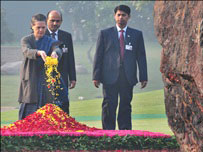 NEW DELHI, Nov 19: The Nation on Monday remembered former Prime Minister Indira Gandhi on her 95th birth anniversary with President Pranab Mukherjee and Vice President Hamid Ansari among prominent leaders who paid homage to the leader.
 NEW DELHI, July 6: Prime Minister Manmohan Singh on Friday sent out clear signals to foreign investors saying there will be no arbitrariness in tax matters. "We want the world to know that India treats everyone fairly and reasonably and there will be no arbitrariness in tax matters," he told a newspaper in an interview.
Aviation
| Business | Defence | Foreign
Affairs | Communication | Health
| India | United Nations
India-US
| India-France | Entertainment
| Sports | Photo Gallery |
Tourism | Advertise with Us
| Contact Us
© Noyanika International, 2003-2009. All rights reserved.