


India
Krishna inaugurates 50th Passport Seva KendraBy Deepak Arora
Inaugurating the sprawling facility, External Affairs Minister S M Krishna reaffirmed government's commitment to providing timely delivery of passport services to Indian citizens. "This is an important milestone. The setting up of Passport Seva Kendras is part of Government’s commitment to deliver passport services to the citizens in an efficient way," said the Minister.
The swanky 16,000 sq ft facility, where passport services will be available on par with best practices worldwide, has been set up in collaboration with IT giant TCS and has a total of 32 counters. An applicant will not be required to stay for more than 45 minutes in the facility to complete all the formalities, officials said. The new PSK will be the third in Delhi and NCR region. Two PSKs -- Shalimar Place in Pitampura and Udyog Vihar in Gurgaon -- have been functioning since August 30 last year.
An applicant will also have the option of choosing time slot in a day. The new PSK, one of the largest in the country, will be able to process nearly 1,000 applications per day. Krishna said government would set up smaller PSKs in North Eastern states to facilitate prompt passport services.
Speaking on the occasion, Mathai said the PSK has been set up to provide a "secure, error-free passport delivery services in comparison with best practices worldwide." "We now are in a position to issue passports, both fresh and renewal cases, in three days after police verification or where police verification is not needed. Passport under Tatkal Scheme will be issued in the next working day if you leave out the day of submission of application," Mathai said.
Mathai said the Regional Passport office at Bhikaji Cama Place will be converted into a PSK. Citizens from any part of the city can go to any of the PSKs for passport services. A total of 77 PSK’s are envisaged under the project and the remaining 27 are expected to be functional at the earliest. After functioning of all the three PSKs under the jurisdiction of RPO, Delhi, total capacity for accepting applications will be around 1800-1900 applications per day. A total of 73.65 lakh passport services were rendered in 2011 through the network of 37 Passport Offices (supported by Passport Seva Kendras) and 178 Indian Missions and Posts abroad. Kudankulam nuclear power plant set to roll in AprilNEW DELHI, Feb 26: The controversy-hit Kudankulam nuclear power plant in Tamil Nadu is set to be operationalized, with its first 1,000mw unit to be opened soon as the project's safety audits have been completed and local resistance now reduced to a few hundred protesters. While the report of the expert group set up by the Tamil Nadu government is awaited, the state government is more supportive of the project being commissioned and the Centre's action against NGOs alleged to have diverted foreign funds to fuel the stir is seen a precursor to the plant being activated. "I am hopeful of moving forward. The expert committees have done their job. Safety issues have been addressed. The plant's first unit can be in working order once we are able to move in the required staff," Srikumar Banerjee, secretary at the department of atomic energy, said. The head of India's nuclear establishment said it will not be easy to outline a timeframe, but the process of loading fuel can get underway once the atomic energy regulatory board is consulted. "The plant has been idle and so the AERB will lay down guidelines. Once these are followed, the plant will generate power," Banerjee said. The two units are "99% and 94%" ready, according to the Nuclear Power Corporation of India and it is estimated that the first unit can be up and running within six to eight weeks. MoS in PMO V Narayanasamy has said that the NGOs that have been banned were channeling funds meant for sectors like health and education for sustaining the anti-nuclear protests. The prolonged standoff at the plant site had led to a 100 staff being allowed to access the project site in two batches daily. This has made keeping the plant in running order difficult as a nuclear installation cannot be switched off in the manner of a conventional factory. The plant needs to be tended to by 3,000 workers, scientists and technicians to get it going. But Prime Minister Manmohan Singh's decisive intervention in stating that foreign NGOs insensitive to India's developmental needs were backing the stir and the government's action in banning three groups indicates a resolve to end the stalemate. The decision follows some quiet exchanges between the centre and state government and spadework in the project area where fishing communities have been leading the agitation. The role of church organizations, perhaps worried that the project might reduce their influence, were active in opposing the plant. The government has reached out to the church groups and sought to convince them that the plant has some of the best safety equipment available globally. Talks with anti-nuclear groups did not, however, make much headway with officials claiming that the protestors were fundamentally opposed to nuclear power and did not set much store by the government's assurances. The move against NGOs is seen as a last resort as the UPA has been sensitive about not getting into a confrontation with such groups although it has had a showdown with sections of civil society like the Anna Hazare movement. It is significant that the Tamil Nadu government, which has been concerned about local reactions, has not contradicted the PM's remarks on the role of foreign funds being diverted from the purposes that they were received. A home ministry probe is understood to have established the diversion of funds. Congress in strong position in UP due to Rahul Gandhi: LaluBulandshahr (UP), Feb 25: RJD president Lalu Prasad on Saturday said that Congress was in a strong position in Uttar Pradesh assembly elections mainly due to hard work done by Rahul Gandhi. "Congress is in strong position in UP assembly elections due to hard work done by its general secretary Rahul Gandhi," Prasad, who is canvassing for Congress candidate from Sikandrabad in Bulandshahr Jitendra Yadav, whose son was recently married to Prasad's daughter, said. The RJD, an ally of UPA, has not fielded its candidates in Uttar Pradesh polls but Prasad is canvassing for some Congress candidates in the state. Asked about the number of seats Congress would get in the 403-member UP assembly for which polls are underway, the RJD supremo said they would get a "large" number of seats. Congress had 22 seats in the last assembly elections in UP. "Influenced by Rahul Gandhi plain talking, a large number of youths are flocking to Congress rallies which indicate that the party is in good position there," Prasad, Lok Sabha member from Chhapra in Bihar, said. The RJD chief, who served as railway minister in UPA I, said an impressive performance of Congress in UP would strengthen the secular forces in the country. On Jitendra Yadav chance, the RJD chief said Yadav is getting support from all castes and classes and he would romp home easily. Accompanied by former RJD leaders and union ministers Prem Chand Gupta and Jaiprakash Yadav, Prasad addressed several rallies in Sikandrabad on Saturday to drum up support for Jitendra Yadav. We are in UP to bring change: Rahul Gandhi
Speaking at a rally here, jointly addressed with RLD chief Ajit Singh's son, Jayant Chaudhary, the Congress leader said that the BSP, SP and BJP have destroyed the morale, potential and prospects of the people of UP, even as other states are moving ahead and India is emerging as an economic superpower. "Western nations including the US and the UK are already threatened by India's rising economic status. When the people of UP come out on their own, they will actually start trembling," Gandhi said, drawing a thunderous applause from the gathering at the Vaishya Inter-College ground. Referring to Mayawati's charge that he (Gandhi) was enacting a 'nautanki' (drama) by visiting Dalit homes, he said that if this was a 'drama', he intended to persist with it. “We (Congress and RLD) are not here to make promises. We are here for change. Individuals do not matter. But change is critical for the development of UP", Gandhi said. Speaking earlier, Jayant Chaudhary called upon youth to bring about a change in UP by electing the Congress-RLD combine. "I see this happening. There is a history in the making,” Chaudhary said. GDP to grow 7.5-8 pc : PMEACNEW DELHI, Feb 22: India is likely to clock a GDP growth of 7.5-8 per cent in 2012-13, Prime Minister's economic advisory panel said on Wednesday and further reiterated that government is aligning the diesel prices in a phased manner and de-regulation of Urea prices. The economy will expand by 7.1 per cent in the current fiscal on the back of good output in farm and construction sector, Prime Minister's economic advisory council Chairman C Rangarajan said releasing the Review of Economy (2011-12). This is a shade higher than the 6.9 per cent GDP growth projection made by the Central Statistical Organisation (CSO). "We might be able to achieve a growth rate close to 8 per cent on our own steam ... provided we take some of the corrective actions," Rangarajan told reporters in New Delhi. Inflation rate at 6.5 per cent at March end will still be above "comfort" levels, he said projecting the rate of price rise to fall to 5-6 per cent next fiscal. He said clocking a 9 per cent growth in the near term would be challenging on account of uncertain global economy. Indian economy was growing at over nine per cent before the financial meltdown of 2008 pulled down the growth rate to 6.7 per cent in 2008-09. Rangarajan said the government should aim at increasing tax revenues by about Rs 35,000 crore through an increase in excise and service tax rates to pre-crisis level, bringing back disinvestment on the table and containing subsidies to check its finances. "It will be necessary during 2012-13 to make some adjustments on the diesel prices in a phased manner. We have not done this for quite some time and international crude prices have gone up ... It is not possible for us to subsidise this sector beyond a level," Rangarajan said. Expressing concern over high fiscal deficit, which is expected to overshoot the target of 4.6 per cent of GDP this fiscal, he said the government "must try" to contain and improve efficacy of subsidies. Rangarajan further said that inflation is still above comfort zone. He projected it to moderate to 6.5 per cent by March end and 5-6 per cent in the next fiscal. While the retail inflation based on Consumer Price Index (CPI) was 7.65 per cent in January, the Wholesale Price Index (WPI) inflation was 6.55 per cent. Rangarajan said that efforts must be made to revert to the pre-crisis level of tax-GDP ratio at 12 per cent, from 10 per cent at present. On improving the tax to GDP ratio, Rangarajan said the excise duty and service tax should be increased to pre-crisis level, a move which will bring in additional Rs 35,000 crore. Before the economic crisis, service tax and excise duty rates were at 12 per cent, but as a stimulus the government had brought them down to 10 per cent in 2008-09. The panel further recommended that the government should consider raising tax rates on certain lower-taxed products in the Budget for 2012-13 to be presented in Lok Sabha on March 16. It also called for aligning the tax rates on items such as tobacco with international standards. He also made a case for implementing certain provisions of the direct taxes code (DTC), especially those pertaining to DTAA, in the forthcoming budget. While Rangarajan refused to put a number for fiscal deficit, it is widely expected that the gap between expenditure and revenue could be as high as 5.5 per cent of GDP as tax collections would be lower coupled with lower realisations from disinvestment and higher subsidy outgo. The government expects that its subsidy bill would increase by Rs 1 lakh crore to Rs 2.34 lakh crore, mainly on account of higher outlay towards fertiliser, food and oil. The panel further said that increased gold imports which are putting pressure on Curent Account Deficit (CAD) would decline to USD 38 billion in 2012-13. This year's import bill of the yellow metal is expected to be USD 58 billion. Congress racing ahead in UP Assembly electionNEW DELHI, Feb 8: The Uttar Pradesh Assembly elections, which witnessed the first phase of polling in 55 constitutencies across 10 districts in central UP and a part of the terai region on Wednesday, were crucial for the Congress, ruling Bahujan Samaj Party and the Samajwadi Party and would decide the country's polity in the days to come. Nearly 126 million voters are eligible to vote in 403 assembly seats during the seven-phase elections between 8 February and 3 March. Counting of votes is scheduled to take place on 6 March. Uttar Pradesh is ruled by Chief Minister Mayawati, a low-caste Dalit icon who is battling another strong regional force, the Samajwadi Party. If it were a separate country, Uttar Pradesh would be the fifth largest in the world by population, with more than 200 million people. The prestige of Congress and BSP in particular is at stake BSP swept the region in the 2007 assembly elections, whereas Congress dominated in the 2009 Lok Sabha elections. The first phase will also decide the fate of several bigwigs who are not themselves in the fray but have put up family members and have the respon sibility of getting as many seats as possible for their parties. The ten districts that went to poll are Sitapur, Barabanki, Faizabad Ambedkarnagar, Bahraich Shravasti, Balrampur, Gonda, Sid harthnagar and Basti. The region is rich in agriculture. Over 80% of people here are dependent on the rural economy. But it is extremely backward with no industry or agri-marketing mechanisms. Devastating floods in the Ghaghra, Sharda and Saryu rivers are an annual feature but no significant flood control work has been done by any government since Independence. The dalit population in the 10 districts varies between 17% and 30%. In 18 of the 55 constituencies, Muslims account for between 20% and 29% of population and in 13 others they are over 30% Other backward classes (OBCs) mainly the Kurmi, Aheer and Lodh castes, constitute 20-25 % of the population and brahmins 8 to 11%. Since Muslims votes are crucial, BSP has fielded 14 Muslim candidates, SP 10 and Congress nine. BJP is hoping to gain from a split in Muslim votes and polarization of Hindus on the issue of the proposed Muslim quota. In the 2007 assembly elections BSP had won 33, SP 20, BJP 4 and Congress 3 in this area which prior to delimitation accounted for 60 assembly constituencies. The scene changed in the 2009 Lok Sabha elections when both Congress and BSP won six seats each out of the total 13 parliamentary constituencies. SP won a lone LS seat here. An assembly segment-wise analysis of the 2009 Lok Sabha shows that Congress was ahead in 29 segments, BSP in 15, SP in nine and BJP in one. The Congress has pulled out all stops to maintain its score From Muslim quota to promoting Gonda MP Beni Prasad Verma as the OBC face of the party to Rahul Gandhi's visit to dalit households. Congress has tried everything to repeat the 2009 performance. Verma was given a free hand by Congress to select candidates in the OBC-dominated region. Many called this the 'mandalisation' of Congress as traditional voters of the party were brahmins, Muslims and dalits. Verma's son Rakesh is contesting from Dariyabad in Barabanki. Big names from other parties in the fray include three ministers in the Mayawati government-Lalji Verma from Katehari in Ambedkarnagar, Sangram Singh Verma from Barabanki seat and Ramhet Bharti from Hargaon in Sitapur. From SP, apart from former assembly speaker Mata Prasad Pandey, there are mafia turned-politicians Mitrasen Yadav from Bikapur, Faizabad, and Abhay Singh from Gosainganj Faizabad. Daddan Mishra, minister in BSP government who defected to BJP, is contesting from Bhinga, Shravasti. RLD state general secretary Munna Singh Chauhan is in the fray from Bikapur, Faizabad. Besides Mitrasen Yadav and Abhay Singh, other mafia-turned politicians in the coming elections include Jitendra Singh Babloo SP MP from Kaiserganj, Brijbhushan Sharan Singh and BJP MP from Azamgarh Ramakant Yadav. Mafia-turned-politician Hari Shankar Tiwari's son Vinay is contesting on a BSP ticket from Bansi in Basti. All major parties have put up candidates with criminal cases in the first phase. The SP has field ed 28 such candidates, BSP and BJP 24 each and Congress 15. BSP has fielded 5 women candidates BJP 6, SP and Congress 4 each. President Patil stresses the need for building human resourceKURUKSHETRA, Feb 8: President Pratibha Patil on Wednesday stressed the need for building human resources, saying it is the talent and work of our people that will shape the future trajectory of becoming a good and strong nation. "We have to focus on building our human resource...it is human beings who set up factories and run them. It is human beings who establish institutions that are engaged in multiple activities, from providing services to undertaking research and scientific activities for the betterment of humanity," she said speaking at the convocation function of Kurukshetra University in Kurukshetra. "Human beings stand at the centre of creative thinking and of ideas, which can bring many changes of head and heart, material and spiritual," she said. On the occasion, degrees of Doctor of Laws Honoris Causa were conferred on Dr Navinchandra Ramgoolam, Prime Minister of Mauritius and Haryana Chief Minister Bhupinder Singh Hooda. The degrees were conferred by Haryana Governor Jagannath Pahadia, who is also the Kurukshetra University's Vice Chancellor. The President awarded gold medals to the toppers of different departments. Degrees to 181 PhD Scholars, number of M Phil and Post Graduates were also awarded. Patil said that she was happy to note that all the eleven gold medalists honoured today were girls. She called upon the boys to work hard as boys and girls are the two wheels of chariot and both wheels have to be sturdy. Patil said the energy of the youth and their enthusiasm must be guided into constructive and productive work. "...so good education facilities and good quality education, from primary to high education levels must receive great attention," she said. Touching upon the roles which universities can play, she said as a nation-building programme can leave no part of the nation untouched, education must cover a wide range of disciplines and fields. She said that education should be a process that makes an individual complete in all respects. Quoting Mahatma Gandhi, she said, a nation needs, "strong souls, strong brains, strong arms". Patil further said that it is for this reason that she has continuously spoken about the importance of exchanges between students and educational institutions, as a way to build deeper co-operation between countries. "Education should also help in developing respect towards nature. We have a responsibility to preserve the planet for future generations. Towards this end, our youth needs to be made responsible and responsive to environment." As teachers play a key role in shaping future of our students, the President said the faculty of a university which is its lifeblood, like a good friend should always advice and guide their students, on how best to face challenges that confront the world. Earlier, the President began her convocation address by expressing her satisfaction that Kurukshetra had become home to many institutions of higher education, including Kurukshetra University. Priyanka: Utho, jaago, badlo UPLUCKNOW, Feb 4: Priyanka Gandhi has given a new slogan “Utho, jaago, badlo UP” (get up, awaken and change UP). “We are not fighting for victory alone. We want to bring about a change in UP,” she added. In a rather unfamiliar display of political aggression, Priyanka Gandhi Vadra on Friday excoriated BSP chief Mayawati on several issues, including corruption, lack of development and bungling of development funds in Uttar Pradesh. Priyanka, on a two-day tour of Amethi and Rae Bareli, clarified that for the time being she did not plan to venture out of these Nehru-Gandhi family bastions to campaign for the Congress party. Taking a direct dig at the Dalit icon, she said, “Mayawati’s frustration has begun to show now.” In her meetings, she called upon the people to vote for change. “My brother (Rahul Gandhi) is worried about your welfare. You have tolerated misrule for 22 years (of non-Congress rule).” Govt has moved 'substantially forward' in curbing graft: PMNEW DELHI, Feb 3: Prime Minister Manmohan Singh on Friday said government has moved "substantially forward" in curbing corruption and improving public services delivery system but acknowledged there is "still a long way" to go to ensure transparency, accountability and probity in public life. Addressing the Conference of Chief Secretaries in New Delhi, the Prime Minister also expressed confidence that a strong Lokpal law would be enacted soon. Dr. Singh recalled that last year he had emphasised the need for a systemic response that reduced opportunities for corruption in public life and had stated that his government was committed to taking all legal and administrative measures to curb the menace. "I had also said that we should make full use of advances in modern technology to improve the delivery of our public services system. We have moved substantially forward in these areas in the last one year," he said. The Prime Minister cited the Citizen's Charter and the Electronic Delivery of Services bills introduced in Parliament last year as examples. Noting that "unfortunately, the Lokpal and Lokayuktas Bills could not be passed in the last session of Parliament", Singh said he does hope that the government "would soon be able to enact a strong Lokpal law". The Prime Minister also referred to the government's plan to frame a law for regulating public procurement, implementing national e-governance plan and providing 'Aadhar' numbers. "All this builds upon our earlier initiatives such as the Right to Information Act, the Judicial Accountability Bill and the Whistle Blowers Bill. But, we still have a long way to go in our efforts for ensuring transparency, accountability and probity in public life," he said. Hailing as "creditable" the growth rate of the country's economy at the rate of 8.4 per cent in the backdrop of a crisis-ridden world economy, Singh said that the growth in the current financial year is, however, likely to be lower between 7 to 7.5 per cent in a large measure due to the continuing uncertainty in the global economic environment. While noting that inflation was a persistent problem during the course of last year, particularly with regard to food items, the Prime Minister said the government took several measures to ease supply constraints that were a cause for rising prices. "This coupled with the policy of monetary tightening that the Reserve Bank adopted has led to a continuous decrease in inflationary pressure in primary food articles in recent weeks. "The overall inflation has also eased. But, monetary tightening together with a difficult global economic environment, particularly the lingering Euro Zone crisis, has impacted the rate of growth adversely", he said. Dr. Singh said that the key to controlling inflation in food articles on a sustainable basis lay in increasing agricultural production and productivity in which the "state governments have a crucial role to play". He also urged states to give more attention to areas such as modernisation of agricultural research and agricultural extension system, public investment in agriculture, and reform of the agricultural marketing system and practices. The Prime Minister felt there was a need to review and amend the Agriculture Produce Marketing Act to enable farmers to bring their products to retail outlets and also allow retailers to directly purchase from the farmers. He said this would bring better remuneration to farmers, check wastage and allow competitive prices to prevail in retail markets.
|
|
||||||||
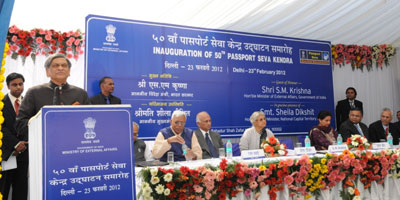
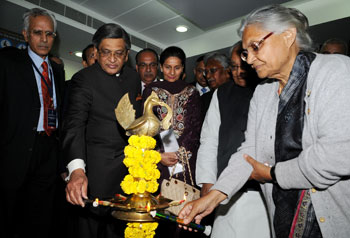 NEW DELHI, Feb 23: External Affairs Minister S M Krishna inaugurated India’s most modern and one of the largest Passport Seva Kendras (PSK) at Herald House here on Thursday. This is the third PSK under the jurisdiction of RPO, Delhi and the 50th Passport Seva Kendra to be operationalized under the Passport Seva Project.
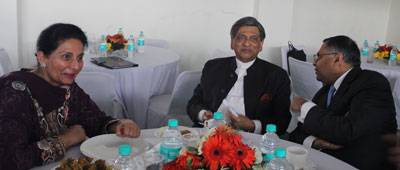
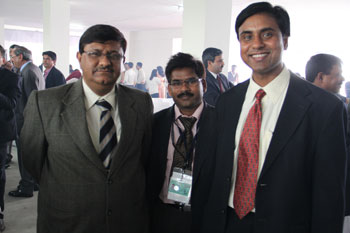
 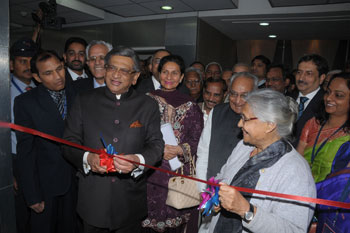 Delhi Chief Minister Sheila Dikshit, Minister of State for External Affairs Preneet Kaur, senior Congress leader Motilal Vohra, Foreign Secretary Ranjan Mathai and TCS CEO and Managing Director N Chandrasekaran were among the dignitaries present on the occasion.
 Officials said any applicant can file application online and upload the required documents following which an appointment will be given by the PSK for verification of the documents.
 The PSK is a flagship e-Governance initiative undertaken by MEA to comprehensively overhaul the passport issuance system. The Project is being implemented in public-private partnership mode with Tata Consultancy Services (TCS) as service provider.
 Generally, the waiting period for issuance of passport is 30 to 45 days.
 SHAMLI (Western UP), Feb 22: Congress general secretary Rahul Gandhi has declared that “it is time for Uttar Pradesh to liberate itself from the misrule, loot and betrayal of the last two decades of non-Congress rule."
Aviation
| Business | Defence | Foreign
Affairs | Communication | Health
| India | United Nations
India-US
| India-France | Entertainment
| Sports | Photo Gallery |
Tourism | Advertise with Us
| Contact Us
© Noyanika International, 2003-2009. All rights reserved.