Gaurav Dhamija Masonic Centre Karnal celebrates Republic Day
By Deepak Arora
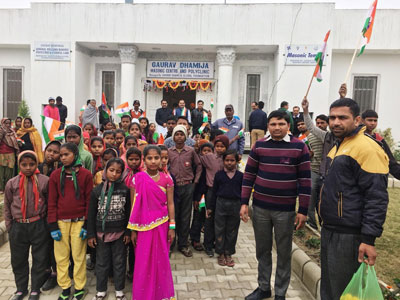 KARNAL, Jan 26: Republic Day was celebrated with great enthusiasm at the Gaurav Dhamija International Masonic Centre in Karnal. KARNAL, Jan 26: Republic Day was celebrated with great enthusiasm at the Gaurav Dhamija International Masonic Centre in Karnal.
The funtion was attended by prominent citizens and common men and women. Over 200 children from the jhuggi clusters were specially brought to the Centre to ensure the participation of the lowerest of the downtrodden in the national mainstream.
A prominent industrialist Bharti was the chief guest and he unfurled the National Flag.
P S Pannu and Naresh Barana of NIFAA and Inderjit Dhamija and Navjot Singh Waraich of Indian freemasonary were some of the prominent persons present on the occasion.
Bharti exhorted the people and children to put in some extra work for the nation each day in whatever field you are. He explained to the children the meaning of freedom and the Constitution and how it can help in upliftment of the poor in the country.
Indian Freemasons have built the Masonic Centre in Karnal in memory of Gaurav Dhamija, a prominent Freemason.
Ikea founder Ingvar Kamprad dies at 91
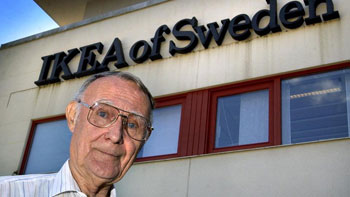 STOCKHOLM, Jan 28: Ikea founder Ingvar Kamprad, who built a global business empire with revolutionary flat-pack furniture and was known for his contempt for taxes, died aged 91, the Swedish furnishing giant said on Sunday. STOCKHOLM, Jan 28: Ikea founder Ingvar Kamprad, who built a global business empire with revolutionary flat-pack furniture and was known for his contempt for taxes, died aged 91, the Swedish furnishing giant said on Sunday.
The company said in a statement that Kamprad “passed away peacefully surrounded by his loved ones” at his home in the southern Swedish region of Smaland on Saturday “following a brief illness”.
“His legacy will be admired for many years to come and his vision — to create a better everyday life for the many people — will continue to guide and inspire us,” Jesper Brodin, CEO and president of the Ikea Group, said in the statement.
Born in 1926 to a farming family in the southern Swedish region of Smaland, Kamprad founded the company at age 17.
Despite his enormous success and wealth, Kamprad’s modest spending habits bordered on the obsessive.
In 1973 he fled Sweden’s higher tax structure for Denmark before seeking even lower taxes in Switzerland.
Starting in 2010 Kamprad gradually made way at the helm of the company for his three sons, finally returning to live in Sweden in 2014.
Kamprad announced in 2013 that he would be stepping down from the board of Inter Ikea, owner of the furniture giant’s concept and brand, and his youngest son became chairman.
The Consortium of Investigative Journalists in 2014 cited leaked tax files from Luxembourg when it identified Ikea as one of the giant multinationals fingered for corporate tax avoidance by shuffling money to tax havens.
Last year, the European Commission announced that it had launched an investigation into Ikea’s tax deals in the Netherlands.
The group insists that it complies fully with national and international tax regulations.
Kamprad was also known for his ties to the Swedish Nazi party during his early days.
Sweden was neutral in World War II, and its Nazi party remained active after 1945. The Ikea founder said he stopped attending its meetings in 1948.
Shah Rukh Khan’s passionate speech at Davos reveals the moment that changed his life
 DAVOS, Jan 23: Shah Rukh Khan, along with actor Cate Blanchett and singer-songwriter Elton John, received awards at the World Economic Forum in Davos on Monday for the work raising awareness about human rights issues. The 52-year-old Bollywood star received the award for showing an exemplary commitment to uphold human dignity through his non-profitable Meer Foundation. DAVOS, Jan 23: Shah Rukh Khan, along with actor Cate Blanchett and singer-songwriter Elton John, received awards at the World Economic Forum in Davos on Monday for the work raising awareness about human rights issues. The 52-year-old Bollywood star received the award for showing an exemplary commitment to uphold human dignity through his non-profitable Meer Foundation.
Meer Foundation provides support to female victims of acid attacks and major burn injuries through medical treatment, legal aid, vocational training, rehabilitation and livelihood support. He has also been responsible for creating specialised children’s hospital wards and has supported childcare centres with free boarding for children undergoing cancer treatment.
It was his impassioned speech about women and child rights which had the world’s top policy makers and executives cheering for the actor. Here is SRK’s full speech from Davos…
I am genuinely and deeply grateful for this honour and it is a privilege to be in the company of two phenomenal and extraordinary human beings and talent, Cate Blanchett and Sir Elton John
She is of course a lady who commands the wind and you sir command the song of a billion hearts, including mine. I am really touched that I am chosen between these two. Just a special request, before you go, can I do a selfie? Now, there I have embarrassed my children.
Actors are renowned narcissists. No matter how much we pretend not to believe in external beauty, we tend to be obsessed by it one way or the other. And perhaps being surrounded by this obsession of beauty, a few years ago I came across a lady who had been brutalised by an acid attack. It kind of changed my life or my perspective of it, at least.
To disfigure a woman by throwing acid on her face, to me, is one of the basest, crudest acts of subjugation imaginable. At the source of it lies the view that a woman does not have the right to assert her choice, say no to the advances of a man or a group of people. And yet, each of the women I met, I found within them the courage to move on with their lives and reject the idea of victimhood. What struck me most about them was this -- what was done to them only made them braver, stronger and able to free themselves, to make the choices everyone around them was telling them they could not make or should not make. From them I have learnt how courage can catalyse victimhood into heroism, how solidarity -- rather than charity – enables the human will to overcome, how equality is not a concept but a truth that encompasses all living beings, how service of others is not a choice anymore for any of us but it is a duty that all of us must fulfill in the name of humankind.
When I journeyed through the life of these heroic women and children through the work of Meer Foundation, I experienced a complete reversal of perspective. I stumbled upon the truth that there are no benefactors and beneficiaries between living beings anymore. There is just a vast pool of resources – natural, spiritual, economic and technological – that everyone is equally entitled but some have gained by more access to it. Either by accident, as in my case, or by talent, design and hard work as in the case of all of you present here. Standing here before all of you who constitute perhaps the most powerful group of human beings in the world, I dare say power is one of these perspectives we like to maintain a certain way but power actually needs a complete reversal more than any other thing in the world today.
I was babysitting my five-year-old son before I came here today and suddenly he screamed, “Papa, papa my eye went into my hair. Can you get my eye out of my hair?” He didn’t say get my hair out of my eye, like we all believe we do. And it is a bit like that when you have power, you think things get in its way but it is actually power that is getting in the way.
It gets in the way of universal access to resources because it seeks to control and enclose them so we, the powerful, need to get out of the way, I think. To pick the barriers apart – the ones that give us names and colours and races and hierarchies. We need to get out of the way and into the work of breaking open access for each and every one with a true sense of ourselves but not as more powerful or less privileged, but genuinely as equals. That is what I have learned from my beautifully scarred women. I am thankful to these brave women and children who I work with for all they have done for me, to World Economic Forum and all of you present here for recognising the heroism by conferring this award upon me.
I want to thank my sister, my wife and my little daughter for bringing me up well and teaching me the value of requesting, sometimes imploring and begging a yes from a woman, instead of forcing it upon her.
Interior design ideas for homes in 2018
NEW DELHI, Jan 29: From designer chairs with royal prints, wall coverings to sage becoming the new neutral colour tone, interior trends for 2018 have more to do with subtle elegance.
Interior design expert Raseel Gujral doles out tips on how to make your living space lively .
* Striking accentuated furniture is often the focal point of your living space. Designer chairs with royal prints can stand as the royal throne of your living room.
* Incorporate furnishings with traditional motifs and exquisite ornate designs that add the much needed vibe of neo classical style to your interiors.
* Hand carved teak wood shutters, furniture legs finished with gold leafing, and ornate hand carved base will add the ultimate royal appeal to furniture designs.
* To exude subtle opulence through your interior décor, opt for crystal accents and fabric embellished or embroidered with mirror fascia.
* Express the drama of the interplay of cultures from two different eras - that of the royalty then and the royalty now, with exquisite wall covering, arches etched at the centre point of the hallway, and drench your home décor with shades like hunter green, stunning pink complemented with the royal gold.
Anjali Goel, design head at La Sorogeeka shares some tips too.
* Reawakening of the designs from yesteryears is going to create a renaissance with designs crafted for the coming years.
* Sage is to be the new neutral colour tone. Replacing the likes of pure white, beige and stone - the muted green with grey reflecting the earthy tone is going to be the trend setter. Paired with woods and a cream colour palette, the green will soften and warm up any space. Other pastels that are tipped to be hot include soft mustards, jades and olives.
* 2018 is going to bring an opera of classical decor by reinventing its approach to styling.
* A surprising blend of modern details with craftsmanship of legendary years is going to give a unique and unreal look to the decor designs.
* The design trends would include features that characterise luxury with opulence. An inventive way to transform the space could be created by designing a statement ceiling as a standout feature.
* Statement doors and boiserie will add flair and style of luxury into the interior decor.
* Exotic inlay patterns, elaborate contemporary carving details webbed together in furniture details is going to fuse eras together creating the new trends for 2018.
* The new trends for 2018 would also include exotic inlay/motif patterns on ceilings and floors with semi-precious stones.
8 of the best interior design trends for 2018
Jan 25: Is redecorating your home your new year's resolution? We round up the key 2018 decorating trends you should consider for your next home improvement project
With 2018 only around the corner, our most loved home brands have given us a glimpse of their hottest decor ranges for spring/summer - which are some of the boldest yet.
From painting walls with dark, moody hues and pairing blush pink shades with greenery, to incorporating exotic, jungle-inspired decor and updating the Scandi trend, we round up a few of our favourite 2018 decoration ideas to refresh your home in the new year.
Pared back Industrial chic
With distinguishable features such as exposed brick, distressed finishes and polished concrete, the industrial trend is set to be as popular as ever.
The new year will see a fresh twist on the aesthetic at Next Home where simple crockery sets and minimalist statement lighting reign supreme.
Colour blocks and paint effects
Say goodbye to painting your walls with solid colour and say hello to creating shapes with colour blocks instead, while ombre walls, stencils and other paint effects will be rising in popularity. Here's a sneak peek at Crown's SS18 collection.
Crown's linear trend gives fresh meaning to Bauhaus, combining grey with watery blues and muted pinks giving the appearance of being diffused by a subtle haze.
Judy Smith, Crown's Colour consultant explains the look: “Linear is about working with the simplicity of straight lines; keeping to slim black outlines in furniture and lighting as well as on walls gives a new and sophisticated look, a modern elegance."
Greenery on blush pink
Plants are creeping their way back indoors, as seen in this preview of Sainsbury's Home's SS18 collection.
Inspired by the opulence of Kew Gardens and exotic hotel cocktail lounges drenched in palms, the range showcases palm leaf prints, soft blush pink furnishings, botanical terrariums and an array of planters and pots filling every corner.
Refined coastal
SS18 will see a fresh and more stylish take on the seaside trend, with deep indigo contrasting with nautical hues, textured finishes and marble.
This Argos preview takes on the trend with porthole mirrors, a mix of stripes, and brass fixtures and fittings.
Style it dark
Sophisticated and atmospheric, dark paint colours are here to stay for SS18 with shades ranging from sumptuous dark blue and charcoal grey to rich jewel tones.
Swoon Editions have gone one step further, pairing moody navy walls with the range of plush velvet upholstered sofas, gold accents and marble.
Relaxed rustic
A mix of weathered woods, natural materials and contrasting earthy tones all feature in the enduring rustic trend.
This Marks and Spencer sneak peek features fresh wild flowers in vintage-inspired mix-and-match vases and distressed furniture.
Modern Scandi
The Scandi trend is set to be just as big in 2018.
You'll be bowled over by Debenhams Hastings collection which features a updated spin on the trend and features a mix of contemporary and mid-century inspired furniture.
Global nomad
The global trend is set to make a big comeback for 2018. Think exotic artefacts, hand crafted textiles and black-white tribal patterns, against jungle patterns, earthy colours and worn timber.
Dunelm's spring summer 2018 voyager range encapsulates the trend perfectly, featuring a mix of flora and fauna prints on everything from home accessories and soft furnishings to dinnerware and bathroom accessories.
India’s Time on the World Stage Has Come, Says New Book by Alyssa Ayres
By Deepak Arora
NEW YORK, Jan 4: “More than at any time over the past quarter-century, India is well on its way to global power,” writes Alyssa Ayres in a new book, Our Time Has Come: How India is Making its Place in the World. She notes, “We are witnessing a country chart its course to power, and explicitly seeking not to displace others but to be recognized among the club of world powers, one in which it believes its membership is long overdue.”
In Our Time Has Come, Ayres, the Council on Foreign Relations Senior Fellow for India, Pakistan, and South Asia, considers the role this ascendant democracy will play internationally, the obstacles it continues to face, and the implications of its rise for the United States and other nations.
Over the past twenty-five years, India’s economic expansion has vaulted it into the ranks of the world’s emerging major powers. A rising India now wants a seat at the table of global powers. With its huge military and growing economy, India is ready to set its own terms on everything from defense to climate to trade.
While Ayres makes the case for India’s elevated global position, she also highlights the challenges the country faces:
@ The Indian economy remains relatively protectionist, and no clear consensus exists on the benefits of a more open economy or stepping up the pace of economic reforms.
@ India struggles with the legacy of its longstanding foreign policy doctrine of nonalignment, and remains ambivalent about how it should exercise power.
@ India is intensely protective of what it sees as its autonomy, and seeks to shape international interactions very specifically on Indian terms.
“Our [the United States’] relationship with democratic India—going from estrangement of the Cold War decades to partnership in the twenty-first century—as it emerges among the world’s great powers will likely stand as a defining policy shift, one that we missed in the twentieth century but have pursued in the twenty-first,” writes Ayres.
The United States’ relationship with India differs from its relationships with longstanding European and Asian partners because New Delhi, while seeking a closer strategic and economic relationship with the United States, does not seek the obligations inherent to an alliance.
To help shape this nontraditional partnership, Ayres emphasizes the need for global governance reform that makes space for India. Her recommendations include backing Indian membership in the Group of Seven, the UN Security Council, and other institutions that set the global economic and security agenda; developing stronger bilateral economic ties with India; continuing to pursue stronger regional security cooperation with India; and supporting institutions of democracy.
“India, as a rising power of Asia, should be better understood and better appreciated in its own terms—as a competitiveness issue for U.S. economic and business interests, and as a matter of the demands of the new global diplomacy in which all of Asia plays a much more pivotal role,” writes Ayres.
Nearly 386,000 children will be born worldwide on New Year’s Day: UNICEF
By Deepak Arora
NEW YORK, Jan 1: UNICEF challenges nations around the world to make sure more newborns survive their first days of life
NEW YORK, Jan 1: Approximately 386,000 babies will be born on New Year’s Day, UNICEF said today. Of these, over 90 per cent will be born in less developed regions.
Kiribati’s Christmas Island in the Pacific will most likely welcome 2018’s first baby; the United States, its last. Globally, over half of these births are estimated to take place in nine countries: India — 69,070; China — 44,760; Nigeria — 20,210; Pakistan — 14,910; Indonesia — 13,370; the United States — 11,280; The Democratic Republic of Congo — 9,400; Ethiopia — 9,020; and Bangladesh — 8,370.
While many babies will survive, some will not make it past their first day. In 2016, an estimated 2,600 children died within the first 24 hours every day of the year. For almost 2 million newborns, their first week was also their last. In all, 2.6 million children died before the end of their first month. Among those children, more than 80 per cent died from preventable and treatable causes such as premature birth, complications during delivery, and infections like sepsis and pneumonia.
“This New Year, UNICEF’s resolution is to help give every child more than an hour, more than a day, more than a month — more than survival,” said Stefan Peterson, UNICEF’s Chief of Health. “We call on governments and partners to join the fight to save millions of children’s lives by providing proven, low-cost solutions.”
Over the past two decades, the world has seen unprecedented progress in child survival, halving the number of children worldwide who die before their fifth birthday to 5.6 million in 2016. But despite these advances, there has been slower progress for newborns. Babies dying in the first month account for 46 per cent of all deaths among children under five.
Next month, UNICEF will launch Every Child Alive, a global campaign to demand and deliver affordable, quality health care solutions for every mother and newborn. These include a steady supply of clean water and electricity at health facilities, the presence of a skilled health attendant during birth, disinfecting the umbilical cord, breastfeeding within the first hour after birth, and skin-to-skin contact between the mother and child.
“We are now entering the era when all the world’s newborns should have the opportunity to see the 22nd century,” added Peterson. “Unfortunately, nearly half of the children born this year likely won’t. A child born in Sweden in January 2018 is most likely to live to 2100, while a child from Somalia would be unlikely to live beyond 2075.”
In Coldest Village On Earth, Eyelashes Freeze, Temperatures Sink To -88F
OYMYAKON, Jan 18: In this remote outpost in Siberia, the cold is no small affair.
Eyelashes freeze, frostbite is a constant danger and cars are usually kept running even when not being used, lest their batteries die in temperatures that average minus-58 degrees Fahrenheit in the winter, according to news reports.
This is Oymyakon, a settlement of some 500 people in Russia's Yakutia region, that has earned the reputation as the coldest permanently occupied human settlement in the world.
It is not a reputation that has been won easily. Earlier this week, a cold snap sent temperatures plunging toward record lows.
The town's official measurement recorded the temperature at minus-74 Fahrenheit this week, though a new digital thermometer installed in town for all to see, part of the town's reputation for frigid temperatures, broke as it registered minus-80 degrees on Sunday. According to the Siberian Times, some residents' own measurements had shown the temperature below minus-88 degrees, approaching a former record from the 1930s.
The village recorded an all-time low of minus-98 degrees Fahrenheit in 2013.
Though schools in the area remain open as temperatures dip into the minus-40s, they were closed on Tuesday, the Associated Press reported.
Dark 21 hours a day in the winter, the town has been an object of international curiosity as its reputation for fearsome cold and the resilient residents who withstand it year after year, has grown.
Amos Chapple, a photojournalist from New Zealand, traveled to the region in 2015 to capture the subzero way of life. The village is remote, located closer to the Arctic Circle than to the nearest major city, some 500 miles away, and Chapple described an arduous trip to get there to The Washington Post. After a seven-hour flight from Moscow, some 3,300 miles away, he took a van to a nearby gas station and then hitched a ride to the village after two days waiting in a shack and living off reindeer soup.
"After the first couple of days I was physically wrecked just from strolling around the streets for a few hours," he said.
The harsh cold climate permeates nearly every aspect of existence for the people who live in the area. The winter diet is mostly meat-based, sometimes eaten raw or frozen, due to the inability to grow crops in the frigid temperatures. Some regional specialties include: stroganina, which is raw, long-sliced frozen fish; reindeer meat; raw, frozen horse liver, and ice cubes of horse blood with macaroni, according to news reports.
"Yakutians love the cold food, the frozen raw Arctic fish, white salmon, whitefish, frozen raw horse liver, but they are considered to be delicacies," local Bolot Bochkarev told the Weather Channel. "In daily life, we like eating the soup with meat. The meat is a must. It helps our health much."
Video taken during the cold snap showed a market, open for business on the snowy tundra, frozen fish standing rigidly upright in buckets and boxes, no refrigeration needed. Customers in heavy winter clothing walked by, one with a child in tow. The narrator said it was minus-56 degrees.
"Here is the treasure," the video's narrator said of the whitefish used to make stroganina. He admitted he was getting a bit cold shooting the video.
"While filming the trading rows my hands froze to wild pain. And sellers stand here all day long. How do they warm themselves?" he said, according to the Siberian Times.
The village was once a stopover in the 1920s and '30s for reindeer herders who would water their flocks at a thermal spring that didn't freeze. Bathrooms are mostly outhouses; the ground is too frozen for pipes. According to the Weather Channel, the ground has to be warmed with a bonfire to break into, such as for digging a grave.
According to the Siberian Times, two men died after their car stalled and they had set out on foot during the cold streak. The group, a horse breeder and four friends, had gone to check on some animals near the river.
The press office for the region's governor said that all households and businesses have central heating and backup power generators, according to the Associated Press.
After his trip, Chapple said it was not easy doing man-on-the-street interviews in a place that was so cold, as people outside rushed quickly from one warm place to another. Alcoholism is believed to be an issue in the area, Chapple told reporters. Depending on how cold the weather dips, people often trade off 20-minute shifts when doing work outside, according to news reports.
Chapple said saliva would freeze into "needles that would prick my lips." Shooting was no easier - his camera would constantly get too cold to shoot, he said. The steam escaping his mouth would "swirl around like cigar smoke" he told Wired, so he'd have to hold his breath so it didn't cloud the frame. He told Wired that he shot one photo without his gloves only to find his thumb partially frozen.
|


