Millennium Alliance supports Katha initiative 300M with goal of universal reading for all children in India by 2050
By Deepak Arora
 NEW DELHI, July 27: India has approximately 150 million children in primary
education, nearly half of which are unable to read well. According to a UNESCO report of September 2016, “India will be half a century late in achieving universal education goals.” NEW DELHI, July 27: India has approximately 150 million children in primary
education, nearly half of which are unable to read well. According to a UNESCO report of September 2016, “India will be half a century late in achieving universal education goals.”
India’s poorest are disproportionately affected by this, which creates entrenched cycles of poverty.
The 300M Alliance has been formed with the objective of reaching the goal of universal reading for all children by 2050. Founded by a group of likeminded people and organisations, and led by Katha, this initiative aims to help children ‘Learn to Read. Read to Learn’.
The 300M Challenge volunteers and mentors will focus on children between the ages of 5 and 10, encouraging them to read with the use of colourful books and community libraries.
Katha has developed exciting print and digital material, based on their tried and tested StoryPedagogy, to encourage reading within 3 months. Katha is developing teaching methods for primary schools which are easy to understand and explain, and are designed to increase the students’ reading abilities. An increase in the proportion of students who are able to read well will be a positive step in the direction of ending entrenched poverty.
300M partners include Aagaaz, Amazon, Aseem’s Library, Bhaagta Bharat, CRY, Cure India, Facebook, Helpage India, India International Centre, Oracle, Pricewaterhouse Coopers Pvt. Ltd., SEWA, Teach for India, United Way of Delhi, and over 100 schools across 17 states in India.
The Federation of Indian Chambers of Commerce and Industry (FICCI), through its key
programme, Millennium Alliance(MA), is providing support and guidance to this
programme.
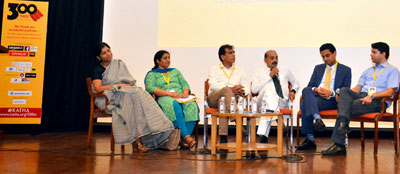
A panel discussion of the Strategic Partners was held today advocating the Power of LEAP (Leverage. Advocate. Partner).
Speaking during the discussion, Mr. Nirankar Saxena, Assistant Secretary General, FICCI, stated, “Millennium Alliance is proud to support Katha in its 300 Million Challenge that intents to bring every child to grade level reading and make reading a joyful experience”.
The MA is an inclusive platform to leverage Indian creativity, expertise, and resources to identify and scale innovative solutions being developed and tested in India to address development challenges that will benefit base of the pyramid populations across India and the world.
Under FICCI’s leadership and in partnership with United States Agency for International Development (USAID) and the Technology Development Board (TDB), and other MA partners, the Alliance will provide innovators with services such as seed funding, grants, incubation and accelerator services, networking opportunities, business support services, knowledge exchange, and technical assistance, and will facilitate access to equity, debt, and other capital. Through the Millennium Alliance, USAID, FICCI, TDB, and other partners, will help realize India’s role as a global innovation laboratory.
India Innovation Growth Programme 2.0 top winners announced
By Noyanika Arora
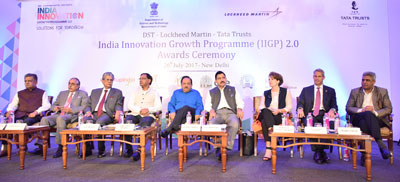 NEW DELHI, July 26: The winners from the University Challenge and Open Innovation Challenge of the India Innovation Growth Programme 2.0 (IIGP 2.0) were announced in New Delhi today. Over 1300 applications for innovative ideas across social and industrial sectors were received. NEW DELHI, July 26: The winners from the University Challenge and Open Innovation Challenge of the India Innovation Growth Programme 2.0 (IIGP 2.0) were announced in New Delhi today. Over 1300 applications for innovative ideas across social and industrial sectors were received.
From the more than 1300 applications, 50 innovators were invited to participate in a week-long advanced training session covering the basic principles of product commercialization, readiness for market, business models, intellectual property rights and competitive positioning by faculty members from the Indian Institute of Ahmedabad(IIM- A).
The India Innovation Growth Programme 2.0 (IIGP 2.0) made up of Tata Trusts along with founding stakeholders the Department of Science and Technology (DST) and global security and aerospace company Lockheed Martin, display a renewed focus on innovations addressing socio-economic challenges. The newly enhanced programme is joined by new partners ,Massachusetts Institute of Technology, Indian Institute of Management at Ahmedabad and Indian Institute of Technology Bombay, in addition to the on-going support and partnership from FICCI and IUSSTF.
Following presentations on their ideas in front of an esteemed judges panel, 10 innovators were declared winners of the IIGP award for 2017. This includes a certificate and a cash award of INR 10 lakh each to winners of the University Challenge and up to INR 25 lakh each to winners of the Open Innovation Challenge as Upspeed Funding.
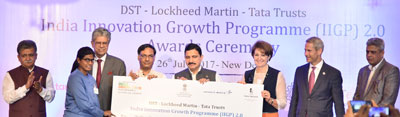 The winning innovations of IIGP 2.0, 2017 provide technologies that can facilitate the promising missions of the government of India, including, Swachch Bharat – Clean India, Green India, Make in India, Digital India, and the recently adopted Healthy India. The IIGP through its past and present winners is striving to strengthen these flagship government initiatives by being a technology enabler. The winning innovations of IIGP 2.0, 2017 provide technologies that can facilitate the promising missions of the government of India, including, Swachch Bharat – Clean India, Green India, Make in India, Digital India, and the recently adopted Healthy India. The IIGP through its past and present winners is striving to strengthen these flagship government initiatives by being a technology enabler.
“Through the India Innovation Growth Programme, we challenge innovators to bring forth ideas and innovations that will shape India’s industrial future,” said Lockheed Martin Chief Technology Officer Keoki Jackson. “This is a tremendous partnership between government, academia and industry as well as a primary example of how we are supporting Make in India’s goal to position the country as a hub for global manufacturing.”
“Tata Trusts have epitomised for over hundred years the concept now recognized as Corporate Social Responsibility. Innovation in technology and its solutions is crucial in the Trusts’ quest to scale and enhance the reach and execution of its programmes. The Trusts bring to IIGP 2.0 their strong interest in innovations that have an effective and durable impact on social change.”Padma Shri V. R. Mehta, Trustee, Tata Trusts.
Congratulating the IIGP winners, Harkesh Mittal, Adviser, Member Secretary, National Science & Technology Entrepreneurship Development Board (NSTEDB), Department of Science & Technology, Government of India said, “the technologies on display during the competition ensure us that India is sitting on a goldmine of talent.
Through IIGP, we hope to inspire a new wave of technological development and find solutions to problems facing India and the world.”
IIGP 2.0 has also been supported by the Department of Industrial Policy and Promotion (DIPP) through Startup India. They will be registering fifty startups that are part of the final stage of IIGP. The IIGP 2.0 is the only public-private partnership of its kind that will invest in social and industrial innovations, train innovators in world-class commercialization strategies, offer support for incubation and assist in business development, ultimately taking ideas and Indian technologies into the global marketplace. The programme will enable entrepreneurs to develop science and technology-based solutions for the benefit of the society.
No girls allowed: Japan’s men-only island gets UNESCO nod
TOKIO, July 10: A men-only island in Japan where women are banned and male visitors must bathe naked in the sea before visiting its shrine, has been declared a UNESCO World Heritage site.
The tiny landmass of Okinoshima is permanently manned by a Shinto priest who prays to the island’s goddess, in a tradition that has been kept up for centuries.
Limited numbers are permitted to land on the island in the Sea of Japan (East Sea) -- this year it was 200 -- for a yearly festival that lasts just two hours, but they must adhere to strict rules.
Most importantly, they must be men, but they must also strip off and take a purifying dip in the ocean before they are allowed to set foot on the sacred ground of the shrine.
Despite its inscription on UNESCO’s World Heritage list -- often the prelude to a leap in tourist numbers -- shrine officials say they are now considering banning future travel for anyone apart from priests, partly out of fears the island could be “destroyed” by too many visitors.
“The island has sometimes been said to ban women, but in principle anyone but the priests who pray there for 365 days a year is barred from entering,” said a spokesman.
The ban on female visitors specifically “has nothing to do with discrimination against women,” according to the official.
It is considered dangerous for women to travel by sea to get to the island and the shrine will not change the centuries-old rule, he said.
“It is meant to protect women, the birth-giving gender,” he added.
The island, which sits off the northwest coast of Kyushu, the southernmost of Japan’s four main islands, was an important window for foreign trade in Japan since ancient times, forming part of a trade route that linked the archipelago to the Korean peninsula and China.
Thousands of gold rings and other valuable items have been found there.
“These treasures are believed to have been offered to the gods in order to pray for national prosperity and the safety of marine traffic,” says the website of Munakata Taisha, the shrine which owns Okinoshima.
UNESCO’s heritage committee considered 33 sites for the prestigious status at its annual gathering in Poland.
On Sunday it also accepted Taputapuatea, a portion of the “Polynesian Triangle” in the South Pacific thought to be the last part of the globe settled by humans, to the list.
It also added Britain’s Lake District -- muse for artists from William Wordsworth to Beatrix Potter -- and the Valongo wharf in Rio de Janeiro where slaves from Africa first arrived in Brazil.
UNESCO’s World Heritage list includes over 1,000 sites, monuments and natural phenomena that are of “outstanding universal value” to humankind.
It includes treasures such as Australia’s Great Barrier Reef, the Taj Mahal in India, and the rock-carved city of Petra in modern-day Jordan.
Happy Birthday Dalai Lama
MUMBAI, July 6: Katrina Kaif on Thursday expressed love and respect to the Dalai Lama on the occasion of his 82nd birthday. The Jagga Jasoos actor took to Facebook to post a photograph of herself with the Dalai Lama.
In the caption, she shared a quote by him and wrote: “Man. Because he sacrifices his health in order to make money. Then he sacrifices money to recuperate his health. And then he is so anxious about the future that he does not enjoy the present; the result being that he does not live in the present or the future; he lives as if he is never going to die, and then dies having never really lived.
“Words that will always ring true only love and immense respect for his holiness on his birthday,” she added.
The Dalai Lama, revered by the Tibetans as a “living god”, celebrated his birthday in Leh.
Born on July 6, 1935, at Taktser hamlet in northeastern Tibet, the Dalai Lama was recognised at the age of two as the reincarnation of the 13th Dalai Lama, Thubten Gyatso.
|


