


United Nations
|
UN Secy Gen Ban condemns Wagah terror attackBy Deepak Arora UNITED NATIONS, Nov 3: The UN Secretary-General, Ban Ki-Moon, has condemned in the strongest terms the terrorist attack that took place on Sunday on the Pakistani side of the Wagah border crossing with India. He expresses his condolences to the families of those killed in the attack and to the people and Government of Pakistan and wishes those wounded a quick recovery. Such terrorist acts are not justifiable under any circumstances. The Secretary-General urges the Pakistani authorities to bring those responsible to justice. India re-elected to UN Economic and Social Council
The 193-member UN General Assembly elected 18 members of the UN Economic and Social Council (ECOSOC) to serve a three-year term beginning January 1, 2015. India was competing in the Asia-Pacific group, in which election was held for three seats. India's term at ECOSOC was scheduled to end this year and it was re-elected after getting 183 votes, the highest in the Asia Pacific group, followed by Japan and Pakistan with 181 votes each. A country required two-thirds majority of 124 to win a seat in the elections. The win comes just a week after India got re-elected to the 47-nation UN Human Rights Council (UNHRC) for the period of 2015-17. India's current term at the human rights body was due to end on December 31, 2014. India had competed in the Asia-Pacific group in which four seats were up for election and it received 162 votes, the highest number in the Asia-Pacific group. Following the human rights council elections in the General Assembly, India's Ambassador to the UN Asoke Mukerji had said that through the election victories, India has consistently proved that in the UN family, its standing is a "high one". He had said the re-election win is a "useful indicator" to show that "what India stands for in the international community is not only a perception of India but is backed-up by a vast majority of the UN membership." In this context, Mukerji had underscored the importance and need for implementing the long-pending reform of the UN Security Council by the 70th anniversary of the world body next year. The other 17 members to be elected to ECOSOC apart from India were Argentina, Austria, Brazil, Burkina Faso, Estonia, France, Germany, Ghana, Greece, Honduras, Japan, Mauritania, Pakistan, Portugal, Trinidad and Tobago, Uganda and Zimbabwe. Of the 18 elected, Austria, Burkina Faso, France, Germany, Greece, India, Japan and Portugal were re-elected. India re-elected to UN Human Rights CouncilBy Deepak Arora UNITED NATIONS, Oct 21: India has been re-elected to the United Nations Human Rights Council (HRC) for the term 2015-2017 in a keenly contested election held Tuesday at the ongoing 69th session of the UN General Assembly in New York. Other countries in the fray were Bangladesh, Indonesia, Thailand and Qatar for four seats in the Asia-Pacific Group. India secured the highest number of votes (162). India is currently a member of the 47-nation UN Human Rights Council and its term will end on December 31 next. The Council members are elected for a period of three years by the majority of members of the General Assembly through direct and secret ballot. They have the ability to discuss all thematic human rights issues and situations that require its attention throughout the year. Last year, the General Assembly had elected 14 countries, including China, Saudi Arabia and Russia to serve on the Council. According to the Council website, the General Assembly takes into account the candidate states' contribution to the promotion and protection of human rights, as well as their voluntary pledges and commitments in this regard. While members of the Council serve for a period of three years, they are not eligible for immediate re-election after serving two consecutive terms. The Council's membership is based on equitable geographical distribution, with 13 seats each for African and Asia-Pacific states, eight seats for Latin American and Caribbean states, seven for Western European and other states and six for Eastern European states. UN has only pledges, no money to fight Ebola
The trust fund has received pledges of about $20 million from various governments, but only $100,000 in actual cash deposits. U.N. chief Ban Ki-moon appealed to the international community to provide the billion dollars that will enable the U.N. and partners to “get ahead of the curve” and meet the target of reducing the rate of transmission by December 1. The U.N. Chief told reporters here on Thursday that the trust fund requires $1 billion for the U.N. operation to tackle the epidemic and while countries have made pledges of 20 million dollars, “our bank account has only a hundred thousand dollars. This is a very serious problem,” he said. The $100,000 in actual cash deposits has come from only one country — Colombia. “Ebola is a huge and urgent global problem that demands a huge and urgent global response. Dozens of countries are showing their solidarity. But we need to turn pledges into action. We need more doctors, nurses, equipment, treatment centres and medevac capacities,” he said as he called on the international community to step up its efforts to respond to the Ebola crisis. He said pledges must be into action, while the United Nations health agency warned of continuously deteriorating situation in Guinea, Liberia and Sierra Leone. Mr. Ban’s call to action echoes the stark warning issued to the Security Council last week by head of the U.N. Mission for Ebola Emergency Response (UNMEER) Anthony Banbury, who said the world must move quickly to ensure that at least 70 per cent of all people infected with Ebola are getting treatment by December 1, and that 70 per cent of all burials occur without contamination by that date. Failing to reach those targets would mean “we fail entirely. With each passing day...the number of people infected grows exponentially,” Mr. Banbury said. The latest figures from the U.N. World Health Organization (WHO) indicate a total of 8,997 cases in seven countries — Guinea, Liberia, Nigeria, Senegal, Sierra Leone, Spain and United States and 4,493 deaths. The disease has taken its toll on healthcare workers, with 427 infected and 236 dead. Ebola escalation could trigger major food crisis
On the eve of World Food Day on Thursday, UN agencies and non-governmental organizations are scrambling to scale up efforts to avert widespread hunger. "The world is mobilizing and we need to reach the smallest villages in the most remote locations," Denise Brown, the UN World Food Program's regional director for West Africa, said in a statement Wednesday. "Indications are that things will get worse before they improve. How much worse depends on us all." WFP has said it needs to reach 1.3 million people in need in hardest-hit Liberia, Sierra Leone and Guinea. So far, the UN agency has provided food to 534,000 people, and it expects to reach between 600,000 and 700,000 this month, Bettina Luescher, WFP's chief spokesperson in North America, told AP. "And we are working hard to reach and scale up to 1.3 million eventually." WFP is providing food to patients in Ebola treatment centers, survivors of the virus who have been discharged, and communities which have been quarantined or have seen widespread transmission, including the families of those affected. It is also helping with logistics and is managing the UN Humanitarian Air Service between the three affected countries and nearby Dakar, Senegal and Accra, Ghana to help humanitarian workers rapidly deploy to the field. "We are assessing how families are coping as the virus keeps spreading," Luescher said. "We expect to have a better understanding of the impact of the Ebola outbreak on food availability and farming activities by the end of October." WFP said its first survey using mobile telephones showed that people living in the Kailahun and Kenema districts of Sierra Leone - where most Ebola cases have been reported - are finding it harder to feed their families than people in other parts of the country and are resorting to more desperate measures to cope. More than 80% of people in those areas said they ate less expensive food, and 75% reported that they have reduced the number of daily means and were serving smaller portions. Kanayo Nwanze, president of the UN International Fund for Agricultural Development, said Monday that up to 40% of farms have been abandoned in the worst-affected areas of Sierra Leone and there are already food shortages in Senegal and other countries in West Africa because regional trade has been disrupted. He said preliminary reports suggest that "trade volume in these markets is half of what it was at this time last year." Andrea Tamburini, CEO of the non-governmental organization Action Against Hunger which operates in the hardest-hit West African countries, said in an interview Wednesday that his two main concerns are the spike in food costs and the shortage of manpower due to restrictions on movement. This has led to farmers abandoning their crops to seek refuge in locations considered less exposed to the Ebola virus, he said. The UN Food and Agriculture Organization said that in Lofa County, the worst affected rural county in Liberia, the price of food and other commodities increased from 30% to 75%, just in August. Action Against Hunger said the price of cassava - a key staple - increased by almost 150% in the Liberian capital, Monrovia, during the first week in August. Tamburini said his organization will be running a survey to watch malnutrition rates but giving farmers "seeds and tools will definitely be there as a first step." The Famine Early Warning Network known as FEWS NET said in an Oct. 10 report that if the number of Ebola cases reaches 200,000-250,000 by mid-January, large numbers of people in the three worst-affected countries would face moderate to extreme food shortages. FEWS NET said that in this scenario, traders' fears of contracting Ebola and restrictions on movement would severely disrupt the availability of food on local markets, contribute to a significant drop in household incomes, and lead to food shortages at local markets. "Contingency planning for an expanded emergency food assistance response is urgently needed given that the size of the food insecure population could be two to three times higher than currently planned," it said. FEWS NET was created in 1985 after devastating famines in East and West Africa by the US Agency for International Development. It provides analysis to help government decision-makers and relief agencies plan for and respond to humanitarian crises. UN ignores Pak bid to seek intervention on KashmirUNITED NATIONS, Oct 13: Pakistan’s latest efforts seeking U.N. intervention on the Kashmir issue have failed to draw any new response from the world body which reiterated that India and Pakistan need to resolve all differences through dialogue to find a long-term solution to the dispute. Sartaj Aziz, adviser to Pakistan Prime Minister Nawaz Sharif on national security and foreign affairs, had written to U.N. Secretary General Ban Ki-moon on the recent border tension with India and sought the U.N.’s intervention, stepping up its attempts to internationalise the Kashmir issue. In the letter to Ban, Aziz said Pakistan believes the U.N. has an important role to play in promoting the objective of peaceful resolution of the Kashmir issue, including through his “good offices”. Ban’s deputy spokesperson Farhan Haq, when asked to comment on the letter seeking Ban’s intervention and his viewpoint on the issue, told reporters on Monday he would refer to a statement that was issued last week by Ban’s spokesperson in which the U.N. chief encouraged India and Pakistan to resolve all differences through dialogue and engage constructively to find a long-term solution for peace and stability in Kashmir. The Secretary-General is “concerned about the recent escalation of violence along the Line of Control between India and Pakistan. He deplores the loss of lives and the displacement of civilians on both sides,” said the statement. A war of words between the two countries over the situation at the LoC took place last week at the U.N. General Assembly where India said that it was a “matter of deep regret” that Pakistan violated the ceasefire, in which eight people were killed and several others injured. India made it clear that its armed forces are “fully ready” to respond to “provocation”. India also said that the onus of creating a positive environment for normalisation of relations is on Pakistan. The U.N. has long maintained an institutional presence in the contested area between the two countries. The U.N. Military Observer Group in India and Pakistan (UNMOGIP) observes and reports on ceasefire violations along and across the LoC and the working boundary between the South Asian neighbours in Jammu and Kashmir, as well as reports developments that could lead to ceasefire violations. India has however always maintained that UNMOGIP has “outlived its relevance” and has “no role to play whatsoever” on the issue. Indian cop wins UN’s International Female Police Peacekeeper AwardUNITED NATIONS, Oct 14: Inspector Shakti Devi of the Jammu and Kashmir Police, who is currently deployed in the UN Assistance Mission in Afghanistan (UNAMA), has been named recipient of the International Female Police Peacekeeper Award 2014 by the UN’s Police Division for her “exceptional achievements” with the UN mission in Afghanistan, including her efforts towards helping victims of sexual and gender-based violence. Ms. Devi has been honoured for her “exceptional achievements” in leading the establishment of Women Police Councils in several parts of Afghanistan, the UN Police Division said in a communication to the Indian mission. It said Ms. Devi has contributed to the improvement of the status of female police and has effectively helped the police of Afghanistan move towards achieving their goals of fully adopting democratic principles of policing. “In addition, her consistent engagement in improving the service for victims of sexual and gender-based violence has led to successful investigation and prosecution,” the UN agency said. The award was delivered during the International Association of Women Police (IAWP) conference held earlier this month in Winnipeg, Canada. India is the largest contributor to UN peacekeeping operations, having contributed more than 170,000 troops in 43 out of 69 peacekeeping missions mandated by the United Nations Security Council so far. The UN also owes India $110 million, the second highest outstanding payment to any country, for costs relating to peacekeeping operations and troops. India contributes US $ 1 million to UN WomenBy Deepak Arora
This contribution constitutes the fifth installment of India's multi-year pledge to provide core predictable funding to UN Women's resources, and takes India's existing total contribution to US$ 5 million to UN Women. The cheque was received on behalf of UN Women, by Phumzile Mlambo-Ngcuka, Under Secretary General and Executive Director of UN Women. During the meeting the External Affairs Minister also reaffirmed Government of India's steadfast commitment to the goals of UN Women, including gender equality, gender mainstreaming, and highlighted the important role played by UN Women in the formulation of the post-2015 Development Agenda, including the use of ICT for Development. India is one of the founding members of the Executive Board of the UN Women, and is presently serving on the UN Women Executive Board. UN asks India, Pakistan resolve issues through talks
“The Secretary-General would call on both countries to resolve their issues diplomatically and through discussions,” Mr. Ban’s spokesperson Stephane Dujarric told reporters on Tuesday in response to a question on whether the U.N. chief can play a role in bringing about peace between the two countries. In escalating ceasefire violations that continued on Tuesday night, Pakistani troops targeted over 40 Border Out Posts and 25 border hamlets with heavy mortar shells in Jammu sector and LoC areas in Poonch district, leaving 12 people injured. It came a day after five villagers were killed and 34 injured in one of the worst ceasefire violations by Pakistan. Meanwhile, Pakistan has also lodged a protest with India on the alleged ceasefire violations and has even approached the U.N. Military Observer Group in India and Pakistan (UNMOGIP) office over the situation. India has however always maintained that UNMOGIP has “outlived its relevance” and has “no role to play whatsoever”. |
|
||||||
 UNITED NATIONS, Oct 30: India has overwhelmingly won its re-election to the UN body on economic and social issues, garnering the highest number of votes in the Asia-Pacific group.
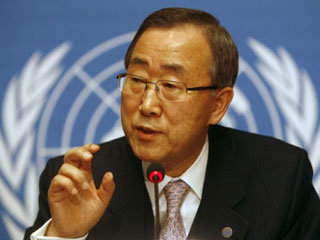 UNITED NATIONS, Oct 16: The U.N. trust fund launched for combating spread of the deadly Ebola virus has only $100,000 cash, a minuscule amount compared to the $1 billion that the world body needs to help tackle the outbreak.
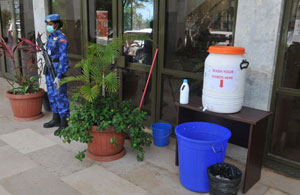 UNITED NATIONS, Oct 16: The global famine warning system is predicting a major food crisis if the Ebola outbreak continues to grow exponentially over the coming months, and the United Nations still hasn't reached over 750,000 people in need of food in West Africa as prices spiral and farms are abandoned.
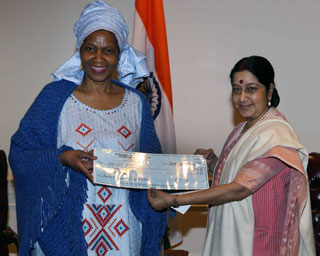 NEW YORK, Oct 1: India's External Affairs Minister Sushma Swaraj handed over on Wednesday a cheque of US$ 1 million towards Government of India's contribution to the core voluntary budget of UN Women (United Nations Entity for Gender Equality and the Empowerment of Women) for the financial year 2014- 2015.

Aviation
| Business | Defence | Foreign
Affairs | Communication | Health
| India | United Nations
India-US
| India-France | Entertainment
| Sports | Photo Gallery |
Tourism | Advertise with Us
| Contact Us
© Noyanika International, 2003-2009. All rights reserved.