


United Nations
|
Modi calls for global convention on terrorBy Deepak Arora
Addressing the UN General Assembly, the Prime Minister made a global call for cooperation on terrorism and called for the world body to speedily adopt a comprehensive international convention of terror, so that no country could differentiate between "good terrorism and bad terrorism." Modi also spoke of India's 'push for peace' in the region, saying he wanted "serious dialogue" with Pakistan in an "atmosphere free of violence." In a speech in Hindi that lasted half an hour, Modi avoided a direct retort to Pakistan Prime Minister Nawaz Sharif's harsh language at the UNGA on Friday, choosing instead to call on Pakistan to understand its own duty in creating an atmosphere for talks. India has already made a formal protest against the speech with its 'right' to reply' in the UNGA on Friday, calling Sharif's speech "objectionable." He said Pakistan must create atmosphere for serious dialogue away from shadow of terror. In his speech, Modi stuck to a more restrained line, adding that the focus of the Indian government, when it came to Kashmir, was on providing relief to the victims of the recent floods there. "Not just in India, but we have offered help with whatever means we have to those affected by the floods in Pakistan as well." The PM made a more detailed reference to terrorism worldwide, saying that while India has faced terrorism for years, the world is now coming to terms with its effects. In a possible reference to the US-led coalition against ISIS that doesn't include Iran or Syria, Modi said "everyone must be included in a global fight against the terror we see in west Asia." Modi's concerns about a "double standard" on dealing with terrorism are significant, given that this will be a major topic for discussion with U.S. President Obama on Monday, when the US is expected to ask India to join the coalition of 40 countries against ISIS. Despite his tight schedule, Modi also held an impromptu meeting with New Jersey Governor Chris Christie, a conversation with a casually-attired former New York Mayor Michael Bloomberg, and delivered a second public address the same day in New York's Central Park at the Global Citizens Festival for ending worldwide poverty. Following his "neighbours first", policy Modi held conversations with three leaders of South Asian countries, in the process winning their support for his proposal to create an International Yoga Day. Touching upon a wide range of regional issues of concern Modi found time to discuss the plight of incarcerated Indian fisherman in Sri Lanka with the country's President Mahinda Rajapaksa, to whom the Prime Minister also flagged the question of environmental damage stemming from bottom trawling. With Bangladesh's Sheikh Hasina, Modi brought up both the land boundary agreement, which he assured her was being taken up for discussion and subsequent action in the Indian Parliament, and the Teesta waters conundrum, which the Prime Minister identified as a sensitive issue that needed a consensus-based approach even though at the present time the water flowed unimpeded by India. In discussions with Nepal Prime Minister Sushil Koirala, Modi said that India stands ready to provide all assistance that Nepal will need in the conduct of the forthcoming SAARC summit in November. Ban thanks India for contribution to UN peacekeeping efforts
Modi met Ban ahead of his maiden address to the U.N. General Assembly and the two leaders discussed regional issues as well as climate change. "The Secretary-General expressed his admiration for the Prime Minister's focus on improving the socio-economic well-being of all Indian people. They discussed climate change and the need to address this challenge. "The Secretary-General thanked India for its significant contribution to United Nations peacekeeping operations. They also discussed regional issues," Ban's spokesperson said in a statement. External Affairs Ministry Spokesperson Syed Akbaruddin told newsmen that the two leaders discussed issues like imminent reforms in the U.N. and the need to involve countries contributing peace troops in the decision making process of the multilateral institution. Modi made a strong pitch before Ban for the U.N. reforms before its 70th anniversary next year, Mr. Akbaruddin said. BRICS Foreign Ministers call for early UN SC reformsBy Deepak Arora
At a meeting here on the margins of the 69th session of the United Nations General Assembly, the Ministers recalled that 2015 is the 70th anniversary of the founding of the United Nations and of the end of the Second World War. They supported the UN to initiate and organize commemorative events to mark and pay tribute to these two historical moments in human history, and reaffirmed BRICS members' commitment to safeguarding a just and fair international order based on the UN Charter, maintaining world peace and security, as well as promoting human progress and development. The Indian delegation at the BRICS meet was led by External Affairs Minister Sushma Swaraj. The Ministers supported the UN Security Council resolution of September 24 on foreign terrorist fighters and called on the international community to cooperate in efforts to address the threat posed by the foreign terrorist fighters, including by preventing their recruitment, movement across borders and disrupting their financial support. They called upon the Israeli and Palestinian sides to do their utmost to preserve the ceasefire regime and to reach a steady truce in the Gaza Strip as well as to prevent further recurrences of the use of force. They highly appreciated the role played by Egypt in the cessation of hostilities. The BRICS member states expressed their support for the immediate resumption of negotiations between the Israelis and the Palestinians based on international law and relevant United Nations resolutions with the final aim of an independent, viable and contiguous Palestinian State based on the 1967 borders and living side by side in security and peace with Israel and all its neighbours. They called upon the international community, in particular the United Nations Security Council, to intensify its efforts towards the realization of this goal. They voiced concern over the grave humanitarian situation in Gaza. The BRICS member states supported Egypt and Norway's plans to hold an international donor conference on the reconstruction of the Gaza Strip in Cairo this October. The Ministers underlined that the implementation of such initiatives should be backed by prompt steps towards lifting the blockade on Gaza and promoting Palestinian reconciliation in order to restore administrative unity to the Palestinian territories on the basis of the political platform of the PLO and the Arab Peace Initiative. The Ministers welcomed the agreement reached between the two Afghan leaders and committed to support the new government of Afghanistan in pursuing the task of building a strong, developed and peaceful nation. IBSA calls for enlargement of UN Security CouncilBy Deepak Arora
The External Affairs Minister of India, Ms. Sushma Swaraj, the Minister of External Relations of the Federative Republic of Brazil, Ambassador Luiz Alberto Figueiredo Machado, and the Minister of International Relations and Cooperation of the Republic of South Africa, Ms. Maite Nkoana-Mashabane met in New York on 25 September 2014, on the sidelines of the 69th Session of the United Nations General Assembly. Noting that the year 2015 is the 70thanniversary of the United Nations and the 10th year following the collective mandate of the Leaders at the 2005 World Summit calling for an early reform of the UN Security Council, the Ministers agreed to intensify their cooperation for a decisive conclusion next year on reforming the Security Council with the addition of new permanent and non-permanent members. They expressed full support for each other's candidature for a permanent seat in a reformed UN Security Council. The Ministers underscored that terrorism is a grave challenge to international peace and security. They called for a comprehensive and determined international action including strengthening of international normative regime through the early conclusion and adoption of the draft Comprehensive Convention on International Terrorism to address this menace. They reaffirmed that the United Nations has a central role in coordinating international action against terrorism and urged the international community for concrete and coordinated response to terrorism, in accordance with international law. The Ministers also exchanged views on the current security situation in parts of the Middle East, Africa and other regions. They agreed that inclusive political processes are the best way to address internal conflicts. The international community, led by the UN and in conformity with the UN Charter and the principles of international law, should support inclusive political processes, rule of law and socio-economic development so that sustainable peace and security is established in conflict-ridden societies. Reiterating their commitment towards further deepening and strengthening of the IBSA Dialogue Forum, the Ministers expressed satisfaction that IBSA provides an important platform for mutual consultation and cooperation on a range of regional and global issues of mutual interest. They noted that the existing comprehensive legal and institutional framework under IBSA comprising intergovernmental interaction and People-to-People Fora for multifaceted mutually beneficial cooperation, provides a solid base to take the IBSA cooperation forward. The Ministers stressed the importance of close coordination and cooperation among IBSA countries in various multilateral fora including the UN, WTO, WIPO, G20, G24, BRICS, BASIC and so on. The Ministers emphasized the growing importance of South-South cooperation. In this context, they noted that the IBSA Fund for Alleviation of Poverty and Hunger plays an important role through sharing of developmental experience of IBSA countries for inclusive and sustainable growth and empowerment of the peoples of developing countries. They agreed that the footprint of IBSA Fund should be expanded to reach out to other countries in need of immediate developmental assistance. The Ministers also stressed the need to explore IBSA Fund projects aimed at women empowerment. UN Security Council unanimously adopts resolution condemning violent extremism
Through resolution 2178 (2014), adopted unanimously during a meeting that heard from over 50 speakers, the Council condemned violent extremism and decided that Member States shall, consistent with international law, prevent the "recruiting, organizing, transporting or equipping of individuals who travel to a State other than their States of residence or nationality for the purpose of the perpetration, planning of, or participation in terrorist acts". Expressing concern over the establishment of international terrorist networks, the Council underscored the "particular and urgent need" to prevent the travel and support for foreign terrorist fighters associated with the Islamic State in Iraq and the Levant (ISIL), Al-Nusra Front (ANL) and other affiliates or splinter groups of Al-Qaida. In that context, the Council, through the resolution, decided that all States shall ensure that their legal systems provide for the prosecution, as serious criminal offences, of travel for terrorism or related training, as well as the financing or facilitation of such activities. Member States, it also decided, shall prevent entry or transit through their territories of any individual about whom that State had credible information of their terrorist-related intentions, without prejudice to transit necessary for the furtherance of judicial processes. It called on States to require airlines to provide passenger lists for that purpose. Outlining further measures for international cooperation to counter international terrorism and prevent the growth of violent extremism, it expressed readiness to designate additional individuals for sanctions listings, and directed the United Nations counter-terrorism subsidiary bodies to devote special focus to foreign terrorist fighters, assessing the threat they posed and reporting on principal gaps in Member States' abilities to suppress their travel. "The world is witnessing a dramatic evolution in the nature of the terrorist threat," Secretary-General Ban said following the adoption. He noted that in the past year thousands of civilians -- the vast majority of them Muslims -- had been killed, maimed, sexually abused and displaced by terrorists, from Afghanistan to Somalia to Nigeria, from Iraq to Libya to Mali. More than 13,000 foreign terrorist fighters from more than 80 Member States had joined ISIL and the Al-Nusra Front as a consequence of the conflict in Syria, he said, citing the estimate of the United Nations Al-Qaeda-Taliban Monitoring Team. Such terrorism must be defeated, but in a way that avoided further radicalization and civilian deaths. That should be done through a multilateral, multifaceted strategy beyond the immediate security approach. "Over the long term, the biggest threat to terrorists in not the power of missiles -- it is the politics of inclusion," he said. Following the Secretary-General's statement, national leaders took the floor, representing Council members and other Member States to welcome the adoption of the resolution, most pledging to cooperate in a global effort to prevent a flow of fighters to ISIL and other extremist groups. Mr Obama welcomed the international, high-level interest and consensus on the issue. He added that international cooperation had already increased, with foreign fighters arrested, plots disrupted and lives saved but more capacity was needed to tackle the problem and prevent fighters from reaching Syria and slipping back over its borders. Reformed former fighters should speak out against groups like ISIL that he said betrayed Islam. The Prime Minister of Iraq expressed gratitude to all those who assisted his country but emphasized that more was needed, as Iraq was the front line against terrorism, with ISIL having slaughtered minorities and other civilians and driven hundreds of thousands from their homes. He stressed that it was not an Iraqi organization, but created through foreign funding, ideologies of hate, oil smuggling networks and foreign recruitment networks, in addition to including former Ba'ath party members. While most speakers acknowledged that a military and security approach to the international spread of terrorism was necessary in the short term, they stressed the need for a comprehensive approach that addressed marginalization, long-standing conflicts and other factors that helped attract individuals to extremism. The Foreign Minister of the Russian Federation stressed the need for consistency in fighting all terrorist groups, and said that it was important to avoid empowering them through international interventions. Syria's representative, criticizing those who had supported armed groups in his country, stated that there were no good terrorists or bad terrorists. Advocating a rethinking of international counter-terrorism strategy due to the fact that the problem was getting not better but worse, Argentina's President said that above all it was critical to ensure adherence to human rights standards in fighting the scourge and not fuel further cycles of violence, in order to avoid "feeding the monster" of terrorism. Also speaking today were the Heads of State or Government of Nigeria, France, Chad, Lithuania, Rwanda, Jordan, Chile, Republic of Korea, United Kingdom, Australia, Luxembourg, Turkey, Qatar, Bulgaria, Kenya, the former Yugoslav Republic of Macedonia, Canada, Netherlands, Morocco, Norway, Trinidad and Tobago and Belgium. Represented at the ministerial level were China, Serbia, Pakistan, Algeria, Senegal, Latvia, Denmark, Albania, Estonia, Kazakhstan and New Zealand. Also speaking were representatives of Singapore, United Arab Emirates, India, Spain, Malaysia, Sri Lanka and Egypt. The President of the European Council also spoke, as did the Secretary of State of the Holy See. India for decisive push to become
|
|
||||||
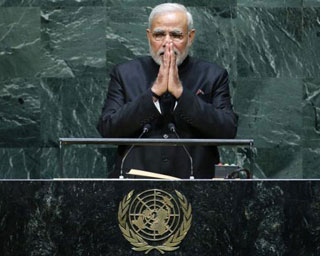 NEW YORK, Sept 27: On day two in New York, Prime Minister Narendra Modi on Saturday morning visited the 9/11 memorial and later addressed the United Nations General Assembly. Soon thereafter, he held a range of bilateral talks with the heads of government of Sri Lanka, Bangladesh and Nepal.
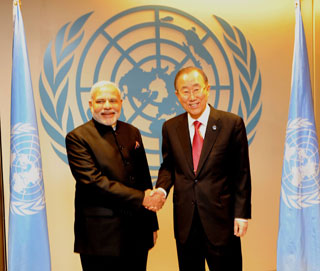 UNITED NATIONS, Sept 27: U.N. Secretary-General Ban Ki-moon has expressed gratitude to Prime Minister Narendra Modi for India's "significant contribution" to peacekeeping operations and voiced admiration for his focus on improving the socio-economic well-being of the country's people.
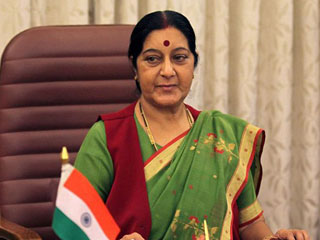 NEW YORK, Sept 26: BRICS Foreign Ministers have reaffirmed the need for a comprehensive reform of the UN, including the Security Council with a view to making it more representative, effective and efficient, so that it can adequately respond to global challenges.
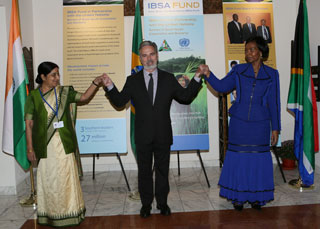 NEW YORK, Sept 25: The IBSA Foreign Ministers have underscored the urgent need for a comprehensive reform of the global institutions of political and economic governance. In this context, they stressed that the UN Security Council must be enlarged in both permanent and non-permanent categories in order to better reflect present day realities and to make it more representative, legitimate, efficient and effective.
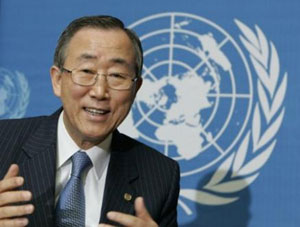 NEW YORK, Sept 25: At a Summit presided over by United States President Barack Obama, opened by United Nations Secretary-General Ban Ki-moon and addressed by scores of national leaders, the Security Council on 24 September called on all States to cooperate urgently on preventing the international flow of terrorist fighters to and from conflict zones.
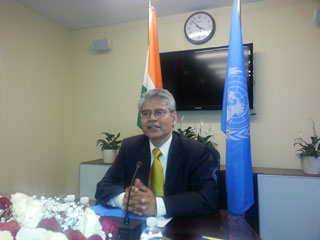 NEW YORK, Sept 23: India plans to give a decisive push to become permanent member of the UN Security Council and its expansion during the 69th session of the UN General Assembly. "India has urged the President of the UN General Assembly for a text-based process for of negotiations in the Intergovernmental Negotiations (IGN) on UN Security Council reforms," according to Ambassador Asoke Mukerji, Permanent Representative of India to the UN.
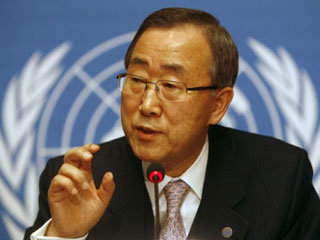 UNITED NATIONS, Sept 4: United Nations Secretary General Ban Ki-moon hopes that Indian Prime Minister Narendra Modi would participate in the key Climate Change Summit being held in New York on September 23. Ban felt this is an area where India can make important contributions.

Aviation
| Business | Defence | Foreign
Affairs | Communication | Health
| India | United Nations
India-US
| India-France | Entertainment
| Sports | Photo Gallery |
Tourism | Advertise with Us
| Contact Us
© Noyanika International, 2003-2009. All rights reserved.