


United Nations
|
UN Chief Urges Science-Based AI Rules, Warns Technology Is Outpacing GovernanceBy Deepak Arora
Speaking at a side event on the “Role of Science in International AI Governance” in New Delhi, Guterres said the world was “barreling into the unknown” as AI innovation continued to move at extraordinary speed. “AI does not stop at borders, and no nation can fully grasp its implications on its own,” he said, stressing that governments cannot afford to base AI policies on guesswork, hype or disinformation. Instead, he called for reliable scientific evidence that can be shared across countries and sectors. The Secretary-General said the United Nations is developing a practical framework for international cooperation on AI, beginning with the Independent International Scientific Panel on Artificial Intelligence. The panel is intended to assess the real-world impact of AI on economies and societies and help countries, regardless of their technological capacity, make decisions based on a common understanding of the technology. Guterres said the UN General Assembly had confirmed the 40 experts he proposed for the panel. The group will now begin work on its first report, which is expected ahead of the Global Dialogue on AI Governance in July. The panel will provide countries with a shared scientific and technical baseline, allowing them to move from broad debates about AI to practical coordination on standards, testing and risk assessment. Guterres said science-based regulation should not be viewed as a barrier to technological progress. “Science-led governance is not a brake on progress. It is an accelerator for solutions,” he said. He called for smarter, risk-based safeguards that protect people, uphold human rights and preserve human control while giving businesses greater certainty to innovate. Such an approach could also help governments identify the areas where AI could deliver benefits most quickly, while preparing for emerging risks involving children, jobs and large-scale manipulation. Guterres also warned that growing technological rivalry and strained international trust could deepen fragmentation in AI governance. Without common standards, different countries and regions could develop incompatible rules and technical requirements, raising costs, weakening safety and widening existing divides. “Science is a universal language,” he said, arguing that common approaches to testing AI systems and measuring risks could improve interoperability across borders. Shared benchmarks would also allow companies and startups to develop and scale AI systems internationally with greater confidence, while ensuring that safety standards travel with the technology. But Guterres stressed that science must inform decisions, not make them. He called for meaningful human oversight in high-stakes areas such as justice, healthcare and credit. Clear accountability must also remain in place so responsibility is not handed over to algorithms. People, he said, should be able to understand how important decisions are made, challenge those decisions and receive clear answers. Guterres concluded with a direct message to governments, scientists and the technology industry: “Less hype. Less fear. More facts and evidence.” With science guiding international cooperation, he said, AI can become a reliable tool for advancing the Sustainable Development Goals rather than another source of uncertainty. Modi, Guterres Discuss AI, UN Reform and a More Inclusive Multilateral Order
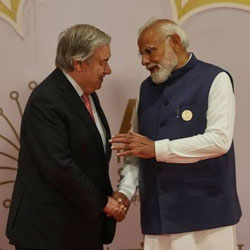
The meeting took place on the sidelines of the AI Impact Summit, which brought global attention to the opportunities and challenges posed by rapidly developing AI technologies. Guterres congratulated Modi on organizing the summit and expressed his appreciation for India's cooperation with the United Nations. The UN chief has backed efforts to make AI more accessible and human-centric, particularly for developing countries. Modi, in turn, welcomed Guterres' initiative to establish the Independent International Scientific Panel on Artificial Intelligence and appreciated his support for developing countries in global AI discussions. India has been pushing for a more inclusive approach to AI, with technology seen as a tool for development rather than a source of widening global inequalities. The two leaders also exchanged views on major international developments and the future of the multilateral system. According to the Indian government, they discussed the need for a multipolar world that reflects present-day global realities and underlined the importance of urgent reform of the United Nations, particularly the UN Security Council.
AI was a major focus of the broader discussions during Guterres' visit to New Delhi. At the AI Impact Summit, the Secretary-General warned that technological development was moving faster than the world's ability to understand and regulate it. He called for international cooperation based on scientific evidence rather than hype or disinformation. Guterres has also advocated common international approaches to assessing AI risks and testing AI systems, arguing that shared standards can help countries cooperate while giving businesses greater certainty. Modi has similarly emphasized the need for AI to be inclusive and focused on human welfare. During the meeting, he reiterated India's MANAV Vision for AI and highlighted technology's role as a catalyst for development. The meeting also highlighted the broader relationship between India and the United Nations. Guterres' appreciation for India's cooperation comes as New Delhi seeks a larger role in shaping global rules on emerging technologies and in reforming international institutions. The two leaders' discussions therefore went beyond AI. They touched on a larger question facing the international system: how global institutions can adapt to a world that is becoming more technologically advanced, economically interconnected and politically multipolar. Modi also wished Guterres well for the remainder of his tenure as UN Secretary-General. India Finally Joins List of Countries Condemning Israel's West Bank ExpansionUNITED NATIONS, Feb 19: India has joined the over 100 United Nations member states which have condemned Israel’s de-facto expansion into the occupied West Bank. The Palestinian Mission to the UN has posted the joint statement by the countries and three global groupings – League of Arab States, Organization of Islamic Cooperation, and European Union – on its social media accounts. Nation states which have signed the statement include Afghanistan, Algeria, Andorra, Australia, Austria, Bahrain, Bangladesh, Belarus, Belgium, Bosnia and Herzegovina, Brazil, Brunei, Burkina Faso, Canada, Chad, Chile, China, Colombia, Cuba, Cyprus, Democratic People’s Republic of Korea, Denmark, Djibouti, Dominican Republic, Egypt, El Salvador, Estonia, Finland, France, Germany, Greece, Guyana, Iceland, India, Indonesia, Ireland, Italy, Japan, Jordan, Kuwait, Kyrgyzstan, Latvia, Lebanon, Liberia, Liechtenstein, Lithuania, Luxembourg, Malaysia, Maldives, Malta, Mali, Mauritania, Mauritius, Mexico, Montenegro, Morocco, Mozambique, Namibia, Netherlands, New Zealand, Niger, Norway, Oman, Pakistan, Philippines, Poland, Portugal, Qatar, Republic of Korea, Russian Federation, San Marino, Sao Tome and Principe, Saudi Arabia, Senegal, Slovakia, Slovenia, Somalia, South Africa, Spain, Sri Lanka, Sudan, Sweden, Switzerland, Syria, Sierra Leone, Tajikistan, Tanzania, The Gambia, Türkiye, Uganda, United Arab Emirates, United Kingdom, Uruguay, Vanuatu, Venezuela, Vietnam, Yemen, and Zimbabwe. “We strongly condemn unilateral Israeli decisions and measures aimed at expanding Israel’s unlawful presence in the West Bank. Such decisions are contrary to Israel’s obligations under international law and must be immediately reversed. We underline in this regard our strong opposition to any form of annexation,” the statement says. Israel has been increasing construction in the occupied West Bank and clearing the last semblances of bureaucratic hurdles to ease total control over the area in recent months, but a recent decision by its government on February 15 will kickstart a land regulation process that will allow it to takeover huge tracts of land in the region. An Associated Press report notes how it paves the way for the resumption of “settlement of land title” processes, which had been frozen in the West Bank since the Mideast War in 1967. When Israel begins the land registration process for a certain area, anyone with a claim to the land must submit documents proving ownership. The Israeli anti-settlement group Peace Now is quoted by AP as having said that the process likely amounts to a “mega land grab” from Palestinians. The statement is noteworthy as even countries which have steadfastly backed Israel’s relentless strikes amounting to a genocide in Gaza – like Germany – have decried its move in the West Bank. India had not been a part of the initial list of 85 signatories but later joined the list of 100. Historically a supporter of oppressed people, India has shifted its stance in its open backing of Israel under Prime Minister Narendra Modi. In June last year, when more than three-quarters of UN member states backed a resolution calling for an immediate ceasefire in Gaza, the release of hostages by Hamas, and unimpeded humanitarian access – India had abstained, arguing that durable peace can only emerge through direct negotiations. In 2024, India had abstained from a resolution by the UN Human Rights Council that called for an immediate ceasefire in Gaza and an arms embargo on Israel. “We reiterate our rejection of all measures aimed at altering the demographic composition, character and status of the Palestinian Territory occupied since 1967, including East Jerusalem. Such measures violate international law, undermine the ongoing efforts for peace and stability in the region, run counter to the Comprehensive Plan, and jeopardize the prospect of reaching a peace agreement ending the conflict,” the joint statement of nations says. Together, the countries have reaffirmed their commitment reflected in the New York Declaration to take concrete measures, in accordance with international law, and in line with the relevant UN resolutions and the July 19, 2024 Advisory Opinion of the International Court of Justice, “to help realise the right of the Palestinian people to self-determination and to counter the illegal settlement policy in the occupied Palestinian territory, including East Jerusalem, and policies and threats of forcible displacement and annexation.” “We reiterate that just and lasting peace on the basis of the relevant United Nations resolutions, the Madrid terms of reference, including the principle of land for peace, and the Arab Peace Initiative, ending the Israeli occupation that began in 1967 and implementing the two-State solution, where two democratic States, an independent and sovereign Palestine and Israel, live side by side in peace and security within their secure and recognised borders on the basis of the 1967 lines, including with regard to Jerusalem, remains the only path to ensure security and stability in the region,” they have said. |
|
||||||
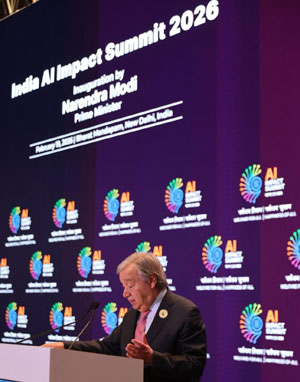 NEW DELHI, Feb. 20: United Nations Secretary-General António Guterres has called for science to be placed at the heart of global artificial intelligence governance, warning that AI is advancing faster than governments can fully understand its risks and implications.
 NEW DELHI, Feb. 20: Prime Minister Narendra Modi and United Nations Secretary-General António Guterres discussed artificial intelligence, the future of multilateralism and the need for urgent reform of the United Nations during a meeting in New Delhi on Friday.
 The discussion comes amid growing calls from developing countries for greater representation in global decision-making institutions. India has consistently argued that international institutions must better reflect the changing distribution of economic and political power and give the Global South a stronger voice.
India-US | India-France | Entertainment | Sports | Photo Gallery | Tourism | Link Partners | Contact Us
© Noyanika International, 2003-2024. All rights reserved.