


United Nations
|
India hopes to meet high expectations on UNSC: PuriNEW YORK, Aug 1: As India assumes the month-long presidency of the UN Security Council, the international community has "very high expectations" from it, according to Hardeep Singh Puri, New Delhi's envoy to the United Nations. Puri said India will conduct itself with "political maturity, dignity" and in a manner which enhances the prestige of the Security Council and which serves the overall interest of the UN. "More than India, rest of the international community has very high expectations from India's presidency of the Council. "Not only will we meet those expectations but after we are through with the presidency... people will say here is a country which truly deserves to be a permanent member" of the UNSC, Puri said. India, which assumed the rotating presidency of the UNSC on Monday, had last held the position in December 1992. Puri said while the presidency does give India an opportunity to focus on issues of importance to it, India will be "very realistic about what Security Council membership entails and what the presidency of the council involves". He added that India does not want to be short-sighted and immature by utilising the presidency to push forward few issues of paramount concern only to it. "The manner in which you conduct yourself in the deliberations of the Council, the kind of positions you take, the political maturity which you display not only as the member of the Council but more in the presidency, those ultimately reflect on the country's credentials". On whether the presidency will help bolster India's efforts towards a permanent seat in the Security Council, Puri said, "when a country conducts itself with political maturity and wisdom, that results in reinforcing the credentials for permanent membership and that is what India has already been doing". He noted that the actual process of Security Council expansion and reform will require traction in the General Assembly. "That is a process which we are already fully engaged in through our efforts" with various countries. He said India has deliberately set a lighter agenda for the month and while it will make suggestions, "ultimately the evolving situations in the global hot spots will determine what the Council has to deal with". UN meets again on deadly Syria crackdownNEW YORK, Aug 2: The UN Security Council was to hold a second day of talks on Syria on Tuesday after President Bashar al-Assad's tanks shelled the protest hub of Hama on the first day of the Muslim holy month of Ramadan. At least 24 civilians were reported killed across Syria on Monday, an activist said, among them 10 during protests after special evening prayers. "Ten martyrs fell and several people were wounded by gunfire from security forces during protests in several Syrian towns after the 'taraweeh' evening prayers," Syrian Observatory for Human Rights chief Rami Abdel Rahman said. He added that the day's death toll on the first day of the fasting month was 24, and that more than 150 people were taken in for questioning on Monday evening. The protests came as the UN Security Council held a first session of emergency talks on the deadly crackdown, with Western powers again demanding a condemnation of the violence, but the closed session ended with no agreement. A top UN official told the meeting that on top of 140 people reported killed in a military offensive on Sunday, 3,000 people have gone missing and 12,000 been taken prisoner since the anti-regime protests erupted in mid-March, diplomats said. Britain, France, Germany and Portugal hope to revive a formal resolution condemning Assad's crackdown, a move which will be discussed on Tuesday. Diplomats said, however, that it was more likely the Security Council would agree a statement, with no warning of UN action. The UN meeting came after Assad showered praise on his troops to mark Army Day, saying in a speech that the army had "proved its loyalty to its people, country and creed." "Its efforts and sacrifices will be admired. These sacrifices succeeded in foiling the enemies of the country and ending sedition, preserving Syria." The embattled president also visited wounded soldiers in a Damascus hospital and said "all Syrians appreciate the army," state news agency SANA reported. Climate change debate in UNSC welcome step: IndiaUNITED NATIONS: India has said discussion on climate change in the Security Council is a welcome step, but maintained that the 15-member body does not have tools to deal with the issue. Following a day-long debate in the Security Council, India's envoy to UN Hardeep Singh Puri noted that peacekeeping missions, use of force and sanctions, which the UNSC can authorise, do not fit the problems of climate change. Puri insisted that climate change needed to stay in the realm of the General Assembly and the United Nations Framework on Climate Change (UNFCCC). "We don't have a problem discussing climate change," the envoy said. "As far as action, it has to be done in the UNFCCC." "Some countries are trying to do a mandate creep," he said, describing a trend to get more issues under the belt of the Security Council. Countries like Brazil and South Africa also emphasised that the UNFCCC should remain central to addressing the issue of climate change. India, however, differed its position from China and Russia, which were fundamentally against the Council dealing with climate change. Mark Lyall Grant, UK's envoy to the UN, also noted that New Delhi has not opposed the Council's statement on the climate change in the same way as Beijing and Moscow. "India played a positive role," he said. After several revisions, the Security Council issued a statement on climate change, last night. Observers noted that its language was weakened to reach a compromise. Proposals that the Secretary-General Ban Ki-moon appoint a special representative on climate change and that he issues periodic reports on its security implications were rejected. "The Security Council expresses its concern that possible adverse effects of climate change may, in the long run, aggravate certain existing threats to international peace and security," the statement said. "The Security Council expresses its concern that possible security implications of loss of territory of some States caused by sea-level-rise may arise, in particular in small low-lying island states." A senior Indian official familiar with the behind-the-scenes negotiations said that India suggested the phrases "in the long run" and "in particular small low-lying island states" to reach a compromise. After the Security Council issued a statement on climate change, Grant acknowledged that the statement was "weak", but a "step forward in raising awareness" about the security implications of climate change. Grant noted that this was progress compared to 2007 when UK had organized the first Security Council debate on climate change but no agreement could be reached. UN condemns attack on US, French embassies in SyriaUNITED NATIONS, July 12: The U.N. Security Council is condemning "in the strongest terms" the attacks against the U.S. and French embassies in the Syrian capital, Damscus. A statement approved Tuesday by all 15 council members said the attacks damaged the embassies and injured diplomatic personnel. The council called on Syrian authorities to fulfill their obligation to protect "the inviolability of diplomatic missions" and staff as required under the 1961 Vienna Convention on Diplomatic Relations. Syria's U.N. Ambassador Bashar Ja'afari accused the United States and France of distorting and exaggerating the facts surrounding Monday's demonstrations outside their embassies. Nonetheless, he said Syrian law enforcement authorities "made every effort to ensure the safety of those embassies" and is committed to protecting embassies and diplomats. India, Pak should resolve K-issue through dialogue: Ban
Following his election as Secretary General of the United Nations for a second term, Ban indicated he was willing to help India and Pakistan find a solution to the Kashmir issue."I will have opportunities in the future as in the past... I will discuss the matter with leaders of both India and Pakistan, how we can help or how this issue could resolved peacefully through dialogue," said Ban. For several months during Ban's first term, the Kashmir Valley had witnessed immense unrest leading to protests, long curfews and many deaths. Earlier this year, India and Pakistan agreed to resume their comprehensive dialogue, with Kashmir on the agenda. Foreign Secretary Nirupama Rao is in Islamabad for two-day talks with her Pakistani counterpart Salman Bashir, during which the two sides are expected to discuss a number of issues including Kashmir. UN General Assembly Approves Second Term for Ban Ki-moon as Secretary-General
In a draft resolution adopted by acclamation, the Assembly also expressed its appreciation for Mr. Ban’s effective and dedicated service during his first term. After taking the oath of office — the current term ends on 31 December 2011 Mr. Ban said the Assembly had given him a great honour that was “beyond expression”. “By acting decisively to renew my mandate, you have given the gift of time — time to carry on the important work that, together, we have begun,” he said, adding that in the coming months, he would solicit Member States’ views and ideas in order to present a broader long-term vision at the Assembly session in September. “Together, no challenge is too large. Together, nothing is “impossible,” he promised. He listed the United Nations many accomplishments since he first took office in January 2007, namely its role in putting climate change squarely on the global agenda; making progress in nuclear disarmament; advancing global health, sustainable development and education; saving lives amid devastating natural disasters; promoting democracy, justice and human rights; creating a new dimension for the responsibility to protect; and setting up UN Women to empower women worldwide. He pledged to work as a “harmonizer and bridge-builder” among all stakeholders to uphold the United Nations Charter and lead the Organization, whose role mattered in a different and deeper way than ever before. “To lead, we must deliver results. Mere statistics will not do,” he said, stressing that the United Nations had far to go, for which decisive, concerted action was needed. “In economic hard times, we must stretch resources — do better with less. We must improve our ability to ‘Deliver as One’.” In addition, the United Nations must “do more to connect the dots among the world’s challenges, so that solutions to one global problem become solutions for all,” he said. A clear timeframe lay ahead: the target date for the Millennium Development Goals in 2015, next year’s Rio+20 Conference and the high-level meeting on nuclear safety in September. General Assembly President Joseph Deiss lauded Mr. Ban’s remarkable leadership of the Organization thus far and his success in strengthening its role and visibility through reform measures, exciting and innovative initiatives, and his constant call for respect for human rights, the rule of law and other Charter-based values. “Loyalty, discretion and conscience,” which the Secretary-General had sworn to exercise when he first took office, had been more than just words. “For the past five years, on a daily basis, they have truly guided you in your work,” Mr. Deiss said. He praised Mr. Ban for creating the Department of Field Support, the Office for Disarmament Affairs and the United Nations Entity for Gender Equality and the Empowerment of Women (UN Women), in order to achieve greater efficiency. In addition, he listed Mr. Ban’s role in implementing the Global Strategy for Women’s and Children’s Health and promoting the safe use of civil nuclear energy. He also gave Mr. Ban high marks for being extremely transparent about his activities and travel abroad, and for strongly collaborating with the General Assembly. Such ties were important, as they fostered dialogue between the Secretariat and Member States and contributed to the revitalization of the Assembly, within the Organization and on the international stage. “The task is not easy, as you know, but I assure you of the full support of the General Assembly and its Member States,” he said. Nelson Messone (Gabon), President of the Security Council, who introduced the draft resolution, also made congratulatory remarks. Ban Ki-moon to stand for new term as UN chief
Ban told a press conference he had sent a letter to UN member states to "offer, humbly, myself in consideration for a second term as secretary general of the United Nations." Ban has led the global body since January 1, 2007 and his term ends on December 31. Diplomats say that with no rival for the position, the UN Security Council is expected to give its approval and the UN General Assembly will hold a vote before the end of June. UN chief calls on world leaders to ensure nuclear safety
Ban made the call Thursday in a lecture at the International Relations Institute in the Ukrainian capital Kyiv, where he participated in conferences commemorating the 25th anniversary of the Chornobyl nuclear power plant explosion. The U.N. leader said he is calling a summit-level meeting on nuclear safety to be held in September in Geneva. He told the audience that "Nuclear safety is our common goal, our common responsibility. We have to think very seriously how we can strengthen our nuclear safety." He said it is the responsibility of all government leaders to ensure the strongest possible safety and preparedness against natural disaster. Speaking in Kiev afterwards, he warned that the recent quake damage to Japan's Fukushima nuclear plant showed that accidents like Chernobyl were likely to occur again in the future. "The unfortunate truth is we are likely to see more such disasters. The world has witnessed an unnerving history of nuclear accidents," he said at a conference, calling for a global debate on the safety of nuclear energy. "To many, nuclear energy looks to be a relatively clean and logical choice in an era of increasing resources' scarcity. Yet the record requires us to ask painful questions: have we correctly calculated its risks and costs?" he said. Ban spoke after flying to Chernobyl by helicopter, standing outside the power plant for around 20 minutes with Ukrainian President Viktor Yanukovych on a visit that he described as an "extremely moving experience." He warned the effects of climate change were likely to lead to more disasters like that at the Fukushima plant, which was damaged by a quake and tsunami in a disaster that Japan has labelled at an equal level of severity as Chernobyl. "We have seen in Japan the effects of natural disasters particularly in areas vulnerable to seismic activities," the UN secretary general said. "Climate change means more incidents of freak and increasingly severe weather (and) with the number of nuclear energy facilities scheduled to increase substantially in the coming decades our vulnerability will only grow." The UN chief's visit came after dozens of international donors gathered in Kiev Tuesday to come up with the funds needed to replace the temporary casing now protecting Chernobyl with a more permanent outer shell. But the high-profile gathering, which included the head of the European Commission and the prime minister of France, fell short of the 740 million euros sought by Ukraine. The pledged money will go to a project administered by the European Bank of Reconstruction and Development (EBRD), with part also funding a safe storage facility for spent nuclear fuel from inside the reactor. Both the new outer shell and the storage centre are due to be operational in 2015 and Yanukovych stressed Wednesday that the money pledged was enough to complete the construction of the shelter on time. "Yesterday we raised the main part of the sum. The rest, I am sure, will be gathered shortly. De facto, we have the possibility to build the new shelter to finish the construction here by 2015," he said. The EBRD said in a statement Tuesday that it would work with major donors "to close the remaining financial gap." The UN chief said he was impressed by the construction work he saw at Chernobyl. "I saw the Chernobyl command centre and the encouraging progress in building a new shelter for a damaged reactor," he said. "It was a very impressive, creative and ambitious project to shelter the damaged reactor for the coming 100 years." UN says no report of sexual abuse by security forces in J&KNEW DELHI: The UN on Wednesday said it had not come across any case of sexual abuse by security forces in Jammu and Kashmir. "We have not received any report of sexual violence in Jammu and Kashmir. So far we do not have any reports about the issue," UN Secretary General's Special Representative on Sexual Violence in Conflict Margot Wallstrom said replying to a question. Various separatists groups have been alleging incidents of sexual violence against women by security forces in the state. Asked whether UN would set up any mechanism to monitor incidents of sexual abuse in Jammu and Kashmir, she said there was no such proposal. However, she said the UN was in the process of setting up such a mechanism to monitor incidents of sexual violence in various African countries and in Columbia and Bosnia. The UN official said she has been tasked by the UN Security Council to take steps to prevent sexual violence against women in conflict zones and the world body was taking a series of initiatives to address the issue. Wallstrom said the world body is "deeply concerned" about growing incidents of sexual violence against women in various conflict zones across the globe and was taking several initiatives to ensure safety of fair sex in the troubled areas. |
|
||||||
 UNITED NATIONS, June 22: UN Secretary General Ban-Ki-moon today said the Kashmir issue needs to be resolved peacefully through dialogue between India and Pakistan, and that he would discuss with leaders of both countries on how he can help in the process.
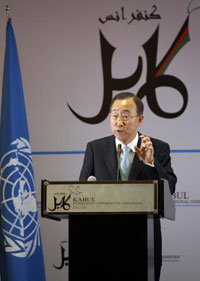 UNITED NATIONS, June 21: UN general assembly of 192 members’ countries acting on the recommendation of the Security Council, the General Assembly on June 21, 2011 unanimously appointed Secretary-General Ban Ki-moon for a second five-year term beginning 1 January 2012.

Aviation
| Business | Defence | Foreign
Affairs | Communication | Health
| India | United Nations
India-US
| India-France | Entertainment
| Sports | Photo Gallery |
Tourism | Advertise with Us
| Contact Us
© Noyanika International, 2003-2009. All rights reserved.