


United Nations
|
Momentum building up for UNSC reform: Nirupama RaoWASHINGTON, Feb 15: Appreciating President Barack Obama for his support for its quest for a permanent seat in the UN Security Council, India said the US support has come at a time when momentum is building up for the expansion of this most powerful wing of the world body. "We deeply appreciate the fact that President Obama made that declaration of support for India's candidature as a Permanent Member of the Security Council and subsequently to that we have had some useful discussion with the State Department," Indian Foreign Secretary Nirupama Rao told reporters at a news conference in Washington on Wednesday. Rao is in Washington to prepare for Secretary of State Hillary Clinton's visit to New Delhi in April. "The US support has come at a very opportune time as this campaign (of UN Security Council reform) has been gathering momentum," she said. The Indian Ambassador to the UN Hardeep Singh Puri was recently in Washington and had discussions with the State Department on this issue. "The subject of UN reform and the US support for it is obviously important because the US as a permanent member of the Security Council has made its position known on the expansion of the Security Council and on the inclusion of the countries like India. It has also supported the candidature of Japan as a permanent member," she said. Brazil, Germany, India and Japan last week revived a bid for permanent seats on the Security Council, saying they hoped for concrete action this year. "There is also a larger issue of building support on the floor of the General Assembly for expansion in both permanent and non-permanent categories of the Security Council and that is a campaign that is ongoing," Rao said. "Last week our external affairs Minister was at the UN for the meeting of the G-4 countries India, Japan, Brazil and Germany on the subject of UN Security Council reform and the stage has now been reached where we have a very large number of countries that have expressed themselves in favour of expansion of in both the permanent and non-permanent categories," Rao said. India and the United States have also been discussing on a range of other issues at the UN and co-operation on UN and multilateral matters. "There is a whole broad band of issues on which we co-operate in the UN," she said. "Today for instance we had discussion on the situation on Sudan, Ivory Coast, the issue of promoting development co-operation in continents like Africa so there are a number of issues that we are discussing within the UN itself," she said on Wednesday. The two countries are having a joint working group on UN peacekeeping which is going to meet in Delhi next month, she added. India, G4 partners begin push for UNSC seatWASHINGTON, Feb 12: India and its G4 partners – Germany, Brazil and Japan – on Friday stepped up their campaign for inclusion in an expanded UN Security Council asserting it would make the body "stronger, more representative, legitimate, effective and efficient." Krishna and his counterparts from Germany, Brazil and Japan met on Friday and conferred frequently around their exchanges as they galvanized supporters, skeptics, and borderline cases in the international community in their joint effort for seats at the big table, currently restricted to five permanent members leery of expanding to accommodate other aspirants. Krishna said they were encouraged by the "assertive and motivated" response during a meeting of the L-69, a diverse group of countries from Africa, Latin America , the Caribbean, Asia and the Pacific, which had given them the impetus to tackle the P-5, keeping France, which is best inclined towards an expansion, at the center of the efforts. "We will expand our outreach between now and April to other member states to convince them if they are not already convinced," Krishna said. "The tempo will pick up because of the overwhelming support (from L-69)." Indian officials already count the support of at least 120 countries and are confident of a Security Council reform by early 2012. In a statement after their meeting on Friday to exchange views on Security Council reform – their second time in the last six months – the G-4 countries reaffirmed their "willingness and capacity to take on major responsibilities" to maintain international peace and security, which they said they have being with distinction. Asserting their support for each other's candidature, they also reaffirmed their view of the importance of Africa to be represented in the permanent membership of an enlarged Council, a gambit clearly aimed at drawing the large number of African votes. They also reconfirmed the need for additional non-permanent members and improvement in the Council's working methods to attract others. The G-4 move is opposed primarily by the so-called United for Consensus group led by Pakistan and Italy, which claims 15 members but which Indian officials say is now down to about half-dozen. The G-4 meeting was attended by India's external affairs minister SM Krishna, Brazil's Antonio de Aguiar Patriota, Germany's Guido Westerwelle and Japan's State secretary for foreign affairs Takeaki Matsumoto. Krishna to attend high-level meeting on UNSC developmentNEW YORK, Feb 3: External Affairs Minister S M Krishna is expected to attend a high-level meeting on peace, security and development at the UN Security Council on February 11 during which he would also push for India's quest for a permanent seat in the top UN organ. The meeting is being organised by the Brazilian delegation that holds the presidency of the Council for this month. "We have received confirmation from minister of foreign affairs of several delegations," Maria Luiza Ribeiro Viotti, Permanent Representative of Brazil, told journalists Wednesday. She said Portugal, India, Germany, Colombia, Gabon and Bosnia have confirmed their participation. "We would like to emphasize a theme that is very dear to developing countries," Viotti said. "We would like to take this broader view on peace and security and explore the inter-linkages between security and development." Brazilian Foreign Minister Antonio Patriota will preside over the meeting, which will be briefed by Secretary-General Ban Ki-moon and Sarah Cliffe, the Director for the World Development Report on Conflict, Security and Development at the World Bank. "The idea," Viotti said, "is to take a more comprehensive approach to the issues of peace and security keeping in mind that many conflicts have an underlying cause that is sometimes related to issues of poverty, social inequalities and problems of youth and unemployment." The Indian mission at the UN was not able to provide details of Krishna's trip but he is expected to push India's agenda for Security Council reform as countries get ready to negotiate on a text containing several options, which has been prepared by Afghanistan's envoy to the UN, Zahir Tanin, who is also the chair of the reform discussion. Issues like how many new permanent seats should be added and who should get those seats in the Security Council, have been discussed for almost two decades. Indian officials, however, have reiterated that ongoing "text based negotiations" are bound to produce results. There are currently 15 members on the Security Council five permanent (Britain, China, France, Russia, United States), which have veto power and 10 non-permanent members that are elected for a two year terms. Several countries including India, Brazil, Germany, Japan and South Africa want to become permanent members. Options include the expansion of permanent and non-permanent seats. It has also been suggested that the new permanent members may not be given veto power to start with but after a review period. During his trip to India in November, US President Barack Obama endorsed India's place on the Council but since then the US officials have indicated that actual change could still take time. "It is complicated by the fact that there are very different views among member states and so the reality is that this will continue to be a complex and potentially lengthy negotiations," Susan Rice, US envoy to the UN, said in November, last year. A senior Indian diplomat, however, said that none of the current permanent members were opposed to India's place on the Council. Speaking on condition of anonymity, he added that reform was coming fast in the next six months to two years before India's current term as a non-permanent member ends. Reform, the official insisted, did not hinge on the consent of the permanent five members. Rather, it was inevitable. US needs to have very close dialogue with India,China: UN chief
"We know that the United States is the single most important and most powerful country in the world. But reality is that there are many emergent countries like China, and India, and even my home country South Korea," Ban said. "They are all making remarkable economic and democratic progress. Therefore it is very important for the United States as one of the most important member states of the United Nations to have a very close dialogue and close corporation with countries like China and India," the UN Secretary General said. Maintaining that the US is the most important partner of the United Nations, he said, therefore, it has been his policy to have a very close relationship and cooperation with United State, the host country. "I have been working with both Republican and Democratic Congress... I will continue my cooperative relationship with them," Ban said. India elected Chairman of UNSC counter-terrorism committee
Elected for a two-year term, Mr. Puri would chair the UN Security Council Counter-Terrorism Committee. He replaces Ertugrul Apakan, Ambassador and Permanent Representative of Turkey, whose term expired on December 31, 2010.
It was established in the wake of the September 11 terror attacks in the United States. The Indian Ambassador has been elected as chairman of the Working Group of the UN Security Council on individuals, groups or entities involved in or associated with terrorist activities and possible compensation for their victims, established by its resolution no 1566 of 2004. The post was again vacated by the Turkish Ambassador. Puri has been elected as chairman of the Security Council Committee concerning Somalia and Eretria established by resolutions 751 in 1992 and 1907 in 2009. The post was earlier held by Mexico. Informal discussions of the Security Council were held yesterday to discuss and finalize the agenda and programme of the 15-membered body for January. Bosnia and Herzegovinian hold the monthly rotating presidency of the UN Security Council. India, which joins the Security Council after a gap of 19 years, has said counter-terrorism would be its top priority during its two-year term. “One of our major pre-occupation is the issue of terrorism. I expect that in the coming months we would have to address that issue through the work of the Council,” Puri had said earlier. “You can expect India to play a very active role in that. This committee deals with issues like building capacities, normative rules dealing with counter-terrorism and dealing with India that is a major area of interest,” the Ambassador said. “I am not suggesting that this is something that we would do immediately on that is starting immediately as we start the work of the council. But in the coming months, we would give a very high priority to this one,” he said. UN's Ban 'appalled' by Nigeria violenceUN Secretary General Ban Ki-moon said that he was "appalled" by an outbreak of bloody attacks in Nigeria that claimed at least 39 lives. A spokesman for the UN leader said on Sunday that Ban "condemns these deplorable acts of violence, especially at a time when millions of Nigerians are celebrating religious holidays, and supports efforts by the Nigerian authorities to bring those responsible to justice." Clashes left at least one person dead and a number of houses burned in the Nigerian city of Jos on Sunday amid tensions following a series of Christmas Eve bomb attacks that killed dozens. Soldiers patrolled the streets of the central Nigerian city while authorities sought to keep the violence from further spreading after Friday's bombings. India gets UNSC seat after 19 yearsUNITED NATIONS, Oct 12: With 187 of 190 nations voting in its favour, India returned as a non-permanent member of the United Nations’ Security Council (UNSC) after 19 years on Tuesday. Of the UN’s 192 members, one nation chose to abstain while another nation’s vote was found invalid. In any case, India’s elevation to UN high table had become almost certain after it emerged as the sole endorsed candidate from the Asia region, with 53 Asian countries supporting it. India will occupy the seat from January 1, 2011 for two years. Till the end, however, despite having firmed up deals with numerous countries in advance, Indian diplomats at the Permanent Mission to the UN remained cautious. It was a hangover from the country’s two previous setbacks — in 1996 and 2006. In 1996, an overconfident India, making a similar bid, found itself defeated by a wide margin by Japan. In 2006, India backed Shashi Tharoor for UN Secretary General, but Tharoor lost out to Ban Ki-moon. Not surprisingly, External Affairs Minister SM Krishna kept ringing the country’s permanent representative to the UN, Hardeep Puri, almost every hour from New Delhi to ensure nothing was going wrong. He also rang about a dozen of his counterparts across the globe to reassure himself of their vote. This year India was not expected to face a contest since the only other official contender, Kazakhstan, withdrew from the contest in December last year. The UNSC has 15 members; five permanent and 10 non-permanent. The permanent ones are the United States, China, Russia, France and England. India certain of UNSC seatUNITED NATIONS, Oct 9: With no other country choosing to enter the contest, India is almost certain to be elected to the United Nations Security Council or UNSC next week, occupying a non-permanent seat from the Asia region on the body. While voting for the election is scheduled for Tuesday, diplomats at India's Permanent Mission to the United Nations in New York have expressed a sense of "quiet and cautious optimism" about India's chances of garnering the 128 or more votes in the UN General Assembly to secure the election. If elected, this will mark 19 years since India has been on the Council. India's Permanent Representative to the United Nations Hardeep Puri said, "Everyone has worked very hard for India. No stone has been left unturned." Other than marshalling the campaign in New York, External Affairs Minister SM Krishna's efforts during bilateral and plurilateral engagements during the UNGA in late September has helped boost India's prospects. In addition, heads of Indian missions in various world capitals have also been engaged in the process of securing votes of as many of the 192 member states of the UN as possible. Earlier this summer, 53 nations from Asia endorsed India's candidacy for the seat on the Council. If elected, India will sit on the Council starting on January 1, 2011. The two-year term will expire at the end of 2012. India will also assume the rotating presidency of the UNSC at least once during its tenure. India's path to being elected became clear after the only other nation that was a candidate for the election to that seat, the Central Asian republic of Kazakhstan, withdrew its candidacy in late December 2009. The Security Council has 15 members including five permanent members, the P-5. Diplomats pointed out that if India does get the requisite votes in the election from the member states of the UNGA, it will be at the "same table" as the five permanent members of the UNSC or the P-5 and that will provide the country's representatives greater ability not only to showcase the role India can play on the Council but also to constructively interface with the P-5 nations. The critical issue of reform of the permanent membership of the Council seems several months from being clarified. But when it comes to the non-permanent seat, with what appears to consensus on India's candidature for seat, that could smoothen the path to achieving that objective. No UN mediation in Kashmir until both parties ask: Ban Ki-moonUNITED NATIONS, Oct 7: Secretary-General Ban Ki-moon on Thursday said the United Nations would play a role in resolving the situation in Kashmir when India and Pakistan wanted the world body to step in. "As far as this role of good offices is concerned, the United Nations normally takes that initiative when requested by both parties concerned," Ban told journalists during his monthly briefing at the UN Headquarters. "India and Pakistan, they are neighbouring countries, important nations in that region - peace and security would have important implications," he said. Kashmir Valley has been in grip of violent protests since June. "I regret the latest loss of life. I have been calling for an immediate end to violence and urge calm and restraint by all concerned," Ban said. "That is the position of the United Nations at this time." While India maintains that Kashmir is an internal matter, Pakistan asserts that it is on the UN docket and has been calling for international intervention especially from the United States. Last week, External Affairs Minister S M Krishna told the UN that Pakistan was sponsoring terrorism in Kashmir, and this later led to a strong exchange of words between the diplomats of both nations with Islamabad accusing New Delhi of sponsoring terrorism in the region. "Jammu and Kashmir, which is an integral part of India, is the target of Pakistan-sponsored militancy and terrorism," Krishna had said. On Monday, Pakistan's former president Pervez Musharraf said his country had trained militants to fight in Kashmir. "They (underground militant groups to fight against India in Kashmir) were indeed formed," Musharraf had told German magazine Der Spiegel. Reacting to Musharraf's statement, India yesterday said the former Pakistan president's assertion that his country had trained militants to fight in Kashmir only confirms what New Delhi had been repeatedly saying over the years. Majority of nations are for UNSC reforms: KrishnaUNITED NATIONS, Sept 29: India on Wednesday slammed Pakistan for sponsoring militancy and terrorism in Jammu and Kashmir and said Islamabad should not impart lessons to it on democracy and human rights. Hitting back at Pakistan a day after its foreign minister Shah Mahmood Qureshi harped on giving the Kashmiri people the right to "self-determination through plebiscite", external affairs minister S M Krishna said Islamabad must stop its state-sponsored militancy and terrorism in the state. "Jammu & Kashmir, which is an integral part of India, is the target of Pakistan-sponsored militancy and terrorism. Pakistan must fulfill its solemn commitment of not allowing territory under its control to be used for terrorism directed against India," he said in his firmly worded speech at the 65th UN General Assembly session here. Krishna said the "credible and firm action by Pakistan against terrorist groups operating from its soil is in the interest of the region as it is in Pakistan's own interest." Slamming Qureshi for his remark against Indian security forces, Krishna said, "Pakistan cannot impart lessons to us on democracy and human rights." He said India was committed to good neighbourly relations with all our neighbours, including Pakistan. Krishna, however, emphasised that "Pakistan has to live up to its commitment not to allow use of its soil by terrorists acting against India." This, he said, would significantly help reduce the trust deficit that impedes the development of better bilateral relations between our two countries. Stating that there can be no justification for terrorism just as there can be no good and bad terrorists, Krishna said it has emerged as one of the most serious threats to international peace and security. "Acts of terrorism need to be condemned by all, wherever and whenever they are committed, by whomsoever and for whatever purposes. It is important for every member state of the UN to note that it is no longer possible to run with the hare and hunt with the hounds. "To defeat this scourge, it is imperative for the global community to build on international cooperation and take concerted action against terrorists and their sponsors," he said. Speaking about the revamp of the UN, Krishna said, the world body needs "urgent reform to reflect contemporary realities and to effectively meet emerging global challenges." "The UN, with its universal membership and equality of nations, enjoys a unique legitimacy that requires it to be at the centre of international governance. We must, therefore, not just reaffirm the central role of the UN in global governance but restore and reinforce it reflecting contemporary realities," he said. Krishna assured India's commitment to the principles and purposes of the United Nations, saying the UN should be at the core of global governance and efforts to meet the challenges of collective peace, security and development. "The changes in the global geo-strategic order since 1945 have barely been reflected in the most vital of the UN's organs, charged with the maintenance of international peace and security," he said. "Developing countries contribute almost all the troops that are part of the UN's peacekeeping presence worldwide. Yet, their voice on the council's high table on decisions relating to international peace and security is barely audible," the minister said. He pointed out the example of Africa, which has no permanent member in the Security Council, though it is seized of conflicts in the continent. "An overwhelming majority of the membership expressed clear support for expansion in both the permanent and the non-permanent categories of the Council along with an improvement of its working methods. It is imperative that we take these negotiations to an early and logical conclusion." No Krishna-Qureshi meeting planned on UNGA margins: India
External Affairs Ministry sources maintained that as of now no bilateral between External Affairs Minister S.M. Krishna and his Pakistani counterpart S.M. Qureshi has been fixed even as the calendar of Mr. Krishna was still “evolving”. “One of the events is the SAARC Foreign Minister’s meeting most likely on September 28. It is expected that the External Affairs Minister and Pakistan Foreign Minister Qureshi will be attending the meeting. That is an event already has been slated at the moment. That is where things stand at the moment,” a source said. Reports from Islamabad on Tuesday claimed that India had sought a meeting between Mr. Krishna and Mr. Qureshi and Indian High Commissioner to Pakistan Sharat Sabharwal had conveyed New Delhi’s request during a meeting with Pakistan Foreign Secretary Salman Bashir. While Mr. Krishna will be in New York till September 29, Mr. Qureshi will be there till September 30. Sources here said there will be many events when the two leaders will be together, including the SAARC ministerial meeting. There are number of bilateral meeting which have been confirmed, including the U.S., Bangladesh, Belgium, Nigeria, France, Russia and South Africa Mr. Krishna will have on the margins of UNGA. There was also no meeting finalised between Mr. Krishna and the Chinese Foreign Minister so far, the sources said. While there are some confirmed bilateral meetings, some are in the process of getting confirmed and some are at uncertainty stage due to timings and availability from both sides, they said. Hope Panel will provide solutions to 50-50-50 challenge: UN
By the year 2050, the world's population will have grown by nearly 50 percent, which means 9 billion people, Ban noted, adding that by the same year global greenhouse gas emissions has to be cut by 50 percent if climate change was to be kept in check. Moon termed this as the "50-50-50 challenge". "The challenge is considerable, and extends far beyond the time-frame for the Millennium Development Goals," the UN chief said referring to the economic and social goals that need to be achieved by 2015. "We will need to provide a dignified life for 9 billion people while at the same time preserving the resources and ecosystems that sustain us," he told journalists. The 21-member panel, which met on Sunday on the sidelines of the opening week of the UN General Assembly, includes India's Environment Minister Jairam Ramesh, US envoy to the UN Susan E Rice, Australia's Foreign Minister Kevin Rudd and EU's Commissioner for Climate Change Connie Hedegaard. The panel, which is co-chaired by Finland's President Tarja Halonen and South African President Jacob Zuma, has been set up to find ways of reducing poverty and promoting sustainable development while preserving climate and natural systems. It will deliver its final report to the Secretary- General at the end of 2011. Ban will use the recommendations of the Panel to provide inputs into the preparations of the annual climate change conference-held every year, and the UN Conference on Sustainable Development to be held in 2012, also called the UN 'Rio+20' Conference. Meanwhile, Ramesh underlined that the West needed to do more to achieve sustainable development, and it "cannot be at the expense of growth in developing nations". "Sustainable development is not just a matter of livelihoods... it is also a matter of lifestyles... What happens in the US in terms of sustainability affects local livelihoods in different parts of the world," the minister said. "Instead of preaching sustainable development of livelihoods to developing countries I think that the American countries turn inward and ask themselves the question whether the lifestyle they are currently embarked on is conducive to sustainability," he added. Several concerns have been raised regarding the broad mandate of the Panel and whether it can produce any concrete results. Halonen admitted that while the global community had all the facts and figures, plans were not being implemented. "How this big ship can find a more effective road," she said, was the big question that needed to be answered. Considering the over-arching mandate of the Panel, Ramesh also said that international community needed to be "realistic" about what could be achieved, and underlined that politics remained a central component in all these discussions. "Its all very well to be ambitious but ultimately we are situated in a political systemthere is politics in the United States, there is politics in India, there is politics in Chinaboth domestic and international politics that is going to drive this agenda forward," he said. India, according to Ramesh, should be venue to host the next Panel meeting. "I'm proposing that the second meeting of this panel should be held in India sometime in April next year," he said. Ramesh, who was present at a working dinner hosted by the UN Secretary-General, will attend the Major Economies Forum (MEF) in New York on Monday. Ban shocked by Pakistan's flood disasterNEW YORK, Aug 15: UN secretary-general Ban Ki-moon has expressed shock and urged the international community to speed up the delivery of aid after visiting flood-affected areas of Pakistan. Mr Ban was visibly shaken by what he saw in some of the worst-hit areas of Pakistan's Punjab province, saying he had never seen a disaster on the same scale before. He flew over flood-affected areas and saw people living on narrow pieces of ground with their possessions and livelihoods washed away. "A heart-wrenching day for me and for my delegation. I will never forget the destruction and sufferings I have witnessed today," he said. "In the past I have visited scenes of many natural disasters around the world, but nothing like this. The scale of this disaster is so large and there are so many people in so many places in so much need." President Asif Ali Zardari said some of the estimated 20 million people affected by the floods may need help for up to two years. And he said the Pakistani military and aid officials cannot reach everyone in need. "The magnitude of the problem; the world has never seen such a disaster. It's much beyond anybody's imagination," he said. "This is a long-term affair; this is a two-year campaign. We have to consider that and keep that in mind. "For two years we've got to give them crops, fertilisers; we've got to give them seed; we've got to look after them, feed them, for two years, to bring them back to where they were. And they will still not be where they were." More than 1,600 people have been killed in Pakistan's worst natural disaster. But amid much public discussion about the effectiveness of the government's handling of the flood disaster, prime minister Yousuf Raza Gilani stressed the challenge it posed. "I want to reassure the nation that we will leave no stone unturned in the way of helping people affected by the disaster," he said. "I have firm confidence that every individual in our nation, the affluent, the civil society and our youth, will participate with enthusiasm in the process of helping flood victims." Mr Gilani said there were still flood victims to be reached. He also said that despite the unprecedented challenge of the floods, the government would continue its fight against terrorism, and it expected the world to support it "in word and deed". International aid groups are struggling to deal with the immediate needs of the flood survivors. Many of the people rescued from the floods are not being registered, so no-one really knows the true scale of the disaster. Benoit De Gryse is country director for Medecins Sans Frontieres Belgium in Pakistan. He says it is impossible to gauge the number of people in need because hunger, disease and homelessness are still unfolding. "The disaster has not finished yet. Because people ask us, 'How do you judge the impact of the disaster?' I want to say that at the moment it's impossible because the disaster is still in progress," he said. "Especially because the population is being chased; they are being chased by the water. There is no safe place for them at the moment, so that's a major challenge." Mr Ban will report back to the UN General Assembly later this week. The UN has appealed for almost $500 million in aid for Pakistan, but that is just for the next 90 days. Ban did not make any statement on Kashmir situation: U.N. office
While seeking to back the staffer who e-mailed Mr. Ban's purported comments to three journalists, Martin Nesirky, spokesman for the Secretary-General, said his office did not release a statement but a “media guidance” that was prepared by the U.N. Secretariat, and that “seems to have been taken out of context.” “There were questions. As a consequence, the Spokesperson's Office then released the media guidance, which was prepared by the U.N. Secretariat. That's all I can say on it,” Mr. Nesirky said. Media guidance is used by public relations to prepare a person with answers to questions that could be put to him. It is a convention media guidance is not treated as the person's observations until he has actually spoken what has been written for him by his media managers. The spokesperson's statement was picked up with a sense of fulfilment by the Ministry of External Affairs. The Ministry was taken aback by the Secretary-General's observations and then pressed its New York-based Permanent Mission into action. The Mission found out that Mr. Ban made no such comments. When journalists asked Mr. Nesirky how he could blame the media for twisting the content of the e-mail and whether it was due to pressure by India, he declined to take any more question. “All I can say is what I've already told you. I don't have anything further to add.” On Tuesday, India reacted angrily to Mr. Ban's observations on the unrest in Kashmir. Its Permanent Mission in New York sought a clarification from the office of the Secretary-General and was told “no such question” was raised at a press conference, nor did Mr. Ban make any such comment. When contacted the same day, the person who circulated the e-mail, Farhan Haq, claimed that Mr. Ban had indeed made the observations. “It was not a statement but remarks in answer to a question … on this topic,” he had said. UN chief concerned over Kashmir situation; calls for peace
“In relation to recent developments in Indian-administered Kashmir, the Secretary-General is concerned over the prevailing security situation there over the past month,” Farhan Haq, Mr. Ban’s spokesperson, said in a statement. “He calls on all concerned to exercise utmost restraint and address problems peacefully,” it added. Meanwhile, the Indian government said that it was aware of anti-India elements based in Pakistan provoking the people of Jammu and Kashmir with the support of certain sections of secessionist groups based in the state. Kashmir Valley has been wracked with demonstrations since June 11, which led to the police and military cracking down on protestors. Among the several victims was a 17-year-old boy who died after being hit by a police tear gas shell. The state government announced that a commission would be set up to inquire into the deaths of civilians during the recent protests. The commission will be headed by a retired high court judge and it will look into 17 incidents in which people died since June 11. The government also announced a compensation package of 100,000 rupees and government job to a member of each family. The inquiry commission is expected to report back in three months. The UN chief also welcomes the recent talks between the foreign ministers of India and Pakistan. “He encourages both sides to rekindle the spirit of the composite dialogue, which was initiated in 2004 and had made encouraging progress on some important confidence building measures, and to make renewed efforts to address outstanding issues, including on Jammu and Kashmir,” the statement said. “He (Ban) underlines the need for patience, perseverance and compromise on all sides,” it added. Mukesh Ambani in key UN group
Ambani is the only Indian to be a part of the MDG Advocacy Group that comprises eminent international personalities including Microsoft Chairman Bill Gates, philanthropist Ted Turner and Nobel laureate Muhammad Yunus, among others. He is expected to focus on a global partnership for development that will include development of an open, rule-based, predictable, non-discriminatory trading and financial system. The U.N. said the top Indian industrialist will also look at the special needs of the least developed countries (LDC) and landlocked developing countries. The MDGs are eight international development goals that all the 192 United Nations member States and at least 23 global organisations have agreed to achieve by the year 2015. These include reducing extreme poverty, reducing child mortality rates, fighting disease epidemics such as AIDS and developing a global partnership for development. The MDG Advocacy Group will support the U.N. Secretary-General Ban Ki-moon in building political will and mobilising global action, says the world body. One of the first tasks of the Group is the preparatory process for the MDG Summit in September this year. The Summit is being seen as a turning point in the collective effort to achieve the goals by the 2015 target date. Ambani is a member of the Prime Minister's Council on Trade and Industry, Government of India, and the Board of Governors of the National Council of Applied Economic Research, New Delhi. UN urges inquiry into death of Indian journalistUNITED NATIONS, July 16: Indian authorities need to look into the death of journalist Hem Chandra Pandey who was killed early July in an encounter with police in Andhra Pradesh, a top UN official said. "I am concerned about the circumstances in which Hem Chandra Pandey was killed and I urge the authorities to shed full light on the conditions under which it occurred," said Irina Bokova,Director-General of the UN Educational, Scientific and Cultural Organisation (UNESCO). Pandey, 30, who worked for several Hindi-language newspapers, was killed along with Maoist leader Cherukuri Rajkumar alias Azad on July 2. UNESCO is the only United Nations agency with a mandate to defend freedom of expression and press freedom. Pandey's wife Babita told journalists on July 4 that her husband had left for Nagpur on June 30 on assignment and been unavailable on his mobile phone since then. Shortly after the incident was reported, the International Federation of Journalists (IFJ) expressed shock and also called for an inquiry. "Hem Chandra Pandey, like any journalist, was well within his rights in seeking to interview an insurgent leader, especially in the context of ongoing peace moves," IFJ Asia-Pacific Director Jacqueline Park said last week. "The IFJ extends its solidarity to Babita Pandey and the family of the killed journalist, and welcomes the Andhra Pradesh Home Minister's announcement of a full inquiry," she added. Babita has stated that the incident was a fake encounter and has asked for a probe by the Central government because she does not trust the state authorities to be honest. Human rights groups in India and civil liberty activists have called for a central investigation. Noting that Pandey was a contributor to leading Hindi-language dailies such as Nai Duniya, Rashtriya Sahara and Dainik Jagaran, IFG said, "a portfolio of his recent writings shows a well-informed engagement with issues of wide social concern, such as inflation, food security and climate change. Nowhere does it reveal an advocacy of violence. UN Security Council slaps new sanctions on IranUNITED NATIONS, June 9: The UN Security Council voted 12 to 2 to impose a fourth round of sanctions on Iran, bringing to a close months of diplomatic efforts by the Obama administration to penalize Tehran for building a covert nuclear facility and accelerating its enrichment of uranium. Brazil and Turkey voted against the measure, while Lebanon abstained. The measure modestly reinforces a range of economic, high-technology and military sanctions against Iran, and targets more than 40 Iranian elites and companies linked to the nation's nuclear program with a travel ban and an asset freeze. India pushes for expansion of permanent seats in UNSCUNITED NATIONS, June 3: India, which is seeking a permanent berth in the UN Security Council, has said that expansion of only non-permanent seats does not constitute reform of the world body and demanded that membership be increased in both categories. In a closed-door meeting at the UN headquarters convened to discuss the negotiating text for the Security Council reform, India also pointed out that a vast majority of countries were in favour of expanding the current size of the world body's top organ from 15 to the mid-20s. "There cannot be any reform without expansion in both the categories of membership," Hardeep Singh Puri, India's envoy to the UN, said last night. "Equally, expansion only in the non-permanent category or any of its other variants does not constitute reform and is merely the perpetuation of the current inefficiency by the same ineffective means in vogue since 1963," he said. India along with Japan, Germany, South Africa and Brazil is seeking permanent membership of the Security Council. Puri's remarks came a day after a top US official said India would play a "central part" in the Security Council reform process but stopped short of publicly endorsing the country's bid for a permanent seat. "We're open to expansion of permanent membership of the Council and we believe that India's going to have a central part to play in the consideration that's going to come of that reform of the UN Security Council," Under Secretary of State for Political Affairs William Burns said. During the inaugural discussions on the UN reform, Zahir Tanin, Afghanistan's permanent representative to the UN, in his capacity as the Chairperson of the process asked member states to submit proposals that can be worked into a negotiating text, which will be the basis for future discussions. In 2009, member states of the UN had finally abandoned the 'Open Ended Working Group' (OEWG) on the issue that had dragged on for 15 years without yielding any substantive results. In March last year, the old talks were replaced by the new "inter-governmental negotiations." At the meeting in the UN headquarters, India also underlined the need for equitable geographical distribution. "India supports a Charter-based distribution of seats that addresses the lack of representation of African, Latin American and Caribbean countries and the lack of adequate representation of Asian countries in the permanent membership," Puri said. This year, India is also running for a non-permanent seat of the Council for which elections will be held in October. Puri and his team have been canvassing for the spot for the past three years. Earlier this year, Kazakhstan's withdrew from the electoral race leaving India with a clean slate for 2010-11. To win, India needs two-thirds of the General Assembly vote, which adds up to about 128 counties saying 'yes' to New Delhi's presence in the Security Council. UN Security Council convenes for emergency sessionUNITED NATIONS, June 1: UN members and officials came out in strong condemnation of Israel's attack on a humanitarian flotilla headed to the Gaza strip, with its chief Ban-Ki-moon seeking a "full explanation" from the country. The Security Council also convened an emergency meeting on Sunday to discuss a draft resolution, to call for an international inquiry into the incident and compensation for those who had been killed. "I condemn this violence," said Secretary-General Ban. "It is vital that there is a full investigation to determine exactly how this bloodshed took place. I believe Israel must urgently provide a full explanation," he said. The operations by Israeli naval commandos killed 10 activists and injured dozens others, sparking a global outrage on Monday. Israel, in turn, accused the people on board the ship of having turned on its soldiers with knives and metal rods and said the defence personnel had acted in self defence. In individual statements, the 15 UNSC members issued remarks, almost all condemning the assault. Veto-wielding permanent members France, Russia and China called for the blockade of Gaza to be lifted and sought an independent inquiry into the bloody episode. "It is clearer than ever that Israel's restrictions on access to Gaza must be lifted in line with Security Council Resolution 1860. The current closure is unacceptable and counterproductive," British Ambassador Mark Lyall Grant said ahead of the emergency session called after the deadly attack. The United States, which is Israel's main ally, regretted the loss of life but did not condemn the attacks like most of the Muslim countries and European nations. It urged Israel to undertake a domestic inquiry. "The United States is deeply disturbed by the recent violence and regrets the tragic loss of life and injuries suffered among those involved in the incident last night aboard the Gaza-bound ships," said Alejandro Wolff, Deputy Permanent US Representative to the United Nations. While the Security Council discussed a draft statement to condemn the attack, top UN officials came out strongly against the incident. "I unequivocally condemn what appears to be disproportionate use of force, resulting in the killing and wounding of so many people attempting to bring much-needed aid to the people of Gaza, who have now been enduring a blockade for more than three years," said Navi Pillay, the UN human rights chief. Turkey, which introduced the statement in the Council, demanded that Israel apologise for the act. "This is a black day for humanity," said Ahmet Davutoglu, the Turkish foreign minister. UN nuclear conference calls on India to joint NPT, CTBTUNITED NATIOINS, May 26: Breaking the tradition of not naming countries, the first draft of the final document of 2010 Nuclear-Non Proliferation Treaty Review conference has asked India, Pakistan and Israel to join NPT and CTBT. "The conference calls upon India, Israel and Pakistan to accede to the treaty as non-nuclear weapon States, promptly and without conditions, thereby accepting an internationally legally binding commitment not to acquire nuclear weapons or other nuclear explosive devices," the first draft of the document said. "The conference also calls upon India and Pakistan to maintain moratoriums on nuclear testing and calls upon India, Israel and Pakistan to sign and ratify the Comprehensive Nuclear-Test Ban Treaty (CTBT) without delay and without conditions," it said. The NPT Review Conference is held every five years to assess the progress in reaching the goals set out in the 1970 treaty to disarm and stop the spread of nuclear weapons. This year it started on May 3 and would end on May 28 when the final draft is expected. India, Pakistan and Israel have not signed the treaty and do not attend. The last conference in 2005 ended in failure. Speaking on the condition of anonymity, a Western diplomat said here that there were countries, which had accepted that India and Pakistan were not going to become part of the treaty and suggested a new track to reign them into the non-proliferation regime. "We are going to try and put them in a cooperation system with obligations so that they would have the same obligations that NPT countries without being in the NPT," he said, noting that such an agreement was better than doing nothing. Several experts, however, have pointed out that by the time the final document was prepared the names of the countries may be replaced by a more general call for the universal acceptance of the Nuclear Non-Proliferation Treaty. Officials noted that naming Israel, for instance, would lead to the country not cooperating with the Arab nations on a plan to have a Middle East free nuclear weapons free zone. "We want something so that all countries come to the table," the Western diplomat said. "But it's so fragile, it's so difficult." Mark Hibbs, an expert at the Carnegie Endowment for International Peace, who had attended the meetings noted that there seemed to be a "tacit agreement" not to retain the names by the end of the conference. ISI used LeT against India: UNUNITED NATIONS, AprIL 16: A United Nations report on Friday said the Pakistan’s powerful military-backed spy agency Inter-Services Intelligence has used militant outfit Lashkar-e-Toiba’s services to foment anti-India passion in Kashmir and elsewhere. The three-member panel concluded that such a policy of the Pakistan military to use terrorists as a tool to achieve its strategic objectives against its neighbours resulted in active linkages between elements of the military and the Establishment with radical Islamists at the expense of national secular forces. Noting that the jihadi organisations are Sunni groups based largely in Pakistan's Punjab, the 65-page report said that members of these groups aided the Taliban effort in Afghanistan at the behest of the ISI and later cultivated ties with Al-Qaeda and Pakistani Taliban groups. "The Pakistani military and ISI also used and supported some of these groups in the Kashmir insurgency after 1989. The bulk of the anti-Indian activity was and still remains the work of groups such as Lashkar-e-Taiba, which has close ties with the ISI," said the panel headed by Chile's UN ambassador Heraldo Munoz. "A common characteristic of these jihadi groups was their adherence to the Deobandi Sunni sect of Islam, their strong anti-Shia bias, and their use by the Pakistani military and intelligence agencies in Afghanistan and Kashmir," the report said. It said that while several Pakistani current and former intelligence officials told the Commission that their agencies no longer had such ties in 2007, but virtually all independent analysts provided information to the contrary and affirmed the ongoing nature of many such links. The report said Qari Saifullah Akhtar, one of the founders of the extremist Harkat-ul-Jihad Islami (HuJI), was reportedly one of the ISI's main links to the Taliban regime in Afghanistan and is believed to had cultivated ties to Osama bin Laden, who lived in Afghanistan during that period. "Akhtar's one-time deputy Ilyas Kashmiri, who had ties with the Pakistani military during the Afghan and Kashmir campaigns, had been a senior aide to bin Laden's deputy Ayman al Zawahiri," it said. "It was such links and connections between elements in the intelligence agencies and militants, which most concerned Bhutto and many others who believed that the authorities could activate these connections to harm her. Given their clandestine nature, any such connection in an attack on her is very difficult to detect or prove," the report said. Benazir's death was preventable: UNWASHINGTON DC, April 16: The assassination of the former Pakistani Prime Minister, Benazir Bhutto, was preventable and the failures of the investigation into her killing were deliberate, according to a long-awaited report by a United Nations Commission of Inquiry into the matter. The 70-page report, released on Thursday, said: “The responsibility for Ms. Bhutto's security on the day of her assassination rested with the federal Government, the government of Punjab and the Rawalpindi District Police.” However, none of these entities took the necessary measures to respond to the “extraordinary, fresh and urgent security risks that they knew she faced”. Benazir Bhutto was assassinated on December 27, 2007 as she was leaving a campaign event at Liaquat Bagh in Rawalpindi; 24 people were killed in the subsequent bomb blasts. In a damning indictment of the police and intelligence authorities charged with investigating the assassination, the U.N. report said the Rawalpindi district police's actions and omissions in the immediate aftermath of the event, including the hosing down of the crime scene and failure to collect and preserve evidence, “inflicted irreparable damage to the investigation”. Further, the Commission complained of authorities' obstruction its investigation, saying: “The Commission was mystified by the efforts of certain high-ranking Pakistani government authorities to obstruct access to military and intelligence sources, as revealed in their public declarations.” The report also said blame for the failure to protect Benazir Bhutto must be laid squarely on the federal government under Pervez Musharraf which, the Commission argued, was “fully aware of and tracking the serious threats to Ms. Bhutto, [yet] did little more than pass on those threats to her and to provincial authorities and were not proactive in neutralizing them or ensuring that the security provided was commensurate to the threats.” In conclusion, the report said it remained the responsibility of the Pakistani authorities to carry out a “serious, credible criminal investigation that determines who conceived, ordered and executed this heinous crime of historic proportions, and brings those responsible to justice.” While the U.N. Commission report was due to be published on March 30, it was delayed by two weeks, reportedly upon the request of the Pakistani authorities. India likely to get permanent seat in UNSC by 2012NEW YORK, Feb 20: Senior diplomats believe that the long-stalled expansion of the United Nations Security Council, including the addition of permanent members, could take place within the next couple of years. As India’s Permanent Representative to the United Nations Hardeep Singh Puri observed, “There is clear and discernible momentum but it has to be progressed. Things are likely to come to fruition in 2011-2012.” India is campaigning for expansion of the Council, and is one of the principal candidates for permanent membership. The campaign along with the other three nations that comprise the G-4 group, Brazil, Japan and Germany, has been revived recently after flagging over the last couple of years. What is more important is that the United States has reviewed its position on the expansion of the UNSC, and has expressed a “preference” for expansion in both categories — permanent and non-permanent. Previously, the US had not been favourably disposed towards such reform and former US Ambassador to the UN John Bolton had even been critical of the G-4 effort to secure such reform. The US has now also outlined the sort of countries that appear to fit the bill for permanent membership. Diplomatic sources said that those criteria work in India’s favour since it fulfils them. They include a growing financial, military and regional profile for potential permanent members. What is equally significant is that nearly 140 member states of the UN have also supported creating a clear document to expand the Council. If that document becomes a reality, it may well fast track the process of expansion. But some tricky issues still have to be worked out. These include the quantum of the expansion since the UNSC currently has 15 members (five permanent and ten non-permanent). The US does not want an “unwieldy” body and would like to see a number below 25 members. Indian diplomats believe that a “compromise” on the figure will be arrived at between 20 and 25 members. What could also help India’s effort to secure permanent membership of the UNSC is the likelihood that after 19 years, it may finally represent the Asia region as a non-permanent member of the Council, starting January 2011. UN panel admits new error in key climate reportNEW YORK, Feb 15: The UN climate change panel has admitted to having imprecisely stated in a key report that 55 percent of the Netherlands is under sea level, saying that is only the area at risk of flooding. The Dutch government this month asked the Intergovernmental Panel on Climate Change (IPCC) to explain the figure, used in a landmark 2007 report, saying its numbers were that only 26 percent of the country is below sea level. It was a new embarrassment for the panel. The same 938-page Fourth Assessment Report also contained an erroneous claim that global warming could melt Himalayan glaciers by 2035. The IPCC admitted in a note sent to a news agency on Sunday that the 55 per cent figure was actually the portion of The Netherlands "at risk of being flooded". It insisted that the imprecision did not affect the conclusions of the report. The figure had been used in various publications to mean "either the area below the highest sea-level reached during storms, or the total area of the country that is prone to flooding from the sea and rivers," the note said. "Therefore, a preliminary analysis suggests that the sentence discussed should end with: 'because 55 per cent of The Netherlands is at risk of flooding'." Ban concerned over Fonseka's arrest, to send envoy to Lanka
Ban conveyed his concerns to President Rajapaksa during a telephonic conversation on Wednesday night. According to a spokesperson of the UN Secretary General, Ban urged the President to respect due process of law regarding the case of the former army chief and "runner-up" in 26th January presidential elections. He called on the Sri Lankan government to guarantee personal safety of Fonseka, who was arrested on Monday for alleged "military offences." The UN chief also announced plans to dispatch his top political official to the island nation for dialogue, the UN News Centre said in New York. Ban said he would send Under-Secretary General for Political Affairs B Lynn Pascoe to Colombo for talks soon. Meanwhile, The European Union (EU) has said that it is "closely" following the situation in Sri Lanka after the arrest of Fonseka. The EU, in a statement from Brussels, called for concrete efforts to overcome the divisions of the past and moves towards genuine reconciliation. "We call on the Sri Lankan authorities to ensure that the rule of law and the safety and security of candidates and campaign workers are ensured," Spokesperson of the High Representative/Vice President of the EU Catherine Ashton said in a statement on Wednesday. "We urge the Government and all communities in Sri Lanka to make concrete efforts to overcome the divisions of the past and to move on to genuine reconciliation, without which there can be no return to long-term security or prosperity," the statement added. Over 1.2 billion dollars pledged for Haiti quake aid: UN dataGENEVA, Jan 19: More than 1.2 billion dollars have been pledged in aid funding to Haiti, which is struggling to recover from last week's deadly earthquake, United Nations data showed Tuesday. Individuals, countries, companies and international organisations have all dug deep into their pockets, while others have helped by deploying experts or sending tonnes of relief items to the country, the United Nations Office for the Coordination of Humanitarian Affairs said on its website. Ban vows to work for nuclear-free world
"I pledge to continue to do everything in my power to advance the goal of a world free of weapons of mass destruction," he said at a meeting with the key UN agencies dealing with nuclear and chemical weapons. "Today there is a new window of opportunity for disarmament and non-proliferation. I am convinced there is much we can do to achieve our common goal," Ban said at a meeting of officials from the International Atomic Energy Agency (IAEA), Organisation for the Prohibition of Chemical Weapons (OPCW) and the Preparatory Commission of the Comprehensive Test Ban Treaty (CTBTO-PrepCom). He vowed to continue building support for an action plan for nuclear disarmament and non-proliferation. The UN Secretary-General pointed out that several developments in 2009, including the "historic Security Council Summit" that discussed nuclear non-proliferation chaired by US President Barack Obama, indicated that a significant progress has been made towards attaining the goal. The summit had witnessed the passing of a nuclear non proliferation resolution and Obama committed to a new agreement with Russia to reduce nuclear war heads. The resolution called upon all states to "refrain from conducting a nuclear test and to sign and ratify the Comprehensive Nuclear Test Ban Treaty (CTBT). "Last year, we saw several encouraging developments. This year, we have much on which to build and a heavy agenda going forward," Ban said. "Building on the historic Security Council summit last September, I will encourage the Council to provide political support for the full implementation of treaty obligations and the strengthening of the treaty organs," he said. At that time, the United Nations and US Secretary of State Hillary Clinton had asked nine states including India to sign up the CTBT; however, New Delhi expressed reservations. A major event on nuclear non-proliferation will be the NPT (Nuclear Non Proliferation Treaty) Review Conference in May. "The Treaty is facing a number of challenges. A successful outcome would strengthen confidence not only in the Treaty but also for the collective global effort to achieve a world free of nuclear weapons," Ban said. "I will promote the universality of the relevant treaties and conventions," he said. Before the big event, Ban will be attending the upcoming session of the Conference on Disarmament in Geneva in January, the Global Zero Summit in Paris in February and the Summit on Nuclear Security in Washington in April. "These events will help generate momentum for the May NPT Review Conference," he said. UN releases stamp on Mahatma Gandhi
United Nations Postal Administration, the world body's postal agency, released the one-dollar stamp designed by a world famous Miami-based artist Ferdie Pacheco, with the Father of the Nation in red, blue and gold. The function was attended by several UN envoys to reiterate the influence of Mahatma Gandhi's life. "In many ways, Mahatma Gandhi previsioned the UN. Much of the work that we do in the area of human rights owes its genesis in the struggle against racial discrimination, which he focused on," Hardeep Singh Puri India's ambassador to the UN said. President of the General Assembly Ali Treki stressed upon Gandhi's commitment to communal harmony between Muslims and non-Muslims. Paying tribute to Gandhi, the US envoy to the UN Susan Rice notified the significance of Mahatma. "Gandhi had influenced millions of Americans. Gandhi believed that physical force could be turned aside by moral forces." Both, Ambassador Puri and Rice spoke of the historic trip that civil rights leader, Martin Luther King Jr, made to India in 1959 to see the country of the Mahatma. On his return Dr King wrote, "It was wonderful to be in Gandhi's land." This year, on the 50th anniversary of the journey, the US sponsored the visit of Martin Luther King III to retrace the steps of his father and mother. Quoting King "The ultimate measure of a man is not where he stands in moments of comfort and convenience but where he stands in times of challenge and controversy," Rice spoke of Gandhi's influence on the US history. "That is true of people but it is also true of nations." The UN has put on sale the envelopes marked with the stamp and the United Nations' seal on it. All over New York City, small and big events were organised to mark the birthday of the Father of the Nation. New Yorkers gathered to sing the Mahatma’s favourite songs and paid floral tributes at his statue in Manhattan. “Gandhi has to be celebrated all over the world because his message echoes around the globe,” said Consul General of India in New York Prabhu Dayal. UNSC adopts nuclear resolution, asks non-NPT states to join treatyUNITED NATIONS, Sept 24: The UN Security Council on Thursday unanimously adopted a resolution asking all non-NPT signatories to join the treaty, a controversial pact which India views as flawed and discriminatory. During an unprecedented summit chaired by US President Barack Obama, the powerful 15-member Council approved the resolution 1887 which calls on countries that have not signed the nuclear Non-Proliferation Treaty (NPT) "to comply fully with all their obligations." Obama said the resolution will strengthen the NPT. "We have made it clear that the Security Council has both the authority and responsibility to respond to violations of this treaty," he said. "Nations with nuclear weapons have the responsibility to move towards disarmament and those without them have the responsibility to forsake them," Obama said. India has refused to sign the NPT in its present format as it views the pact as discriminatory which favours the nuclear powers. "Although we averted a nuclear nightmare during the Cold War, we now face proliferation of a scope and complexity that demands new strategies and new approaches," Obama told the Council. "Just one nuclear weapon exploded in a city, be it New York or Moscow, Tokyo or Beijing, London or Paris, could kill hundreds of thousands of people," he warned. The resolution also asks all states to refrain from conducting nuclear tests and ratify the Comprehensive Test Ban Treaty (CTBT). It seeks talks on framing a treaty to ban the production of fissile material for atomic weapons and calls on non-NPT members to join it as non-nuclear states. The resolution also contains provisions to deter countries from abandoning the NPT. While refraining from making any direct reference to Iran and North Korea, both dubbed by the US as "rogue" states, it refers to Security Council resolutions asking both Tehran and Pyongyang to halt their controversial nuclear programmes. India says won't sign NPTNEW YORK, Sept 24: India has refused to abide by the UN Security Council resolution asking all non-NPT nations to sign the pact, saying it cannot accept the "externally prescribed norms or standards" on issues that are contrary to its national interests or infringe on its sovereignty." India maintained that it cannot join the NPT as a non-weapon country even as it reiterated its commitment to no testing and no-first-use besides non-discriminatory universal non-proliferation. In a letter to UN Security Council President Susan E Rice, India's Permament Representative to the UN Hardeep Singh Puri has said "India cannot accept calls for universalization of the NPT." The development came as the UN Security Council unanimously passed a resolution asking all countries which have not signed the Non Proliferation Treaty to sign the agreement. Citing Prime Minister Manmohan Singh's statement in Parliament on July 29, Puri said "there is no question of India joining the NPT as a non-nuclear weapon state. Nuclear weapons are an integral part of India’s national security and will remain so, pending non-discriminatory and global nuclear disarmament." He said India "cannot accept externally prescribed norms or standards on matters within the jurisdiction of its Parliament or which are not consistent with India’s constitutional provisions and procedures, or are contrary to India’s national interests or infringe on its sovereignty." Puri contended India cannot comply with non-proliferation obligations to which it has not provided its consent. Krishna to meet Pak minister on Sept 27
Pakistan’s action against the perpetrators of the 26/11 Mumbai terror outrage is likely to top the agenda of both meetings, though the Pakistan foreign secretary said Monday that "all issues, including terrorism and the core issue of Jammu and Kashmir, will be discussed." Krishna holds meetings on UN sidelinesNEW YORK, Sept 21: Indian External Affairs Minister S M Krishna held a few bilateral meetings with his counterparts and others who gathered in New York for the current UN General Assembly session. Mr Krishna, who arrived on Sunday night, held talks with his counterpart from Brazil Celso Amorim and South African Minister for International Relations and Cooperation Maite Nkoana-Mashabane. In the meeting the Ministers reaffirmed their commitment to multilateralism and increased participation of developing nations in decision-making in global bodies. "They reiterated the need for the UN to be reformed and so as to become more representative and reflective of the needs and priorities of the developing nations," a statement from the Permanent Mission of India to the UN said. "They committed to coordinate with each other and the broader UN membership for achieving genuine reform of the UN Security Council at the earliest," it said. League of Arab States Secretary General Amre Moussa held negotiations with Mr Krishna. The two sides discussed the latest West Asia situation and other issues of mutual concern. Chief Representative to the UN Hardeep S Puri and Joint Secretary in the Foreign Ministry Asith Bhattacharjee also participated in the meeting. During this visit, Mr Krishna will represent the Prime Minister at the Climate Change Summit being held later in the day and his address to the 64th session of the UN General Assembly on September 26. The Ministers week-long programme to the UN and New York, includes participation in meetings concerning Myanmar, terrorism and SAARC. He will also address an Indian-American community meeting on 24th September. Foreign Ministers and Secretaries of both India and Pakistan will meet on September 26 and 27 respectively. Mr Krishna is also expected to meet US Secretary of State Hillary Rodham Clinton. India lobbies hard for UNSC seat, hopes to end 18-year drought
India’s main rival for the Asia seat is Kazakhstan, which has never won a seat to the Security Council. India has already been elected six times, the last time as long ago in 1991-92, when the world was a completely different place. The last time India sat on the Council, the Soviet Union was still a country and the first US invasion of Iraq was a taste of things to come in the new world order. As a non-permanent member at the time, India had little choice but to go along with the Security Council resolution sanctioning the Iraq invasion. The Security Council consists of five veto-wielding permanent members — US, Russia, China, UK and France — and 10 non-permanent members, not allowed a veto but elected for two-year terms, from regions like Asia, Africa, eastern Europe, Latin America and the Caribbean, and western Europe. An Indian win against Kazakhstan is also aimed at wiping out the nightmare of 1996, when India fought a hugely unequal contest against Japan for the Asian seat and was trounced 142-40, in favour of Japan. Japan, the second highest donor to the UN and currently on the Security Council again, holds the honour of representing Asia as many as 10 times. The Ministry of External Affairs (MEA), which had projected a huge victory for India in 1996, was stunned at the scale of its defeat. Today, more than 13 years later, with the campaign well underway for the last several months — and with a full year to go — it appears far more confident, but cautious. Of the 192 voting countries in the UN General Assembly, Indian officials who spoke on the condition of anonymity said they had already got the support of “more than 100 countries.” The hope exists that Kazakhstan will withdraw its candidature when faced with overwhelming support for India, but clearly, no one’s taking any chances. The upcoming UN General Assembly session will be used to lobby hard, underlining requests already made by Indian ambassadors worldwide, as well as by the prime minister and the external affairs minister to visiting dignitaries. As many as three out of five permanent members, including Russia and France, are believed to have committed support to India. Still, there remains a certain uncertainty over whether India should be expending its “political capital” over a non-permanent seat that has been variously described as a “toothless, anachronistic, archaic wonder,” left over from the Cold War era. Perhaps, part of the reason to go ahead with the contest two years ago was the realisation that the expansion of the UN Security Council was still some years away, and that the Permanent Five were never going to dilute their own veto power by sharing it. Then when (now minister of state for external affairs) Shashi Tharoor lost the race to UN Secretary-General in 2006, Delhi’s dream of being at the helm of global affairs died quickly. A large section of the political-security establishment believes that India shouldn’t even bother. This “realist” school, which seeks to further India’s national interest by cultivating friendships with big powers like the US, is dismissive about the “multi-lateral” school which seeks to make friends irrespective of the influence nations wield. The BJP-led NDA governments (1998-2004), which took the decision to go nuclear in 1998, clearly believed in following a muscular approach to India’s foreign policy. But the Congress-led UPA alliances have followed suit, sewing up the Indo-US deal with alacrity in the face of pressure from the Left parties and the BJP. |
|
||||||
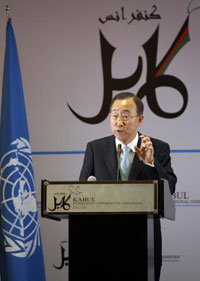 NEW YORK, Jan 22: For the United Nations to be an effective organisation, it is important for the US to have a very close dialogue and cooperation with emerging countries like India and China, UN chief Ban Ki-moon has said.
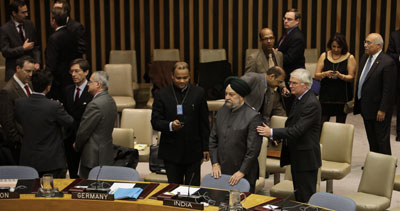 NEW YORK, Jan 5: Indian Ambassador to the United Nations Hardeep Singh Puri has been elected Chairman of the all important Security Council Committee on counter-terrorism and two other key committees of this 15-membered body.
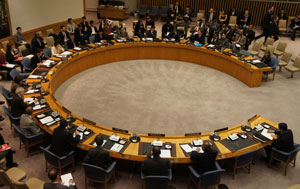 Guided by Security Council resolutions 1373 (2001) and 1624 (2005), the Security Council Counter-Terrorism Committee works to bolster the ability of United Nations member states to prevent terror acts both within their borders and across regions.
 NEW DELHI, Sept 22: A day after there were reports of India seeking a meeting with Pakistan, the government on remained non-committal on the issue and maintained that as of now there was no bilateral meeting fixed with Islamabad on the margins of U.N. General Assembly in New York.
  NEW DELHI, Aug 4: The United Nations Secretary-General's office has said Ban Ki-moon did not make any statement on the Kashmir situation.
  NEW DELHI, July 18: Reliance Industries Limited chief Mukesh Ambani has been chosen by the United Nations as a member of a key advocacy group on Millennium Development Goals (MDG), whose mandate includes finding ways to fight socio-economic evils such as poverty.
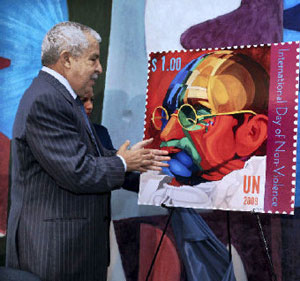 NEW YORK: The United Nations in a function organised by the Indian Mission to commemorate the 140th birth anniversary of the father of the nation; also marked as the International Day of Non-Violence, has released a stamp featuring him on Friday.
  NEW DELHI, Sept 18: India is lobbying hard for a non-permanent seat to the UN Security Council, when the Asia seat comes up for renewal at the end of next year, hoping to end a drought that would have lasted 18 years by the time elections are held in October 2010.

Aviation
| Business | Defence | Foreign
Affairs | Communication | Health
| India | United Nations
India-US
| India-France | Entertainment
| Sports | Photo Gallery |
Tourism | Advertise with Us
| Contact Us
© Noyanika International, 2003-2009. All rights reserved.