


United Nations
|
Antonio Guterres, Modi Discuss BRICS Priorities, Global Conflicts and AI WeaponsBy Deepak Arora
Jaishankar at UNGA: India backs peace, warns against weaponisation of trade, technology and financeBy Deepak Arora
Addressing the high-level debate of the 81st UN General Assembly, India's External Affairs Minister S. Jaishankar said the United Nations was entering its ninth decade at a time when conflicts and confrontations had become the world's primary concern. He said the consequences were being felt far beyond the countries directly involved in wars. “Countries far from conflicts, are being penalized for no fault of theirs,” Jaishankar said, stressing that those most affected often have the least say in decisions shaping the global order. Jaishankar began his address with a greeting from “1.4 billion people of Bharat” and used the speech to outline India's position on conflicts in the Gulf, Ukraine and the Middle East, while highlighting India's role in development, humanitarian assistance, peacekeeping and emerging technologies. On the conflict in the Gulf, he expressed deep concern over continuing hostilities and condemned attacks on commercial shipping and seafarers using international waterways. India, he said, was calling on all parties to exercise restraint, de-escalate tensions, protect civilians and ensure the uninterrupted movement of energy and commerce.
India was prepared to do everything possible to ease pressures on food and energy security, Jaishankar said. On the Middle East, he said India continued to believe that a durable peace required a two-state solution. At the same time, India was providing humanitarian assistance and relief to the Palestinian people. But Jaishankar's sharpest warning came over what he described as the “weaponization of everything.” He said extreme competition was undermining institutions and creating new chokepoints in finance, market access, supply chains and technology. Resources and connectivity, he said, were increasingly being used as instruments of leverage. Countries were consequently focusing on de-risking and diversification, but the broader result was a decline in trust and goodwill. The Global South, he said, was facing a particularly serious “4F crisis” involving food, fuel, fertilizer and finance. Fertilizer shortages, disruptions to grain movements and climate-related pressures were adding to difficulties already facing developing countries. Jaishankar also warned that the Global South's right to industrialize was being undermined by non-market practices and restricted market access. Artificial intelligence, which had been expected to create new opportunities, was also producing concerns over bias and the misuse of technology. On terrorism, Jaishankar adopted a firm tone, saying governments supporting cross-border terrorism must be held accountable. He called for a continued zero-tolerance approach and greater scrutiny of terrorist financing. Referring to remarks made at the UN the previous day, without naming the speaker in the statement, Jaishankar accused a “serial practitioner of terrorism” of misrepresenting facts and attempting to normalize terrorism. India, he said, would exercise its right to defend itself against terrorism. “Friendship and goodwill cannot co-exist with terrorism,” he said. A major part of the address was devoted to India's role in the Global South. Jaishankar highlighted India's development gains, including health, nutrition, education, drinking water, electricity, roads and housing, as contributions to wider progress toward the UN Sustainable Development Goals. He pointed to India's digital public infrastructure, expanding physical infrastructure, startup ecosystem and sectoral development programmes as areas where Indian experience could be shared internationally. India, he said, has undertaken 600 major development projects across 78 countries, covering infrastructure, manufacturing, agriculture, information technology and capacity building. Climate initiatives have also become part of India's international development partnerships, he said, particularly with African countries and small island developing states. He cited the International Solar Alliance, the Coalition for Disaster Resilient Infrastructure and the Global Biofuels Alliance. India's humanitarian role was another focus. Jaishankar said India had provided medical assistance in conflict zones, during epidemics and after natural disasters, while also supporting food, medicine, energy and fertilizer needs. India has also remained a major contributor to UN peacekeeping, with its contingents currently serving in nine of 11 mandates, he said. On artificial intelligence, Jaishankar said India viewed the technology as a driver of human empowerment, economic growth and large-scale problem solving. He argued that every country should have the ability to develop its own AI ecosystem, models and deployment strategies according to national priorities. Jaishankar concluded by making a broad case for a more representative global order. He said the world was moving toward multipolarity and that the post-1945 system was giving way to new realities. “The case for reformed multilateralism only gets stronger day after day,” he said, arguing that a pluralistic international order requires dialogue, wider consultation and transparent decision-making. He also paid tribute to outgoing UN Secretary-General António Guterres, praising his decade of service and specifically noting his support for India's Mission LiFE initiative. Ending on a message associated with Mahatma Gandhi, Jaishankar told delegates that peace could not simply be imposed or negotiated. It had to become a mindset and an outlook. “There is no way to peace; peace is the way,” he said. |
|
|||
 NEW DELHI: With wars continuing in the Middle East and Ukraine, global food supplies under pressure and major questions hanging over the future of international cooperation, UN Secretary-General António Guterres met Prime Minister Narendra Modi in New Delhi on Friday on the sidelines of the BRICS Summit. The meeting brought together several of the most pressing issues facing the world, from reform of global institutions and freedom of navigation to food security, sustainable development, renewable energy and the rapidly growing role of artificial intelligence.
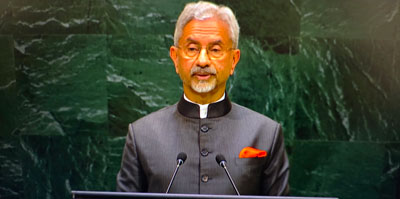 UNITED NATIONS, Sept 26: India on Saturday called for a stronger and more predictable international order, warning that conflicts, terrorism and the growing weaponisation of finance, technology, trade and supply chains are deepening instability across the world.
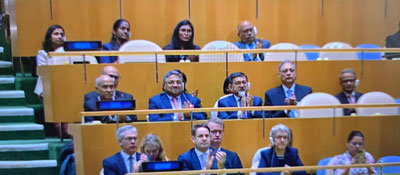 Turning to Ukraine, Jaishankar said the conflict had entered its fifth year and reiterated Prime Minister Narendra Modi's call that “endless war must give way now, to an end to war.” India supports ongoing efforts to bring peace, he said, while emphasizing the need to protect seafarers and maintain supplies of food grains and energy.
India-US | India-France | Entertainment | Sports | Photo Gallery | Tourism | Link Partners | Contact Us
© Noyanika International, 2003-2024. All rights reserved.