


United Nations
|
UN chief António Guterres calls for end to attacks on shipping, warns maritime disruptions threaten global food supplyBy Deepak Arora
Guterres Says UN80 Enters Decisive Phase as UN Pushes to Reform, Cut Duplication and Improve DeliveryBy Deepak Arora
Addressing Member States, Guterres said the initiative was launched out of a “profound sense of responsibility” to the people served by the United Nations, future generations, Member States and the Organization itself. He argued that the case for reform remains strong as conflicts spread, humanitarian needs grow, development gains come under pressure and public trust in institutions is tested. “We are answering that call with real change,” Guterres said, pointing to efforts to strengthen mandate delivery, reduce fragmentation, improve accountability and ensure that UN resources produce greater impact. The Secretary-General said UN80, launched less than 18 months ago, has moved from diagnosis to design and increasingly to implementation. The initiative is organized around three broad workstreams covering organizational efficiency, mandates and the way the UN system is structured to deliver results. Under the first workstream, the Secretariat is changing how it uses resources and manages operations. Guterres said changes introduced in 2026 include a 21 percent reduction in Secretariat posts, relocation of functions to lower-cost locations and efforts to consolidate services and eliminate duplication. A major part of the drive is the expansion of shared services. A common administrative platform in New York now serves about 6,000 personnel, while payroll functions have been consolidated into a single global team. A digital hub has also been launched in Valencia. The Unified Services Roadmap, published in July, is examining how operational services can be shared across UN entities, pillars and locations. Guterres said feasibility studies point to potential efficiencies of 20 to 80 percent in some back-office services, although he stressed that projected savings must first become actual savings before they can be redirected to core UN work. Technology and data are also central to the effort. The Technology Accelerator Platform is intended to reduce fragmented digital solutions, while the UN System Data Commons is bringing data and statistics from across the UN system into a single platform, with commitments from more than 25 UN entities. Guterres said the underlying principle was straightforward: where the UN performs essentially the same function, it should question whether separate systems and infrastructure are necessary. The second major area of reform involves UN mandates. Guterres said mandates have accumulated for decades without systematic management and review. General Assembly resolution 80/251 now provides a framework for addressing the problem while reaffirming that decisions on mandates remain the exclusive prerogative of Member States. A new mandate registry contains more than 40,000 resolutions and decisions dating back to 1946, linking them with programmes, budget references and Secretary-General’s reports. The Secretariat has also reviewed more than 600 series of mandated reports issued during the past three years. New guidance is intended to make reports shorter, clearer and more focused on evidence and action. Guterres said the initial changes could reduce reporting by about 700,000 words this year, joking that the reduction is longer than Leo Tolstoy’s War and Peace. The third workstream is focused on changing how the wider UN system operates. Under the New Humanitarian Compact, a new humanitarian delivery model is being piloted in Afghanistan, Haiti, Somalia, Sudan and the Occupied Palestinian Territory. The aim is to simplify planning, integrate supply chains and data systems, clarify responsibilities and strengthen the role of Resident and Humanitarian Coordinators. The Secretary-General also highlighted reforms to UN development operations, including redesigned country teams, expertise-on-demand, Joint Knowledge Hubs and Regional Platforms for Integration. These initiatives are intended to provide countries with more coordinated and flexible access to UN expertise while avoiding unnecessary new structures. Guterres also outlined structural changes being considered or implemented across the UN system. He welcomed the General Assembly’s decision to merge the United Nations System Staff College and UNITAR, describing it as an important step in consolidating training capacities. Other changes include integrating UNRISD into the UN University and moving toward integration of the UN Interregional Crime and Justice Research Institute into UNODC. Possible changes involving UNDP and UNOPS, UNFPA and UN Women, and the transition of UNAIDS functions to other parts of the UN system are also under consideration. Guterres stressed that UN80 is not about restructuring for its own sake. “Start with the problem. Follow the evidence. Focus on the mandate,” he said, arguing that institutional solutions should be chosen according to their ability to deliver greater impact. He said the initiative has now entered its third phase, focused on decisions and implementation, with the goal of moving pilots to scale. But Guterres made clear that the next stage cannot be driven by the Secretary-General alone. “Above all, Member States will be in the driver’s seat,” he said, emphasizing that many of the decisions ahead belong to the General Assembly and other governing bodies. He called on Member States to use resolution 80/251 across the full mandate lifecycle, support the restructuring of country and regional arrangements, back shared services and common technology platforms, assess structural proposals on their merits, align funding practices with UN80 goals and exercise coherent governance across the UN system. He also urged countries to pay their assessed contributions fully and on time. “Efficiency can make every dollar work harder,” Guterres said. “It cannot make an unpaid dollar appear.” The Secretary-General concluded by stressing that the success of UN80 will ultimately depend on changing behavior across the Secretariat, the wider UN system and intergovernmental bodies. “Coherent governance is what makes coherent delivery possible,” he said. |
|
|||
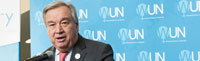 UNITED NATIONS: UN Secretary-General António Guterres has called for an immediate end to attacks on commercial shipping and civilian infrastructure in the Strait of Hormuz, the Black Sea, Red Sea and around Bab al-Mandab, warning that disruptions at key maritime chokepoints are driving up prices, worsening hunger and putting the global food system under severe pressure. Speaking with newspersons here on Monday, Guterres said conflicts in different regions were increasingly converging in their impact on the world's most vulnerable populations, with disruptions to maritime traffic restricting the movement of energy, fertilizers, grain and other essential commodities.
 UNITED NATIONS, Sept 4: UN Secretary-General António Guterres has told the General Assembly that the United Nations has entered a critical new phase of its UN80 Initiative, shifting from identifying reform possibilities to making decisions and putting changes into practice.
India-US | India-France | Entertainment | Sports | Photo Gallery | Tourism | Link Partners | Contact Us
© Noyanika International, 2003-2024. All rights reserved.