


United Nations
|
UN chief António Guterres calls for end to attacks on shipping, warns maritime disruptions threaten global food supplyBy Deepak Arora
UN Chief to Attend BRICS Summit in New Delhi, Set for Talks with PM ModiBy Deepak Arora
At a summit hosted by India, Guterres is expected to tell BRICS leaders that today's economic, demographic and geopolitical realities have moved far beyond the world that existed when the United Nations and other major international institutions were created after the Second World War. The Secretary-General will address an open session of the summit on September 13 on the theme, “Resilience, Innovation, Cooperation and Sustainability: Shaping the Future for Inclusive Global Growth.” Stéphane Dujarric, spokesman for the Secretary-General, said Guterres is expected to underline that the countries represented at the BRICS summit are themselves part of the changing global reality. His message is expected to carry particular weight in India, which has long argued that the world's major institutions have failed to keep pace with the dramatic shift in global economic and political power. New Delhi has been one of the strongest voices calling for reform of the UN Security Council and greater representation for developing countries in global decision-making. India has repeatedly argued that a Security Council designed in the aftermath of World War II cannot adequately deal with the political realities of the 21st century. Guterres is expected to echo that broader concern in his remarks, particularly in calling for reforms to multilateral institutions, including the Bretton Woods system and the Security Council. He is also expected to argue that a more multipolar world can bring greater balance to global affairs. But that, he will say, must be backed by real changes in international institutions. The shift toward multipolarity alone will not solve the problem if the structures governing the global economy, international security and political decision-making remain rooted in another era. For India, the Secretary-General's visit comes at a significant moment. As host of the BRICS Summit, New Delhi will be at the center of discussions involving some of the world's largest and fastest-growing economies. India has increasingly sought to position itself as a leading voice of the Global South while pressing for changes in institutions where developing countries continue to seek greater influence. The BRICS platform has also gained importance in the wider debate over who shapes the rules of the global order. Guterres is expected to use his address to argue that reform is necessary if multilateralism is to remain relevant and effective at a time of growing geopolitical tensions, economic uncertainty, climate pressures and rapid technological change. The Secretary-General's meeting with Modi is expected to be one of the key engagements of his visit. Dujarric said Guterres will also hold bilateral meetings with other officials attending the summit. While details of those meetings were not immediately available, discussions are expected to cover international developments and the future of multilateral cooperation. Guterres has consistently argued that developing countries must have a stronger voice in international institutions, particularly as the global economy and political balance continue to shift. His message in New Delhi is expected to be clear. The world of 2026 is not the world of 1945. The institutions created for that earlier era cannot simply remain unchanged. For India, which has spent years pressing for a permanent seat at a reformed Security Council and a greater role for developing nations in global decision-making, the Secretary-General's visit is likely to give fresh attention to a debate that New Delhi has pushed for decades. As BRICS leaders gather in the Indian capital, Guterres will be joining a conversation that goes to the heart of one of the biggest questions facing the international system: whether global institutions can change quickly enough to reflect the world that now exists. |
|
|||
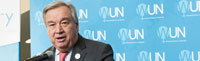 UNITED NATIONS: UN Secretary-General António Guterres has called for an immediate end to attacks on commercial shipping and civilian infrastructure in the Strait of Hormuz, the Black Sea, Red Sea and around Bab al-Mandab, warning that disruptions at key maritime chokepoints are driving up prices, worsening hunger and putting the global food system under severe pressure. Speaking with newspersons here on Monday, Guterres said conflicts in different regions were increasingly converging in their impact on the world's most vulnerable populations, with disruptions to maritime traffic restricting the movement of energy, fertilizers, grain and other essential commodities.
 UNITED NATIONS, Sept. 9: UN Secretary-General António Guterres is heading to New Delhi for the 18th BRICS Summit, where he will meet Indian Prime Minister Narendra Modi and make a strong case for reshaping global institutions that still reflect the power structure of 1945.
India-US | India-France | Entertainment | Sports | Photo Gallery | Tourism | Link Partners | Contact Us
© Noyanika International, 2003-2024. All rights reserved.