


United Nations
|
'The answer to global transportation challenges is not less transport – it is sustainable transport' – UN chiefASHGABAT, Nov 26: Opening the first-ever Global Sustainable Transport Conference, United Nations Secretary-General Ban Ki-moon told delegations gathered in Ashgabat, Turkmenistan, that the world has the resolve, commitment, imagination and creativity “to transform our transport systems in a sustainable manner that will improve human wellbeing, enhance social progress and protect our planet.” “This sector is responsible for nearly a quarter of energy-related greenhouse gas emissions. And that is expected to substantially increase in the future,” said Mr. Ban in his opening remarks to the conference, which opened today in the Turkmen capital and wraps up tomorrow, adding: “Without action on the transportation front, we will not be able to limit global warming to well below 2 degrees Celsius and as close to 1.5 as possible.” The 2 degrees Celsius threshold was set by global leaders with the adoption of the Paris Agreement on Climate Change last December, which entered into force early this month, on 4 November 2016. The two-day conference has brought together representatives from the UN, governments, the private sector and civil society, with the common goal of setting new directions for global transport efforts. Mr. Ban noted that the transport sector transcends economics, indeed, it has a human side, and “we should all be concerned about people who do not have the access they deserve.” “Sustainable transport is out of reach for too many rural communities. Millions of persons with disabilities cannot use public transportation because it is inaccessible. Older persons struggle to move from one place to the next. Even where transport is available it may not be safe – especially for women and girls, who often rightly fear they may be attacked,” he explained. In this respect, the Secretary-General highlighted the critical importance of sustainable transport, noting that it has to answer to the needs of those who have the least. “When it does, we can bridge more than physical distances; we can come closer as one human family,” he underscored. Further highlighting the heavy toll of unsustainable transport on human life, Mr. Ban said road accidents claim about one and a quarter million lives every year. “The vast majority – nine out of 10 – is in developing countries,” he said, also noting that city traffic saps productivity. Further, transport contributes to air pollution, which costs more than three million lives a year. Mr. Ban noted that the answer to such challenges “is not less transport – it is sustainable transport […] we need more systems that are environmentally friendly, affordable and accessible. Technological advances can get us there.” The Secretary-General went on to outline seven ideas for sustainable transport, including the need for an integrated policy framework that aligns with the UN Sustainable Development Goals (SDGs). “Second, we must address the needs of vulnerable countries, including least developed countries, landlocked developing countries and small island developing States,” he said, noting that those countries need simplified border crossings and harmonized regional regulations and requirements. The third idea, Mr. Ban said, was the need to promote better transport systems in cities. “That means improving public transport while promoting walking and cycling,” he said. He also highlighted the need to make all transport systems safe and secure “to reach the ambitious target set in the 2030 Agenda calling for access to safe, affordable, accessible and sustainable transport systems for all.” Calling for bold and innovative steps in re-thinking transport systems, from design, to technology and consumption patterns, the UN chief stated, as his fifth idea, the need to address the environmental impacts of transport in order to mitigate the impact on climate change and reduce local air pollution. Mr. Ban underscored that all these ideas need financing, noting, “it takes investments to see results.” “That means mobilizing funds from a variety of sources and fostering North-South, South-South and triangular cooperation. Public-private partnerships are indispensable,” he explained. Lastly, Mr. Ban highlighted, as his seventh idea, the importance of partnerships, saying: “We have to mobilize all partners by putting people at the centre of transport planning – and by working together. Transport is team work.” As this will be the finial international conference he is convening as UN Secretary-General, Mr. Ban said he is happy to end his term by focusing on sustainable transport, telling delegations that he is confident the international community as “the resolve, commitment, imagination and creativity to transform our transport systems in a sustainable manner that will improve human wellbeing, enhance social progress and protect our planet Earth.” Later in the day, Mr. Ban took part in a ribbon cutting ceremony for the opening of the new UN House in Ashgabat, where he noted that the Government of Turkmenistan has worked tirelessly with the UN over the past 16 months to renovate the building to ensure it meets the highest standards. “This new UN House is a great example for other countries around the world,” said the Secretary-General, thanking President Gurbanguly Berdimuhamedov for his commitment to providing the facility, as well as his support to its maintenance in the coming years. Calling the grand structure “a powerful symbol of the strong partnership between Turkmenistan and the United Nations,” Mr. Ban noted that many members of the UN family are working with the Government and people of Turkmenistan: led by the UN Resident Coordinator, together with the UN Development Programme (UNDP), the UN Educational, Scientific and Cultural Organization (UNESCO), the UN Population Fund (UNFPA), the UN Children's Fund (UNICEF), the World Health Organization (WHO), The UN office on Drugs and Crime (UNODC), the International organization for Migration (IOM), UN Women, the UN Department of Safety and Security (UNDSS), as well as the World Bank. “I count on our staff to open the doors of this UN House wide to many partners, especially from civil society,” he said, stressing that by supporting the activities of civil society, securing human rights and promoting fundamental freedoms, “we can realize true progress. This also demands full equality and true empowerment for women and girls.” Deeply concerned about situation at Kashmir LoC: Ban Ki-moon
“The secretary-general is deeply concerned about the deterioration of the situation along the Line of Control in Kashmir in recent days,” a United Nations statement attributed to his spokesman said. “He calls on all involved to prioritise the restoration of calm and stability in order to prevent any further escalation and loss of life,” the statement said, adding that Ban “trusts India and Pakistan can find common ground and work towards a sustainable peace.” “The UN stands by the people of the region and supports all efforts to reach durable peace and security,” said the statement. Tension between India and Pakistan have increased after the attack on an Indian Army base in Uri on September 18 and the resultant “surgical strike” on terrorist launchpads in Pakistan-occupied Kashmir by the army 10 days later. Since then, cross-border firings have increased killing soldiers and civilians on both sides. This week, 12 people, including three Pakistani soldiers, were killed in alleged Indian cross-border firings. The Indian response came after the Indian Army warned of “heavy retribution” following the killing of three of its soldiers, with the body of one of them mutilated in a cross-LoC attack. Pakistan has denied as “false” and “baseless” its troops were responsible for the mutilation and deaths of Indian soldiers. India slams UNSC's inability to sanction leaders of terror organisations
Asserting that the Security Council is stuck in its own “time warp and politics,” India’s Permanent Representative to the U.N. Ambassador Syed Akbaruddin on Monday slammed the Council’s inability to sanction the leaders of terrorist organisations. “While our collective conscience is ravaged everyday by terrorists in some region or another, the Security Council gives itself 9 months to consider whether to sanction leaders of organisations it has itself designated as terrorist entities,” Akbaruddin said at a session on equitable representation and increase in the membership of the Security Council here. Earlier this year, China extended the “technical hold” on India’s move to get Azhar designated as a terrorist by the UN. The six-month validity of the technical hold lapsed in late September and China sought another three-month extension on India’s bid. He lamented the snail-paced and “never-ending carousel of discussions” on UNSC reforms, saying “it is time to break the impasse” to urgently reform the body that is “unresponsive” to the current global situation. The inability to respond to humanitarian situations, terrorist threats and peacekeeping vulnerabilities during this year itself were part of the price that was being paid for the international community’s lack of progress on the critical matter, he noted. “On issues pivotal to international security such as Syria, there is inaction, and on other situations like dealing with the peacekeeping crisis in South Sudan we see fragmented action, which is not implemented even months after being agreed upon,” Akbaruddin said. “The Security Council, stuck in its own time warp and politics, can only be described as working randomly on the basis of a mix of ad-hocism, scrambling and political paralysis. Need one say more about the urgency of the need for reform of this relic which has long been unresponsive to the needs of our time,” he said. Akbaruddin said the never-ending carousel of discussions on UNSC reforms leaves many in the international community perplexed as the crucial reform of the Security Council has been delayed despite both its importance and its urgency. He pointed out that the Council’s global governance structure does not cease to surprise the international community with its persistent inability to even effectively engage with the tasks at hand. “The lack of representativeness of its membership, especially in the permanent category, which was decided upon 70 years ago adds to its lack of legitimacy and credibility,” he added. The Ambassador expressed the hope that under the current U.N. General Assembly president, Peter Thomson, a process on furthering the reform will be put in place that can help move from discussions to negotiations. “It is time to break the impasse. It is time to reflect the different hues in a text so that everyone can discern the trend lines and trajectory of thinking of Member States,” he said. |
|
||||||
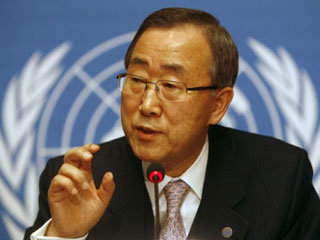 UNITED NATIIONS, Nov 25: Deeply concerned over the “deterioration” in situation along the Line of Control in Kashmir, UN Secretary-General Ban Ki-moon has called for restoration of stability in the region, saying the world body supports “all efforts” to reach “durable” peace and security.
 UNITED NATIONS, Nov 8: India has strongly criticised the United Nations Security Council (UNSC) for taking months to consider sanctioning leaders of groups it has itself designated as terror entities, in an obvious reference to the “technical hold” on India’s bid to get Jaish-e-Mohammed (JeM) chief Masood Azhar banned by the U.N.
Aviation
| Business | Defence | Foreign
Affairs | Communication | Health
| India | United Nations
India-US
| India-France | Entertainment
| Sports | Photo Gallery |
Tourism | Advertise with Us
| Contact Us
© Noyanika International, 2003-2009. All rights reserved.