


United Nations
|
International Day of Non-Violence at UNBy Deepak Arora
October 2 was marked as the International Day of Non-Violence by General Assembly This year’s celebrations will be held at the ECOSOC Chamber of the United Nations on Sunday. President of General Assembly Peter Thomson, Deputy Secretary General Jan Eliasson, Finance Minister of Bangladesh Abul Maal A. Muhith, and Prof. Barry L. Gan, Director of Center for Non-Violence, St. Bonaventure University, New York will address the gathering. Ambassador Syed Akbaruddin said the opening segment will be followed by a recital of songs emphasizing virtues of Peace and Non-Violence by Ms. Sudha Raghunathan a renowned Indian Classical singer in the Carnatic Music tradition. As a tribute to Mahatma Gandhi’s focus on preserving the environment, the Ambassador said India will submit its certification of Instrument of ratification of the Paris Agreement on October 2 to the United Nations. India had last year the same day, announced it climate action plan and declared its Intended Nationally Determined Contribution. This October also marks the fiftieth anniversary of performance of Dr. M.S. Subbulakshmi, He said the UN Postal Administration (UNPA) will release a postage stamp commemorating the birth anniversary and fiftieth anniversary of performance by Dr. M.S. Subbulakshmi at the United Nations on October 2. Assistant Secretary General, Department of Management will release the stamp on behalf of UNPA. The stamps will be available for purchase at the UNPA website http://unstamps.org . Dignitaries, diplomats and officials from the United Nations and the Permanent Missions to the United Nations, civil society, academia, media and invited guests will attend the Event. UN chief Ban Ki-moon offers to mediate between India, Pakistan
The offer came after Pakistan’s ambassador met with the UN chief and urged him to personally intervene, while India said it did not want to aggravate the situation. Ban called on “both sides to exercise maximum restraint and take immediate steps to de-escalate the situation,” a statement from his spokesperson said. The UN chief said India and Pakistan should address differences through diplomacy and dialogue, and offered to mediate. “His good offices are available, if accepted by both sides,” the UN spokesperson said. Tensions between the two arch rivals have been boiling since the Indian government accused Pakistan-based militants of launching an assault on an army base in Kashmir earlier this month that killed 19 soldiers. India on Thursday said it had carried out “surgical strikes” several kilometers (miles) inside Pakistan-controlled Kashmir on “terrorist” targets. “This is a dangerous moment for the region,” Pakistan’s ambassador Maleeha Lodhi said after meeting with Ban at UN headquarters in New York. “The time has come for bold intervention by him if we are to avoid a crisis, because we can see a crisis building up.” Lodhi accused India of creating “conditions that pose a threat to regional and international peace and security”. UN spokesperson Stephane Dujarric earlier said the UN chief “would welcome all proposals” or initiatives aimed at de-escalation. Ban is following the situation “with great concern,” said Dujarric, citing the escalating rhetoric between the two countries and the increased tensions along the Line of Control that separates Kashmir between the nations. India says no desire to aggravate tensions A UN military observer mission (UNMOGIP) is looking into reports of ceasefire violations along the line of control and will report to Ban, he added. “UNMOGIP has not directly observed any firing across the line of control related to the latest incident,” he added. In a statement, India’s mission to the United Nations said “India has no desire to aggravate the situation,” and that “our response was a measured counter terrorist strike.” “It was focused in terms of targets and geographical space,” the mission said. “It is reflective of our desire to respond proportionately to clear and imminent threat posed by terrorists in that instance.” “With our objectives having been met that effort has since ceased.” The Pakistani ambassador said she had suggested to Ban that plans for a visit to India and Pakistan expected in November could be brought forward to avert a crisis. Lodhi also met this week with the current Security Council president, New Zealand ambassador Gerard van Bohemen, to ask that the top UN body keep a close eye on developments. India and Pakistan have fought three wars since they gained independence from Britain seven decades ago, two of them over the disputed Himalayan region of Kashmir. 'Even a slaughterhouse is more humane,' says Ban Ki-moon on attacks in AleppoBy Deepak Arora
UN Secretary-General Ban Ki-moon condemned the attacks today on the two largest hospitals in rebel-held parts of Syria's Aleppo as "war crimes." “Imagine the destruction – people with limbs blown off, children in terrible pain with no relief, infected, suffering, dying, with nowhere to go, and no end in sight.” “Imagine a slaughterhouse. This is worse. Even a slaughterhouse is more humane,” Ban told a UN Security Council meeting. The government of President Bashar al-Assad, backed by Russian air power, Iranian ground forces and Shi’ite militia fighters from Iran, Iraq and Lebanon, has launched a massive assault on Aleppo. It is the opposition’s last major urban stronghold.
It would be the biggest strategic prize of the war for Assad and his allies. Taking full control of Aleppo would restore almost-total government rule over one of the most important cities of western Syria. Warplanes, thought to be Russian or Syrian, knocked two hospitals out of service in the besieged rebel sector of Aleppo on Wednesday. The air strikes came as ground forces intensified their assault on the city. India asks world community to joint hands to defeat terrorismBy Deepak Arora
Addressing the UN General Assembly, Sushma Swaraj said “if any nation refuses to join this global strategy we must isolate it. In our midst, there are nations that still speak the language of terrorism, that nurture it, peddle it, and export it. To shelter terrorists has become their calling card. We must identify these nations and hold them to account.” Unlike Pak Prime Minister Nawaz Sharif's address at the UNGA where he address most empty chairs, Sushma Swaraj's address was marked by regular clapping from the delegates and audiences in the visitors gallery. One could also hear slogans of "Bharat Mata Ki Jai". India, Sushma Swaraj said, had attempted a “paradigm of friendship…without precedent” to resolve outstanding issues but all it got in return was “Pathankot, Uri and Bahadur Ali, a terrorist in our custody whose confession is living proof of Pakistan’s complicity in cross-border terror”. While naming and shaming Pakistan, Indian Minister said Pakistan remains in denial when confronted with such evidence. “It persists in the belief that such attacks and provocative remarks will enable it to snatch the territory it covets. My firm advice to Pakistan is: Abandon this dream. Let me state unequivocally that Jammu and Kashmir is an integral part of India and will always remain so,” she said.
Swaraj, who spoke in Hindi, added that “those accusing others of human rights violations would do well to introspect and see what egregious abuses they are perpetrating in their own country, including in Balochistan. The brutality against the Baloch people represents the worst form of state oppression.” Without naming Lashkar-e-Taiba founder Hafiz Saeed, designated a terrorist by the UN Security Council and the US, Swaraj said: “These nations, in which UN-designated terrorists roam freely, lead processions and deliver their poisonous sermons of hate with impunity, are as culpable as the very terrorists they harbour. Such countries should have no place in the comity of nations.” Swaraj also rejected Sharif’s contention that India had set pre-conditions for talks. “Did we impose any pre-condition before extending an invitation for the oath-taking ceremony of our government? Did we impose any pre-condition when I went to Islamabad for the Heart of Asia conference and agreed to begin the comprehensive bilateral dialogue? Did we impose any pre-condition when Prime Minister Modi travelled from Kabul to Lahore?” She said the world community is yet to reach a conclusion on a comprehensive convention on international terrorism proposed by India in 1996. This has prevented nations from agreeing on “norms to punish and extradite terrorists” and there is need to act with “fresh urgency to adopt this convention”. Swaraj also brought up the reform of the UN Security Council so that it does not remain an outdated body that “reflects the world order of an older era” and comes to terms with present day realities. In a speech seeking to marry New Delhi’s national interest with global objectives to buttress its stature as an emerging global power, Swaraj stressed India’s commitment to climate change and announced it will submit its instrument of ratification of the Paris Agreement on October 2, the birth anniversary of Mahatma Gandhi, who, she added, “epitomised a lifestyle with the smallest carbon footprint”. She also emphasised India’s commitment to the UN’s Sustainable Development Goals (SDGs), which she said, were “matched by the development vision of my government, which is geared towards the achievement of these same objectives”. Several schemes of the Indian government dovetailed with the SDGs, such as the Swachh Bharat, Beti Bachao, Beti Padhao, Make in India and Digital India campaigns. While India will play a leading role in combating climate change through measures such an international solar alliance, it expects developed nations to hold up their end of the bargain by providing finance and technology transfers. Prime Minister Narendra Modi congratulated Sushma Swaraj for her speech at the 71st UNGA session. Full text of Sushma Swaraj’s speech at UN general assembly
Here is the full text of her speech: Hon’ble President, 1. On behalf of India and on my own behalf, I congratulate you on your election as President of the 71st United Nations General Assembly. Let me also take this opportunity to thank Secretary General Ban Ki Moon for his services to the United Nations,history’s largest peace movement. Mr. President, 2. A year has passed since I stood here at this hallowed podium to address the members of the international community. Since then, much has changed in the world around us – some for the better, some for the worse and much which has been cause of great concern. There can be no better platform to ponder our actions and our achievements over the last year. We must remember that we will be defined not just by our actions, but equally, by our inaction. Mr. President, 3. A number of issues have been debated in this august Assembly - from the necessity of global partnerships in sharing new vaccines and promoting access to affordable drugs to counter anti-microbial resistance, to the need for faster implementation of the Sendai Framework to mitigate the risk of natural disasters. From the challenge of ensuring well-ordered mobility of productive human resources, to the necessity of adequate consultations with Troop Contributing Countries before framing mandates for UN Peacekeeping Operations. But my time is limited. I would therefore, focus only on some of the most pressing issues facing the international community. Mr. President, 5. I congratulate you for the priority you have given to the Sustainable Development Goals (SDGs) by making them the theme for the 71st UNGA. I am happy that the 17 goals adopted by this Assembly are matched by the development vision of my Government, which is geared towards the achievement of these same objectives. Under the Swachh Bharat Mission (Clean India Campaign), more than 400,000 toilets have been constructed in schools. The Beti Bachao Beti Padhao (Educate the Girl Child, Save the Girl Child) programme has become a nation-wide mission. The Make in India brand is receiving international acclaim. Almost 250 million bank accounts have been opened for the poor under the Jan Dhan Yojana, the largest financial inclusion programme the world has ever seen. Digital India is transforming the country. Under the Skill India initiative, a number of programmes are underway to enable youth to reap the demographic dividend. These initiatives have added a new dimension to India’s growth story, making it the fastest growing major economy in the world at a time of slow global growth. Mr. President, 7. However, in a globalised world, national effort needs to be supplemented by international cooperation for the successful implementation of Agenda 2030. 8. Climate change is yet another serious challenge confronting us. There are enough resources on this planet to fulfil everyone’s needs, but not enough to fulfil anyone’s greed, for greed is limitless. In this context PM Modi has championed a new concept – Climate Justice.If we respect nature, nature will respect and nurture us and future generations. But, if we exploit nature mindlessly, then we must be mindful that nature will unleash its fury upon us. In different parts of the world, we have already seen nature drift towards the unnatural – from torrential rain to excessive heat, from tsunamis to storms and cloudbursts. 9. We must curb reckless consumption, and adopt lifestyles in harmony with nature. Yoga, the storehouse of India’s ancient wisdom, epitomises a sustainable lifestyle. Let me record our gratitude for the unprecedented global response to the International Day of Yoga. 11. India has launched an ambitious domestic effort to transform our energy mix to achieve 40% energy from non-fossil fuel sources by 2030. The massive investments required entail a predictable and stable environment towards which we are working actively. Apart from this, our path-breaking initiative for an International Solar Alliance is intended to make efficient solar technology available for all. 12. I assure this Assembly that India will continue to play a leading role in combating climate change. We have decided to submit our Instrument of Ratification of the Paris Agreement on October 2, the birth anniversary of Mahatma Gandhi who epitomised a lifestyle with the smallest carbon footprint. Mr. President, 13. Let me now turn to a subject of the most critical importance, one which deeply concerns every member of this Assembly. This monthwe marked the 15th Anniversary of the 9/11 terror attacks on this city. Tragically, less than 15 days ago, another attempt at killing innocents was made through an act of terror in this same city. We,who have suffered in Uri recently, understand the pain inflicted by the same forces. The world has been battling this scourge for long. However, despite the blood and tears of innocent victims, attacksthis year alone in Kabul and Dhaka, Istanbul and Mogadishu, Brussels and Bangkok, Paris, Pathankot and Uri as well as daily barbaric tragedies in Syria and Iraq, remind us that these malevolent forces are yet to be defeated. 14. We must acknowledge that terrorism is undoubtedly the biggest violation of human rights. It targets the innocent and killsindiscriminately. Terrorism has gone way beyond affectingindividuals or nations – it is a crime against humanity itself. But it is important to ask - who is behind this and who benefits from it?Terrorists do not own banks or weapons factories, so let us ask the real question: who finances these terrorists, who arms them and provides sanctuaries? We heard similar questions being asked by Afghanistan from this podium. Mr. President, 16. Therefore if we want to defeat terrorism, there is only one way – that we unite across our differences, add steel to our resolve and inject urgency in our response. We need to forget our prejudices and join hands together to script an effective strategy against terror. This is not an impossible task provided we have the will. We can do it, we must do it. Otherwise our future generations will forever hold us to account. And if any nation refuses to join this global strategy, then we must isolate it. 17. In our midst, there are nations that still speak the language of terrorism, that nurture it, peddle it, and export it. To shelter terrorists has become their calling card. We must identify these nations and hold them to account. These nations, in which UN designated terrorists roam freely, lead processions and deliver their poisonous sermons of hate with impunity, are as culpable as the very terrorists they harbour. Such countries should have no place in the comity of nations. Mr. President, Mr. President, 20. And what did we get in return? Pathankot, Bahadur Ali, and Uri.Bahadur Ali is a terrorist in our custody, whose confession is a living proof of Pakistan’s complicity in cross-border terror. But when confronted with such evidence, Pakistan remains in denial. It persistsin the belief that such attacks will enable it to obtain the territory it covets. My firm advice to Pakistan is: abandon this dream. Let me state unequivocally that Jammu and Kashmir is an integral part of India and will always remain so. Mr. President, 22.The CCIT was proposed by India in 1996. In 2016, despite the passage of two decades, we are yet to come to a conclusion. As a result, we are unable to develop a norm under which terrorists shallbe prosecuted or extradited. Therefore it is my appeal that this General Assembly acts with fresh resolve and urgency to adopt this critical Convention. 23. Just as we need a more contemporary approach to combating terrorism, we also need a less outdated Security Council thatcontinues to reflect the world order of an earlier era. The vast majority of nations share the belief that the UN should not remain frozen in 1945, just to serve the interests of a few. Whether it is institutions or issues, we must come to terms with present day realities and the challenges that confront us. An expansion in the Permanent and non-Permanent membership of the Council to reflect contemporary realities is therefore, an urgent necessity. We must move forward substantively towards text-based negotiations. Mr. President, 25. The 21st century has begun in the shadow of turmoil, but we can turn this into a golden age in the history of civilization through united and concerted efforts. But what happens tomorrow will depend on what we do today. Thank you. Sushma Swaraj arrives in New York to address UNGA on Sept 26By Deepak Arora
Swaraj is expected to present “vision document” for the 71st UN General Assembly and is expected to present evidence of Pakistan's involvement in recent terrorist attacks on Indian soil to the assembly. “Leading India’s delegation to the 71st UNGA. EAM @SushmaSwaraj arrives in New York,” Ministry of External Affairs Spokesperson Vikas Swarup tweeted. Indian diplomats have already given a strong response to Sharif speech at the UNGA in which he had focused elaborately on Kashmir. Exercising the Right of Reply, First Secretary in the Permanent Mission of India to the UN Eenam Gambhir had called Pakistan home to the “Ivy League of Terrorism” and a “terrorist state” that commits “war crimes” by using terrorism as an instrument of state policy. Outlining India’s focus for the United Nations General Assembly (UNGA) session, India’s Ambassador to the UN Syed Akbaruddin had said that terrorism is the “primary concern” for India as well as for nations across the world. He listed reform of the UN Security Council, sustainable development, climate change and peacekeeping as other priorities for India in the current UNGA session. Swaraj is third in line to speak on the final day of the general debate which has run from September 20. Oman is first up at 9 am EST (6:30 pm IST same day), followed by Bahrain and then India. There are total 17 speakers. The session would come to a close with the closing remarks by President of the 71st session of the General Assembly
Peter Thomson. There is no layover session scheduled for Monday which coincides with the date of the first Clinton versus Trump presidential debate. Pakistan’s discourse had no takers in United Nations: Indian Minister Akbar
“India’s version stated by Prime Minister Narendra Modi and External Affairs Minister Sushma Swaraj was accepted by the world because it is the honest truth,” said Akbar. Responding to question on Pakistan’s denial of proof of its involvement in Uri attacks, MJ Akbar said "Sure there are at least 1-2 scientists in Pak, if they examine DNA samples (of terrorists).” “They (Pakistan) will get proof of Pathankot and Uri attack. Pakistan can fool its own people but not the World,” he said. Earlier on Thursday, MJ Akbar said, “We cannot have prosperity without peace, and the principal threat to peace now is terrorism. The poor are the most vulnerable victims of terrorism, not least because conflict leads to devastation.”
Akbar stressed that the developed world must help make global governance more democratic and equitable while nation states do all within their powers to bring education, healthcare, sanitation, housing, employment to their peoples, the international community, especially. He said there is need for new mechanisms such as a Special Rapporteur on the Right to Development to strengthen the work of the Human Rights Council on the Right to Development particularly in the context of 2030 Agenda with a view to strengthening international cooperation on this issue. 'Democracy-deficit' Pakistan is 'Ivy League of terrorism', says India at UNGABy Deepak Arora
In a strong rebuttal to Pakistan Prime Minister Nawaz Sharif, First Secretary in the Permanent Mission of India to the UN Eenam Gambhir said that UN-designated terrorists continued to roam Pakistan’s streets freely and operate with SState support. Exercising India’s Right of Reply to Sharif’s “long tirade” about the situation in Jammu and Kashmir, Gambhir said “the worst violation of human rights is terrorism”. “When practised as an instrument of state policy, it is a war crime,” she said. “What my country and our other neighbours are facing today is Pakistan’s long-standing policy of sponsoring terrorism, the consequences of which have spread well beyond our region.” Gambhir said India sees in Pakistan “a terrorist state” that channelises billions of dollars, much of it diverted from international aid, to training, financing and supporting terrorist groups as militant proxies against it neighbours. Gambhir, in a reference to JeM chief Masood Azhar and Mumbai terror attack mastermind Zaki-ur-Rehman Lakhvi, said terrorist entities and their leaders, including many designated by the UN, continue to roam the streets of Pakistan freely and operate with the State’s support. “With the approval of authorities, many terrorist organisations raise funds openly in flagrant violation of Pakistan’s international obligations,” she said. She said while Pakistan’s nuclear proliferation record is marked by “deception and deceit”, it talks about restraint, renunciation and peace. “Similar false promises it has made to us — the international community — on terrorism. Perhaps renunciation of lies and self-restraint on threats could be a good place for Pakistan to start,” Gambhir said. India also strongly slammed Sharif for glorifying Hizbul Mujahideen militant Burhan Wani who was killed on July 8 by the Indian forces. “Even today we heard support by the Prime Minister of Pakistan for a self-acknowledged commander of a known terrorist organisation,” she said. Gambhir said Pakistan was a democracy-deficit country that practised terrorism on its own people. “It extends support to extremist groups, it suppresses minorities and women and denies basic human rights including through draconian laws,” she added. Gambhir voiced India’s firm resolve to protect all its citizens from all acts of terrorism in Jammu and Kashmir. “We cannot and will not allow terrorism to prevail,” she said. The diplomat reminded the UN that the trail of the most “horrifying” and “dastardly terror attack” of 9/11 led all the way to Abbottabad in Pakistan, where Al Qaeda leader Osama bin Laden had been hiding “for years” and was killed by US forces. She also noted that the land of Taxila, one of the greatest learning centres of ancient times, “is now host to the Ivy League of terrorism” and attracts aspirants and apprentices from all over the world. “The effect of its toxic curriculum are felt across the globe,” she said, adding that it is ironic that a country, which has established itself as the global epicentre of terrorism, is preaching human rights and talks about ostensible support for self-determination. She also told the UN General Assembly that shortly before Pakistan gave its “hypocritical sermons” in the world body, its envoy in New Delhi was summoned in the context of the most recent of the terror attacks in Uri that claimed 18 Indian lives. “That terrorist attack is part of a trail of continuous flow of terrorists trained and armed by our neighbour and tasked to carry out terrorist attacks in my country,” she said. While in New York, Sharif once again raised the Kashmir issue with almost every world leader, including those from the US, the UK, Japan and Turkey. He sought their intervention to resolve the matter. Earlier addressing the 71st session of the UN General Assembly, the Pakistan Prime Minister said that his country wants peace with India. But he asserted there can be no peace and normalization of relations between the two Asian neighbours until the Kashmir issue is fully resolved. “Peace and normalization between Pakistan and India cannot be achieved without a resolution of the Kashmir dispute. This is an objective evaluation, not a partisan position,” said Sharif. World leaders at UN approve plan for refugee crisis
The issue of what to do about the world’s 65.3 million displaced people took centre stage at the UN General Assembly with leaders from the 193 member states converging on New York for the first-ever summit on Addressing Large Movements of Refugees and Migrants. “The bitter truth is this summit was called because we have been largely failing. Failing the long-suffering people of Syria, in not ending the war in its infancy. Failing others in now chronic conflict zones, for the same reason. Failing millions of migrants who deserve far more than lives marked by cradle-to-grave indignity and desperation,” said Zeid Ra’ad al-Hussein, the UN high commissioner for human rights. Zeid praised the political consensus reached in approving the New York Declaration on Migrants and Refugees, but warned against complacency and self-congratulation. “We can change this ... but not when the defenders of what is right and good are being outflanked in too many countries by race-baiting bigots, who seek to gain, or retain, power by wielding prejudice and deceit, at the expense of those most vulnerable,” Zeid said. The declaration no concrete commitments and is not legally binding but rather calls on countries to protect refugees’ human rights, boost humanitarian aid and increase resettlement of refugees. “Today’s summit represents a breakthrough in our collective efforts to address the challenges of human mobility,” said Secretary-General Ban Ki-moon, adding that the declaration will mean “more children can attend school; more workers can securely seek jobs abroad, instead of being at the mercy criminal smugglers, and more people will have real choices about whether to move once we end conflict.” The document seeks to standardise responses to refugee situations and provide better education and jobs to refugees. It also encourages resettlement and includes plans for a campaign to combat xenophobia. That may prove an uphill struggle as the declaration comes at a time that refugees and migrants have become a divisive issue in Europe and the United States. A number of countries rejected an earlier draft of the agreement that called on nations to resettle 10 percent of the refugee population each year, something that has led several human rights groups to criticize the document as a missed opportunity. The US and a number of other countries also objected to language in the original draft that said children should never be detained, so the agreement now says children should seldom, if ever, be detained. The declaration paves the way for negotiations on a pair of global compacts, one providing guidelines on the treatment of migrants in vulnerable situations and another on seeking more equitable burden sharing in support of the world’s refugees. According to the UN Refugee Agency, refugees are people forced to flee due to armed conflict or persecution, while migrants choose to move in search of a better life. Around the world, there are currently about 21.3 million refugees, 3.2 million asylum seekers, and 40.8 million migrants. More concrete progress is expected at a follow-up summit on Tuesday called by President Barack Obama, where at least 45 countries are expected to make pledges that are in line with US goals of increasing humanitarian aid by $3 billion, doubling resettlement and increasing access to education for 1 million youngsters and access to employment for another million of the displaced. “You hear all around the world the UN hasn’t handled the refugee crisis. The way the UN will handle the refugee crisis is if all of us countries within the UN step up and dig deep and face those political headwinds that we all face, to do more, to give more, to take on a greater share of the resettlement challenge,” said Samantha Power, the US ambassador to the UN. Prior to the pledging summit with world leaders, Obama will host a meeting with top executives from 50 companies to discuss what the private sector can do to help address the problem, Power said. India raises Balochistan, PoK issue at UN, hits out at PakistanGENEVA, Sept 14: Raising the issue of Balochistan for the first time before the UN, India on Wednesday accused Pakistan of widespread human rights violations there as well as in Pakistan-occupied Kashmir (PoK). During the 33rd Session of the UN Human Rights Council in Geneva, India said the main reason for disturbances in Kashmir is the cross-border terrorism sponsored by Pakistan that stems from its territorial ambitions over the place that has found concrete expression in repeated armed aggressions. Pakistan’s dismal track record is well known and many countries have repeatedly called upon Pakistan to end cross- border infiltration; dismantle the terrorism infrastructure; and stop acting as an epicentre of terrorism, India’s Ambassador and Permanent Representative at the UN in Geneva Ajit Kumar said. India’s credentials as a peaceful, democratic, pluralistic society that is deeply committed to the welfare of its people are well established and on the contrary, Pakistan is characterised by authoritarianism, absence of democratic norms and widespread human rights violations across the country including Balochistan, Kumar said. Exercising its right of reply to the statement made by Pakistan, Kumar said Pakistan is a country, which has systematically abused and violated the human rights of its own citizens, including in Balochistan, as well as of the people of Pakistan-Occupied Kashmir. “The fundamental reason for disturbances in Kashmir is the cross-border terrorism sponsored by Pakistan which has provided active support since 1989 to separatist groups and terrorist elements including those operating from the territory under Pakistan’s control. “Pakistan has once again sought to mask its territorial ambitions and use of terrorism as a state policy under the garb of concern for human rights. “J&K is an integral part of India and will always remain so. We reject attempts by Pakistan to denigrate the democratic choice that has been regularly exercised by the people of J&K,” he said. In a no-holds-barred offensive, India said while advocating restraint to others, Pakistan has no hesitation in using air power against its own people. “Pakistan also continues to provide sanctuary to UN- designated terrorists. It was, therefore, no surprise that Pakistan failed to convince the international community to secure the membership of the Human Rights Council last year,” Kumar added. India strongly rejects Pakistan’s continued misuse of the Council to make tendentious references about internal matters pertaining to the Indian state of J&K, the ambassador said. “This stems from Pakistan’s territorial ambitions over Kashmir that has found concrete expression in repeated armed aggressions. Pakistan continues to be in illegal occupation of a large part of territory in J&K,” he said. Reiterating that the situation in the Valley arose from the death of a self-acknowledged commander of Hizb-ul- Mujahideen terror group, India said it was further aggravated by sustained cross-border terrorism emanating from Pakistan. Kumar said the high number of causalities sustained by Indian security forces is a reflection of the tremendous restraint they have displayed in difficult circumstances. In contrast, the people of Pakistan as well as Pakistan Occupied Kashmir have become victims of sectarian conflict, terrorism and extreme economic hardship due to Pakistan’s authoritarian and discriminatory policies in complete disregard of human rights, he added. Emphasising that terrorism was the grossest violation of human rights and should be so acknowledged by any impartial observer. “The heart of the matter is that we are dealing with a state that regards the use of terrorism as a legitimate instrument of statecraft. “The world watches with concern as the consequences of Pakistan’s actions have spread beyond its immediate neighbour. All of us stand prepared to help, if only the creators of this monster wake up to the dangers of what they have done to themselves,” the Indian envoy added. “The institutions of governance in Pakistan have corroded to such an extent that it has become a hub for the global export of terror,” he said. The envoy also said that it will be in the fitness of things if instead of ritually raking up alleged human rights violations elsewhere, Pakistan were to focus its energies on improving human rights situation within Pakistan and Pakistan-occupied Kashmir. It must also take action against the perpetrators of terrorist attacks on its neighbours who are roaming freely in Pakistan with impunity, so that terrorism emanating from Pakistan - the gravest risk for peace and stability of the region - could be addressed effectively, he added. Ban expresses concern over tensions on Korean Peninsula and in South China SeaBy Deepak Arora
Addressing the eleventh East Asia Summit, which opened in Vientiane, the capital of the Lao People’s Democratic Republic (Lao PDR), today, the Secretary-General said East Asia faces “some grave threats and challenges to peace and security that put at risk our shared goals and raise the spectre of turmoil and violence.” The UN chief called for concerted efforts to prevent tensions over territorial or maritime claims from impinging on regional relations and stability. “I have consistently urged all parties to resolve their disputes in the South China Sea in a peaceful and amicable manner, through dialogue and in conformity with international law,” he said. “It is more important than ever to exercise the utmost restraint. Tensions can only be eased through dialogue with one another through constructive approaches and through efforts to understand the perspectives of all parties.” Deeply concerned about the heightened tensions on the Korean Peninsula, Mr. Ban called “in the strongest possible terms” for the Democratic People’s Republic of Korea (DPRK) to abide by all the relevant resolutions of the Security Council, which has met eight times so far this year to discuss the threats posed by the country.
“The members of the Security Council deplore all Democratic People’s Republic of Korea ballistic missile activities, including these launches, noting that such activities contribute to the Democratic People’s Republic of Korea’s development of nuclear weapons delivery systems and increase tension,” the 15-member Council said in the press statement, which noted that the launches were in “grave violation” of the country’s international obligations under various resolutions it has adopted. In his speech today, Mr. Ban also urged the leaders of the DPRK to “reverse their course, take steps towards de-escalation, and commit to de-nuclearisation.” He said “the engines of growth and economic power are shifting across the globe. Asia continues its rise as a centre of technological progress, dynamism and influence.” The East Asia Summit, hosted and chaired by Lao PDR this year, gathers countries within and beyond East Asia to further objectives such as regional peace, security and prosperity. Established in 2005, it has evolved as a forum for strategic dialogue and cooperation on such issues of common regional concern. The Secretary-General encouraged the leaders who gathered for the summit to strengthen cooperation in responding to the threat of terrorism and the spreading poison of violent extremism. The recent terrorist attacks in Davao City in the Philippines are a reminder of the global nature of these threats, he noted. “I urge all countries to implement relevant recommendations from the Plan of Action to Prevent Violent Extremism that I presented earlier this year to the United Nations General Assembly,” he said. The Plan calls for a comprehensive approach encompassing not only essential security-based counter-terrorism measures but also systematic preventive steps to address the underlying conditions that drive individuals to radicalize and join violent extremist groups. It provides more than 70 recommendations to Member States and the UN system. “Addressing extremism is at its core about building peaceful, resilient societies,” Mr. Ban said. East Asia also faces serious challenges in dealing with the production, trafficking and consumption of illicit drugs and the chemicals used to make them, the Secretary-General said. The high-level debate at April’s UN General Assembly Special Session on the World Drug Problem adopted the outcome document, with a strong focus on prevention and the treatment of drug users. “This outcome document is consistent with the approach of the United Nations,” he said. Mr. Ban noted that over the past ten years, he has seen East Asia make significant advances in conflict resolution, sustainable development, democratization and human rights. “East Asian countries met or nearly met almost all the Millennium Development Goals, setting an inspiring example for progress towards the SDGs [Sustainable Development Goals] and the 2030 Agenda,” he said. “But there is still much work to do to ensure that everyone, throughout this region, enjoys basic freedoms, rights and opportunities,” he added. While in Asia, the Secretary-General also visited Singapore, Myanmar, Sri Lanka, and China. UNGA Prez condemns N Korea's N-testNEW YORK, Sept 9: While condemning in the strongest terms the nuclear test by the Democratic People's Republic of Korea, the UN General Assembly President Mogens Lykketoft has said that he was appalled and gravely concerned by the announcement. He said "this irresponsible and unacceptable act represents a serious threat to international peace and security and is a clear violation of Security Council resolutions 1718, 1874, 2087, 2094 and 2270." The UNGA President called on the Democratic People’s Republic of Korea to pursue its objectives in a peaceful manner, abandon its nuclear weapon and missile programmes and comply with all its international obligations. UN Charter translated into Sanskrit, tweets Syed AkbaruddinUNITED NATIONS, Sept 7: The UN Charter, the seminal treaty of the United Nations, has now been translated into Sanskrit. "The Charter is now in Sanskrit. Thank you Dr Jitendra Kumar Tripathi for this pioneering effort," India's Permanent Representative to the UN Ambassador Syed Akbaruddin tweeted late yesterday. Akbaruddin also tweeted a photo of the Charter’s Sanskrit cover. Tripathi is Secretary of the Lucknow-based Akhila Bharatiya Sanskrit Parishad. The United Nations Charter was signed on June 26 1945, in San Francisco, at the conclusion of the United Nations Conference on International Organisation, and came into force on October 24 1945. The Charter is available in all six official languages of the UN. USAID, FAO sign pact to help achieve Sustainable Development GoalsBy Deepak Arora ROME, Sept 7: The United States Agency for International Development (USAID) and FAO have signed a $15 million agreement aimed at boosting the capacity of developing countries to track key agricultural data -information that is essential to good policymaking and that will help track progress toward achieving the Sustainable Development Goals (SDGs). The second of the SDG goals is to end hunger, achieve food security, improve nutrition, and promote sustainable agriculture. "In the decades to come, humanity will need to produce more food for a growing population using natural resources such as water, land and biodiversity in a sustainable way - while coping with the challenges imposed by climate change," said FAO Director-General José Graziano da Silva. "Our ability to boost food yields sustainably and meet the SDG hunger eradication target will hinge on the availability of better, cost-effective and timely statistical data for agriculture and rural areas" he added. USAID is very pleased to have the opportunity to collaborate with the FAO on this important endeavor that will help build sustainable agricultural and food systems,” said Beth Dunford, Assistant to the Administrator for USAID’s Bureau for Food Security and Deputy Coordinator for Development for the U.S. Government’s Feed the Future initiative. “Strong national data systems are critical for governments and private sector actors to make informed and smart decisions that foster food security and economic prosperity. Our work with FAO under the Feed the Future initiative builds on years of success and lessons learned, and is essential to bring about the types of data systems to support the more catalytic investments needed to achieve a food-secure world by 2030”? she added. The USAID donation will cover the first phase of an FAO-led project that will run from 2016 to 2021 starting with pilot efforts in four developing countries, two in Sub-Saharan Africa, one in Latin America and one in Asia. A dialogue is under way with eligible countries. The goal: To design and implement a new and cost-effective approach to agricultural data collection in developing world contexts, known as agricultural integrated surveys (AGRIS). The AGRIS methodology will not only capture improved annual data on agricultural production, but also broader and more detailed structural information relating to farms, including employment, machinery use, production costs, farming practices, and environmental impacts. It will incorporate recent innovations like remote sensing, GPS, mobile technology and various uses of "big data." These tools will introduce more objective approaches to measuring agricultural performance, in some cases replacing traditional, more expensive methods. In addition to better and more detailed data, AGRIS will also promote the integration of disparate data sources, improve data timeliness and usability, and cut data collection costs. The end result will be high-quality data on a wide range of technical, economic, environmental and social dimensions of agriculture that will help governments analyse and understand the impacts of agricultural policies, assess progress toward the SDGs and other goals, and shape better policies. The need for better, cost-effective and timely statistical data for agricultural and rural areas is widely recognized. Critical gaps in data production and dissemination persist in several countries - a consequence of long-standing issues such as shortages of financial and human resources, and the resulting limitations in technical capacities. FAO has already been addressing such issues through the" Global Strategy to improve agricultural and rural statistics" (GSARS) programme, an umbrella effort working to enhance the capacity of developing countries to produce and use agricultural and rural statistics and to strengthen statistical governance mechanisms. AGRIS is a spin-off of the Global Strategy's research programme. "With efforts like our Global Strategy and ‘next generation' tools like AGRIS, we're engaging with partners to spark what we hope will be a new era in agricultural data collection," according to FAO Chief Statistician Pietro Gennari. AGRISis being implemented by FAO within the context of the multi-agency Global Rural and Agricultural Integrated Surveys (GRAInS) Partnership, which is currently establishing in Rome a Global Survey Hub. First UN food aid in two years reaches over 30,000 IraqisBAGHDAD, Sept 6: The UN said on Tuesday it has delivered food supplies to more than 30,000 residents of Qayyarah for the first time in two years after Iraqi forces expelled jihadists from the northern town. Government forces on August 25 pushed the Islamic State group out of Qayyarah, considered strategic for a planned offensive against the jihadists' last Iraqi stronghold of Mosul further north. Qayyarah had been "inaccessible for over two years", the UN World Food Programme (WFP) said in a statement. "The people of Qayyarah... are suffering extreme hunger with scarce access to food supplies," said WFP's country director for Iraq, Sally Haydock. WFP said the food delivered in the past week included dates, beans and canned food as well as rations containing lentils, rice, flour and vegetable oil, enough to last for a month. "All of its shops were either destroyed or closed and food stocks were running dangerously low with people surviving only on wheat from the recent harvest," it said. "Safe drinking water, electricity and medical services remain nearly impossible to access," it added. The UN food agency said it had also distributed food to "almost 2,000 displaced people living in camps and with host families in areas surrounding Qayyarah". Located on the Tigris river, Qayyarah was retaken in a three-day operation led by Iraqi special forces backed by US-led coalition air strikes. Its capture is part of a plan by Iraqi forces to drive IS from their last stronghold in Iraq in Mosul, 60 kilometres away. The United Nations refugee agency UNHCR warned last month that a Mosul offensive could displace another 1.2 million people. Around 3.4 million people have already been forced to flee their homes in Iraq by conflict since the start of 2014. WFP said it was "scaling up its food assistance in Iraq ahead of the Mosul offensive but "urgently" needed $ 106 million to assist displaced families until the end of 2016. |
|
||||||
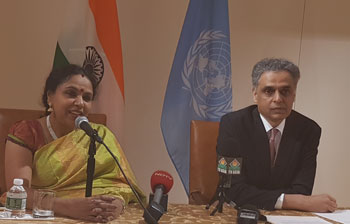 NEW YORK, Sept 30: The Permanent Mission of India to the United Nations is organizing a sevent to commemorate the International Day of Non-Violence on October 2, the birth anniversary of Mahatma Gandhi. The event is a reminder to Mahatma Gandhi’s unequivocal message to uphold values of peace, tolerance and understanding, according to Ambassador Syed Akbaruddin, India’s Permanent Representative to the U.N.
 UNITED NATIONS, Sept 30: UN secretary-general Ban Ki-moon on Friday offered to act as mediator between India and Pakistan to defuse rising tensions over disputed Kashmir.
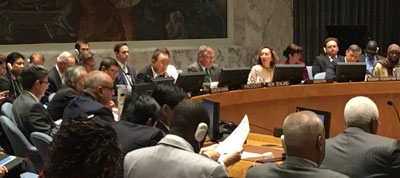 Syria’s largest city before the war, Aleppo has been divided for years between government and rebel zones.
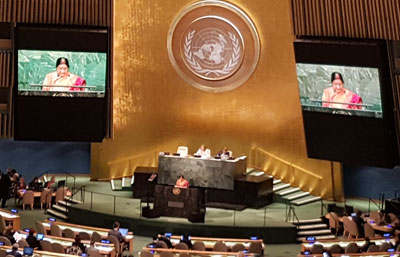 UNITED NATIONS, Sept 26: India's External affairs minister Sushma Swaraj on Monday urged the world community to “join hands to script an effective strategy” against the menace of terrorism.
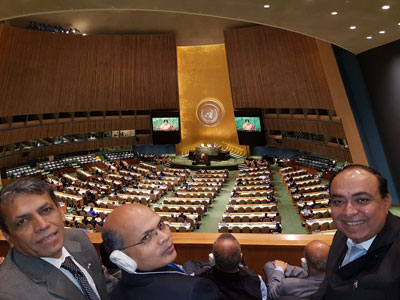 Referring to Sharif’s address at the UNGA on September 21, Swaraj said: “Those living in glass houses should not throw stones.”
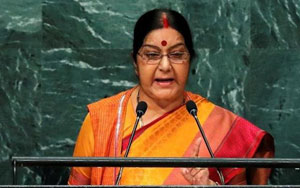 External affairs minister Sushma Swaraj on Monday addressed the United Nation General Assembly, speaking on several issues and focusing on terrorism. Swaraj said that terrorism is the biggest violation of human rights.
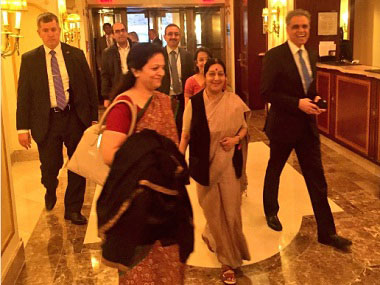 NEW YORK, Sept 24: India's External Affairs Minister Sushma Swaraj arrived here on Saurday afternoon. She will address the United Nations General Assembly on September 26.
 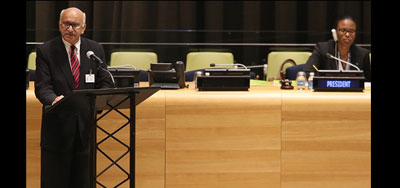 NEW YORK, Sept 24: Minister of State for External Affairs MJ Akbar on Saturday night said that Pakistan’s discourse had no takers in United Nations.
 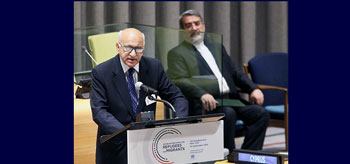 Speaking at a high-level segment on Right to Development, he said the challenge of the 21st century is to seek peace in all its dimensions and there is no peace greater than peace of mind. “Food, shelter and an economic future are fundamental human rights. They must become the new normal in every corner of the globe,” he said.
 NEW YORK, Sept 21: India has named Pakistan a “terrorist state” and accused it of carrying out “war crimes” against Indians through its “long-standing policy” of sponsoring terrorism. The statements came hours after Islamabad raked up Kashmir issue at the 71st UN General Assembly session.
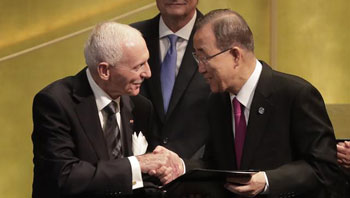 NEW YORK, Sept 19: With more people forced to flee their homes than at any time since World War II, global leaders on Monday approved a declaration aimed at providing a more coordinated and humane response to the refugee crisis that has strained resources and stoked divisions from Africa to Europe.
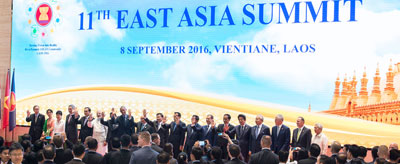 VIENTIANE, Sept 8: While hailing Asia’s economic growth and progress on development, United Nations Secretary-General Ban Ki-moon has expressed concerns over the tensions on the Korean Peninsula and in the South China Sea.
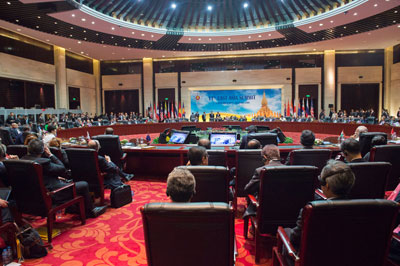 In a press statement on Tuesday, the Council condemned the ballistic missile launches conducted by the DPRK on Monday, 5 September, and called again on the DPRK to refrain from further actions in violation of Council resolutions and to comply fully with its obligations under these resolutions.
Aviation
| Business | Defence | Foreign
Affairs | Communication | Health
| India | United Nations
India-US
| India-France | Entertainment
| Sports | Photo Gallery |
Tourism | Advertise with Us
| Contact Us
© Noyanika International, 2003-2009. All rights reserved.