


United Nations
|
Sushma Swaraj asks Pak to give up terrorism
"The future of the international community is now dependent on how we respond to the greatest threat that we face today -- Terrorism. Countries that support terror must be made to pay a heavy price," Ms Swaraj said. Naming Pakistan, she said the mastermind behind the Mumbai terror attacks are walking free. "New attacks are taking place. Recently we have caught two Pakistani terrorists alive," she said. "These terror attacks are meant to destabilise India and legitimise Pakistan's illegal occupation of parts of Jammu and Kashmir." India does not have four points, it has only one, she said. "Give up terrorism and we will sit and talk." Talks and terror cannot go together, she said. If the response is "serious and credible", India is prepared to address all outstanding issues through a bilateral dialogue. Pakistan Premier Sharif's four-point "peace initiative" included demilitarisation of Kashmir and an unconditional mutual withdrawal from Siachen Glacier. In his address on Wednesday, he had also said non-resolution of the Kashmir issue was a failure of the United Nations. Exercising the right to reply, India had accused Mr Shaif of misusing the global forum to "distort reality and portray a false picture of the challenges in our region." Over the weekend, Prime Minister Narendra Modi, in an address to the Indian community in California's San Jose, had described terrorism as one of the biggest threats to the world. Taking an apparent dig at the UN, he said, "They can't distinguish between good terrorism and bad terrorism in our world. Terrorism is terrorism." The proposed National Security Adviso level talks between India and Pakistan got scuttled last month after Pakistan insisted on raising the Kashmir issue and meeting the leaders of Hurriyat. Pak breeding and sponsoring terrorists, says India at UNUNITED NATIONS, Oct 1: India hit back strongly at Pakistan after it raked up the issues of Kashmir and LoC ceasefire violations at the UN, asserting that Islamabad is actually a victim of its own policies of breeding and sponsoring terrorism. Exercising India’s Right of Reply during the general debate of 70th session of UN General Assembly here late Wednesday, first secretary in the permanent mission of India to the UN Abhishek Singh termed as “regrettable” Pakistan once again choosing to “misuse” the high level segment of the UN General Assembly session to “distort reality and portray a false picture of the challenges in our region”. Pakistan prime minister Nawaz Sharif, in his address to the General Assembly earlier in the day, had said his country is the “primary victim” of terrorism. The heart of the matter is a state that regards the use of terrorism as a legitimate instrument of statecraft. The world watches with concern as its consequences have spread beyond its immediate neighbourhood. "All of us stand prepared to help, if only the creators of this monster wake up to the dangers of what they have done to themselves,” Singh said, adding that Pakistan was seeking to mask its activities as though an outcome of domestic discontent in Jammu and Kashmir carries no credibility with the world. On Sharif’s remarks that Jammu and Kashmir is under foreign occupation, Singh said the “occupier in question is Pakistan.” On Sharif’s reference to ceasefire violations and exchanges of fire along the Line of Control and the International Boundary, Singh said the world knows that the ”primary reason for firing is to provide cover to terrorists crossing the border. "It needs no imagination to figure out which side initiates this exchange,” he said. He added that it is not uncommon for states, when confronted with serious challenges, to shift responsibility on others. "That is the case with Pakistan and terrorism, reflecting the inability to recognise that this is a home grown problem that has begun to bite the hand that fed it. We agree that terrorism has underlying causes in this case, poverty of wisdom and ignorance of consequences,” he said. He also pointed out that India’s reservations about the proposed China-Pakistan economic corridor stem from the fact that it passes through Indian territory “illegally occupied” by Pakistan for many years. On Sharif saying that the dispute over Jammu and Kashmir remains unresolved and that dialogue has not progressed, Singh said “this is because Pakistan has chosen to disregard its commitments, whether it was under the 1972 Simla Agreement, the 2004 Joint Declaration forswearing terrorism, or more recently, the understanding between our two Prime Ministers at Ufa”. Singh asserted that on each occasion, it is India that has extended the hand of friendship. "India remains open even today to engage Pakistan on outstanding issues in an atmosphere free of terrorism and violence,” he said. Success of peacekeeping missions depends on UN’s moral force: ModiUNITED NATIONS, Sept 29: Pressing for reforms in the United Nations Security Council, Prime Minister Narendra Modi rued on Tuesday that nations contributing to UN’s peacekeeping operations had no say in the decision-making process. “Success of peacekeeping ultimately depends not on the weapons they (soldiers) carry but on the moral force of the UNSC,” Modi said, addressing a summit on peacekeeping hosted by US President Barack Obama at the UN headquarters in New York. Modi, who has been demanding a permanent berth for India at the UNSC, said the country was committed to the peacekeeping efforts, and announced the contribution of one additional battalion of Indian troops comprising 850 soldiers and three police units, and higher representation of women peacekeepers. “The problems arise to a large extent because troop contributing countries do not have a role in decision-making process,” he told a gathering of world leaders, including Obama, UN Secretary General Ban Ki-moon and Pakistan Prime Minister Nawaz Sharif. India is one of the largest contributors to the peacekeeping, having provided 180,000 soldiers to 48 of the 69 such missions. More than 125,000 troops and police from 120 countries serve in the UN’s 16 peacekeeping missions worldwide. Modi underlined the need for carrying out the “long-pending task of reforms” of the UNSC to ensure its “relevance and effectiveness”, welcoming the peacekeeping summit that came at a time when the UN is in the 70th year of its existence. The Indian PM said the security environment was changing fast, with peacekeepers facing a range of complex challenges as demands are growing and resources are decreasing. He reiterated that India had been contributing to such missions from the beginning and was the first to send its female unit to Liberia. As many as 161 Indian soldiers have made sacrifice during peacekeeping missions, Modi said. “This legacy of sacrifice is shared by three nations present here,” he said, in an apparent reference to Pakistan and Bangladesh. Speaking at the summit, US President Obama said more than 50 countries have offered to contribute some 30,000 new troops and police to the UN’s struggling peacekeeping missions. The pledges represent a major boost to UN blue helmet operations as peacekeeping demands grow worldwide and conflicts become deadlier. The new contributions include helicopters, engineering units, field hospitals and bomb-detonating expertise that is desperately needed to bolster UN peace missions. UN chief demands Burkina Faso military shows 'restraint'UNITED NATIONS, Sept 18: UN secretary general Ban Ki-moon called on Thursday for Burkina Faso's military to "exercise restraint", after three people died and scores more were injured in protests following a coup. Ban condemned "in the strongest terms" the coup led by a close ally of toppled ex-leader Blaise Compaore and warned that those responsible for any bloodshed would face justice. The UN chief called on the country's "defense and security forces to exercise restraint and ensure respect for the human rights and security of all Burkinabe citizens." "Those responsible for the coup d'etat and its consequences must be held accountable." It was the second strongly worded statement from the UN chief in two days and came after the Security Council condemned the actions in the west African nation and also demanded the release of the arrested leaders. It comes after presidential guard members loyal to Compaore burst into a cabinet meeting on Wednesday and seized acting president Michel Kafando, prime minister Isaac Zida and two ministers. Ban said he was "outraged" by the attack and demanded that the leaders be immediately released. General Gilbert Diendere, Compaore's former chief of staff, was appointed head of a governing council, which announced a nighttime curfew and shut down the borders. Diendere ousted a transitional authority that had been charged with running the Sahel nation until presidential and legislative elections are held, the first round of which is due to take place on October 11. UN Security Council is failing Syria, admits Ban Ki-moon
The UN secretary general told the Guardian that Russia and China should ‘look beyond national interest’ and stop blocking Security Council action on the Syria conflict as the influx of refugees hits record levels. “We need some solidarity, unity of purpose, particularly among the permanent members of the security council,” he said in an interview. “When they are divided, it is extremely difficult for the United Nations to deliver. That’s why I’ve been urging the members of the Security Council to look beyond national interest. We have to look for the global interest. “When the Security Council members are united we have seen very speedy and tremendous impact in addressing the issues, as we have seen in the case of chemical weapon investigation in Syria.” Although Ban did not name Russia and China, the two countries have repeatedly blocked resolutions critical of the Syrian government, threatening to impose sanctions or tried steering it towards a negotiated settlement. Last year China and Russia vetoed a move backed by 13 other permanent and non-permanent members of the Security Council to refer the Syrian conflict for investigation by the International Criminal Court. Ban had backed the referral to the ICC, stating the Syrian people “have a fundamental right to justice.” The UN high commissioner for refugees has described the mass displacement of civilians fleeing the fighting as the largest refugee crisis in a generation. Since the start of the conflict approximately 4 million people have crossed into neighboring countries. While the frustration builds over international action to try and end the Syrian humanitarian crisis being blocked by Moscow and Beijing, criticism of other permanent members’ use of the veto for narrow political interest is longstanding. The US has used its veto to protect Israel from criticism more times than all the number of vetoes cast by permanent members combined. India strongly rejects Pakistan raising Kashmir issue at UNNEW DELHI, Sept 3: Strongly rejecting Pakistan's call for plebiscite in Jammu and Kashmir, India has asserted that the state is an integral part of the country and its citizens have chosen a democratically-elected state government as it lambasted Islamabad for raising the issue at the UN. "Pakistan must know that this is the platform of the Inter-Parliamentary Union where the 2030 development agenda is being discussed," said Lok Sabha Speaker Sumitra Mahajan. She strongly rejected Pakistan raising the issue of Jammu and Kashmir at the Fourth World Conference of Speakers yesterday, saying that the Pakistan representative's remarks on the issue in the UN are "totally irrelevant". Raking up the Kashmir issue at yet another UN forum, Acting Speaker of the National Assembly Of Pakistan Murtaza Javed Abbasi had said in his speech that "it is time" to enable the people of Jammu and Kashmir to exercise their right to self-determination through an "independent and impartial plebiscite under the United Nations". Mahajan said Jammu and Kashmir has been an integral part of India since independence and elections have been held in the state for the past many years. "Pakistan should keep in mind that the people of Jammu and Kashmir have voted to elect their state government. What can be more democratic than this," she said, strongly rejecting Pakistan's call for a plebiscite. She said Pakistan is trying to make an issue out of a non-issue by bringing up Jammu and Kashmir at every platform of the UN. "They are ignoring the realities on the ground. This (Jammu and Kashmir) is not an issue for the UN. They are making a non-issue an issue but they will not get success," she said. She further said that Pakistan is not focusing on the theme of the conference, which is development but bringing a bilateral issue into the forum. "They are not focused on development. They are not thinking about their citizens and how development should take place in Pakistan. But instead every now and then they try to raise only one issue," Mahajan said. In his speech, Abbasi had said that "outstanding disputes" continue to fester in South Asia preventing the region from realising its tremendous economic and social potential. He had claimed "foremost among these disputes" is the issue of Jammu and Kashmir, which is an "internationally recognised" disputed territory, underwritten by several United Nations resolutions. "The Kashmiri people have waited for too long for their just and inalienable right to self-determination. Peace in South Asia is an imperative not only for the people of that region but also for the citizens of a globalised world," he had said. |
|
||||||
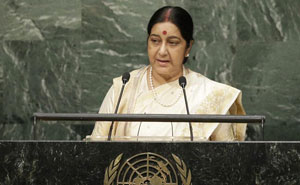 UNITED NATIONS, Oct 3: Declaring Pakistan as a perpetrator of terror, India's External Affairs Minister Sushma Swaraj said that terror attacks should stop before talks between the two nations can begin.
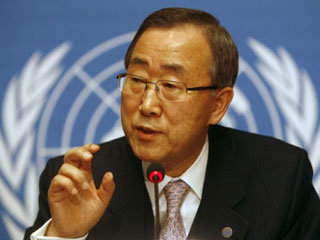 LONDON, Sept 7: The UN Secretary General Ban Ki-moon admits that the UN security council is failing Syria because of big power divides that has cost hundreds of thousands of lives and resulted in the largest civilian displacement of our generation.

Aviation
| Business | Defence | Foreign
Affairs | Communication | Health
| India | United Nations
India-US
| India-France | Entertainment
| Sports | Photo Gallery |
Tourism | Advertise with Us
| Contact Us
© Noyanika International, 2003-2009. All rights reserved.