


United Nations
|
India's Aakash tablet unveiled at UNBy Deepak Arora
On the occassion, the Permanent Mission of India to United Nations, New York hosted a special event to unveil and launch the world's most cost competitive tablet Aakash2 at the United Nations today. Terming India as a 'superpower on the information superhighway', he appreciated the launch of technologies such as the Aakash2, which helped bridge the digital divide.
Terming it a product of 'frugal innovation', Mr Tuli outlined that the device incorporated that best of innovative hardware design with a unique business model, and reflected Government of India's commitment to eliminating illiteracy by equipping all 220 million students in India over the next 5 years with low cost computers & internet. UN recognizes State of PalestineUNITED NATIONS, Nov 29: The United Nations voted overwhelmingly on Thursday to recognize a Palestinian state, a long-sought victory for the Palestinians but an embarrassing diplomatic defeat for the United States. The resolution upgrading the Palestinians' status to a nonmember observer state at the United Nations was approved by a more than two-thirds majority of the 193-member world body, a vote of 138-9, with 41 abstentions. A Palestinian flag was quickly unfurled on the floor of the general assembly, behind the Palestinian delegation. In the West Bank city of Ramallah, hundreds crowded into the main square waved Palestinian flags and chanted "God is great." Others who had crowded around outdoor screens and television sets to watch the vote hugged, honked and set off fireworks before dancing in the streets. Real independence, however, remains an elusive dream until the Palestinians negotiate a peace deal with the Israelis, who warned that the General Assembly action will only delay a lasting solution. Israel still controls the West Bank, east Jerusalem and access to Gaza, and it accused the Palestinians of bypassing negotiations with the campaign to upgrade their UN status. The United States immediately criticized the historic vote. "Today's unfortunate and counterproductive resolution places further obstacles in the path peace," UN ambassador Susan Rice said. And US secretary of state Hillary Clinton called the vote "unfortunate" and "counterproductive." The United States and Israel voted against recognition, joined by Canada, the Czech Republic, Marshall Islands, Micronesia, Nauru, Palau and Panama. Israeli Prime Minister Benjamin Netanyahu called the speech by Palestinian President Mahmoud Abbas to the General Assembly shortly before the vote "defamatory and venomous," saying it was "full of mendacious propaganda" against Israel. He called the vote meaningless. Abbas had told the General Assembly that it was "being asked today to issue the birth certificate of Palestine." Abbas said the vote is the last chance to save the two-state solution. After the vote, Netanyahu said the UN move violated past agreements between Israel and the Palestinians and that Israel would act accordingly, without elaborating what steps it might take. Just before the vote, Israel's UN ambassador, Ron Prosor, warned the General Assembly that "the Palestinians are turning their backs on peace" and that the UN can't break the 4,000-year-old bond between the people of Israel and the land of Israel. The vote had been certain to succeed, with most of the member states sympathetic to the Palestinians. Several key countries, including France, this week announced they would support the move to elevate the Palestinians from the status of UN observer to non-member observer state. Thursday's vote came on the same day, November 29, that the UN General Assembly in 1947 voted to recognize a state in Palestine, with the jubilant revelers then Jews. The Palestinians rejected that partition plan, and decades of tension and violence have followed. The vote grants Abbas an overwhelming international endorsement for his key position: establishment of a Palestinian state in the West Bank, Gaza Strip and east Jerusalem, the territories captured by Israel in the 1967 Mideast war. With Netanyahu opposed to a pullback to the 1967 lines, this should strengthen Abbas' hand if peace talks resume. The overwhelming vote also could help Abbas restore some of his standing, which has been eroded by years of standstill in peace efforts. His rival, Hamas, deeply entrenched in Gaza, has seen its popularity rise after an Israeli offensive on targets linked to the Islamic militant group there earlier this month. Israel has stepped back from initial threats of harsh retaliation for the Palestinians seeking UN recognition, but government officials warned that Israel would respond to any Palestinian attempts to use the upgraded status to confront Israel in international bodies. The Palestinians now can gain access to UN agencies and international bodies, most significantly the International Criminal Court, which could become a springboard for going after Israel for alleged war crimes or its ongoing settlement building on war-won land. However, in the run-up to the UN vote, Abbas signaled that he wants recognition to give him leverage in future talks with Israel, and not as a tool for confronting or delegitimizing Israel, as Israeli leaders have alleged. |
|
||||||
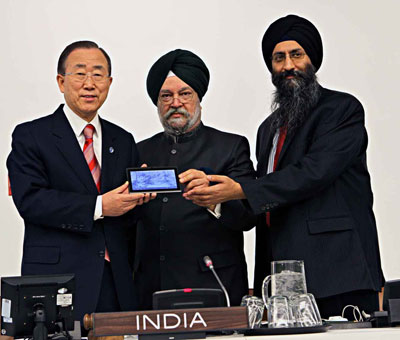 UNITED NATIONS, Nov 28: On the occassion of India's Presidency of the UN Security Council, UN Secretary General, Mr. Ban Ki-moon, unveiled the Aakash2 Tablet at the United Nations.
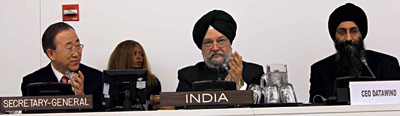 Calling them as 'great enablers' with potential to transform people's lives, he encouraged partners around the world to work with the United Nations to help young people reach for the sky and meet their dreams.

Aviation
| Business | Defence | Foreign
Affairs | Communication | Health
| India | United Nations
India-US
| India-France | Entertainment
| Sports | Photo Gallery |
Tourism | Advertise with Us
| Contact Us
© Noyanika International, 2003-2009. All rights reserved.