


United Nations
|
UN elects Justice Dalveer Bhandari to ICJBy Deepak Arora
Prior to that, he had a distinguished and successful career as an attorney at law for 23 years. He is also a member of leading international academic and legal bodies and is closely associated with a large number of Committees dealing with various aspects of International Law such as: Human Rights, Biotechnology, Sustainable Development, Securities Regulation, Trade, Nuclear Weapons, Non-Proliferation & Contemporary International Law and Space. Justice Bhandari will serve the remainder of the term 2012-18. India was last represented at the ICJ more than two decades ago. India, Pakistan should continue peace talks: Ban Ki-moon
Ban also praised India’s “leadership role” at the UN Security Council and said New Delhi showed “great wisdom” and stuck to “principled positions” especially in the case of West Asian countries, during the Arab Spring. Responding to a question on the recent launch of Agni-V, he also encouraged India to engage in “dialogue” to permanently eliminate nuclear weapons. On the second day of his four-day visit, the UN Secretary General met Prime Minister Manmohan Singh, UPA chairperson Sonia Gandhi, Lok Sabha Speaker Meira Kumar and held talks with External Affairs Minister S M Krishna. When asked about his discussion with the Prime Minister on terrorism, he said that “terrorism cannot be justified by stating any reasons or justifications”. Referring to the Mumbai terror attack, he said: “All perpetrators of this crime should be brought to justice as soon as possible.” He called for the international community to be “united” in the war against terrorism, as “it is not possible for a single country” to tackle the issue. He also said that India and Pakistan should continue their dialogue on regional security and peace to enable “better, improved relations” between them. He advocated peaceful resolution of Kashmir issue while respecting the “will” of the people there. “Main yahaan aakar bahut khush hun,” said Ban Ki-moon at Delhi’s Jamia Millia Islamia University Friday. Discussing ‘India’s role in the family of nations’, he said as the second-largest contributor to UN Democracy Fund ($30million in past five years), India was the “backbone” of UN efforts to “prevent further conflict and keep peace”. Urging tolerance, he said it was crucial for India to pass the test not only for itself but for the world. “I count on India to show the way.” During his meeting with the Prime Minister, the UN chief lauded India's efforts on public health and sustainable development, the Prime Minister's Office said. He had said the UN would wish to help India in dealing with polio, malaria, tetanus, measles and HIV transmission related mortality. Describing India as a "regional and global force", UN Secretary-General Ban Ki-moon asked it to "do even more" in advancing peace and security in the region while tackling human rights challenges through legislation and other means. He also hoped that India would find a way to build and strengthen partnerships of common ground with its neighbours without naming any specific country. Addressing a gathering after being conferred Degree of Doctor of Letters (Honoris Causa) by Jamia Millia Islamia, he said it was imperative for India to tackle its own human rights challenge through legislation, policy and action to protect citizens regardless of gender, identity or social origin. "I believe India will also find the way to build and strengthen partnerships of common ground with your neighbours. I know there are many challenges, but I see a future of steadily warmer ties built on a shared heritage and a common future," he said in his 20-minute speech. Calling himself a "student of India", Ban lauded the country's rise as a economic power and asked it to make more efforts to eradicate maternal mortality rate and reduce the number of children dying due to preventable diseases. As the world looks ahead, Ban said he would encourage India as a "regional and global force" to do "even more" in advancing peace and security, in sharing its experiences and in deepening south-south cooperation. In his speech which began with a 'Namaste' and ended with "Dhanyavad', Ban quoted Mahatma Gandhi, Maulana Abul Kalam Azad and Nobel Laureate Rabindranath Tagore to drive home his point that India has to play a larger role in the 21st century. Noting that tolerance is being tested here and around the world, Ban said it is crucial for India to pass those tests not only for the country but for the world in which the country's profile is so distinct and admired. Lauding the "Indian progress" and "Indian leadership" in eradicating polio, the UN chief hoped that same would be achieved in eradicating other diseases. He reminded India that it has to do a lot more in eradicating maternal mortality rate and reduce the number of children dying due to preventable diseases. Every week, more than 1,000 Indian mothers die from pregnancy or childbirth and every 20 seconds, an Indian child under five dies from a largely preventable cause, he said. "This is one of the most difficult development challenges we face anywhere in the world. But if we make progress on women's and children's health, we can unleash progress across the Millennium Development Goals," he said. Referring to India's "rich tradition of outstanding" women leaders, he termed the election of 10 lakh women to village councils as a "remarkable achievement". Contending that worries about economic uncertainties and corruption have raised questions whether institutions are up to the task, Ban said old order is breaking and "we do not yet know the shape of the new." "The 21st century mix of change and challenge brings me to India. You are the world's largest democracy. You are an emerging economic leader. You are a superpower on the information superhighway. You are a beacon for the world -- proving that democracy and development are one and the same path," he said. On economic slowdown and inequality, Ban said growth was alone not enough and that the world needs inclusive growth that reduces inequalities and moves people from the "margins to the mainstream". "That is why we have made the challenge of sustainable development the leading priority of the United Nations," he said. During his four-day stay, India will convey its views on major regional and global issues apart from strongly pitching for an expansion of the Security Council with its inclusion as a permanent member. Syria accepts 10th April peace deadline: Annan
The former UN chief briefed the powerful 15-member UNSC in a closed session by video-conference from Geneva on the latest developments concerning Syria and his efforts to address the crisis in the country. He asked the Council to support the 10th April deadline and begin consideration of a potential UN monitoring mission to Syria. Later talking to reporters, US Ambassador to the UN Susan Rice said Annan has pressed the Syrian government to cease troop movements, use of heavy weapons and pull out of troops from population centres by 10th April. Annan told the UNSC that the Syrian foreign minister sent him a letter on Monday, in which he said that the Syrian military will begin immediately and will complete by 10th April "the cessation of all forward deployment and use of heavy weapons and will complete its withdrawal from population centers," Rice, who is the current President of the UNSC, said. Annan urged the government of Syria to start implementing the withdrawal plans immediately and to ensure that forces move no further into population centers. Rice said while the Syrian government has not put any "conditions or preconditions" to begin implementing Annan's peace plan, she cautioned that "over the course of the last many months promises (have been) made and promises broken." "We have seen commitments to end the violence followed by massive intensification of violence," she said, adding that the proof will lie in actions, not in words. India contributes a further US $ 4.71 million to the UN Democracy Fund
The large majority of funds go to local civil society groups- both in the transition and consolidation phases of democratization. UNDEF plays a unique role complementing the UN's traditional work with Governments to strengthen democratic governance around the world. UNDEF projects exist in developing countries, in societies in transition and in challenging environments. UNDEF projects are two years long and fall under one or more of six main areas: a) Community development b) Rule of law and human rights c) Tools for democratization d) Women e) Youth f) Media. UNDEF is based on voluntary contributions from Governments; in 2010, it surpassed 110 million dollars in contributions and now counts 39 countries as donors, including many middle- and low-income States in Africa, Asia and Latin America. UNDEF grants range from US$50,000 to US$500,000. Applications are subject to a rigorous and competitive selection process, as UNDEF receives an average of about 2,000 applications a year and only some 60-70 are selected. Presently, the Advisory Board of UNDEF (for 2012 – 2013) comprises 19 members: 13 Member States, including the seven largest contributors to UNDEF (USA, India, Australia, France, Germany, Spain, Sweden) and six countries reflecting geographical diversity and commitment to democratic principles (Jamaica, Lithuania, Tanzania, Timor - Leste, Tunisia, Uruguay) ; three individual members (Prof. Michael Doyle, Professor of International Affairs, Columbia University - Chair, Ms. Shazia Rafi, Secretary General, Parliamentarians for Global Action, Mr. Jeffrey Wright, Actor and Founder, Taia Peace Founder),; and two civil society organizations (Women's Environment and Development Organisation -WEDO and Third World Network). Ban welcomes UNSC mesasage to SyriaNEW YORK, March 22: UN chief Ban Ki-moon welcomed UN Security Council's "clear and unified" message to the Syrian government, saying the adoption of statement marks a "turning point" in the international community's response to the year-long crisis in the Arab country. The 15-nation UNSC adopted the statement that backs joint UN-Arab League envoy Kofi Annan's six point proposals to end the violence and human rights violations, secure humanitarian access and facilitate a comprehensive political dialogue between the Syrian government and opposition. Welcoming the adoption of the statement, Ban said he is "encouraged by the clear and unified message of the Council," which has extended its support to Annans efforts to finding a solution to the year-long Syrian crisis that has killed over 8000 people. As the situation continues to deteriorate in Syria, "it is more urgent than ever to find a solution that will end the tragic suffering of the Syrian people," Ban said, adding that the united action by the Council marks a "turning point" in the international communitys response to this crisis. Ban "adds his voice to the Council's in calling upon the Syrian government and opposition to work in good faith with the Joint Special Envoy towards a peaceful settlement of the Syrian crisis, and to implement fully and immediately his initial six-point proposal submitted to the Syrian authorities," a statement by Ban's spokesperson said. In the statement, the Security Council called upon the Syrian Government and opposition to work with Annan towards a peaceful settlement of the Syrian crisis and to implement fully and immediately his initial six-point proposal. It also said it will consider "further steps as appropriate" based on any progress reported by Annan on his mission. The presidential statement is non-binding in nature but still becomes part of the UN records. Unlike a UN resolution, a presidential statement can be adopted if it is approved unanimously by all 15 Council members and does not require nine votes in favour and no vetoes from the five permanent council members to be passed. The last presidential statement on Syria was adopted in August 2011, when India held the rotating presidency of the UNSC. UN diplomats called the adoption of the statement a "good sign", given that Russia and China have in the past not been on the same page as the other Council members. Russia's UN Ambassador Vitaly Churkin said the council had "finally chosen to take a pragmatic look at Syria" by adopting the statement. Annan meets Assad in crux bid to end bloodshed
State media reported the start of talks between President Bashar al-Assad and Annan, on his first visit since being named international envoy on the conflict. It came as a human rights group reported fierce shelling of Idlib in northwest Syria and a day after another 70 civilians were killed in the regime's crackdown on dissent. Human rights watchdogs say the conflict has cost more than 8,500 lives since last March. Emissary of the United Nations and the Arab League, Annan has the support of Damascus allies Beijing and Moscow and his mission has been welcomed by the both the Syrian government and opposition. But Russia said its Foreign Minister Sergei Lavrov made clear to Annan at a meeting earlier in Cairo that Moscow was opposed to "crude interference" in Syria's affairs. "A particular emphasis was placed on the inadmissibility of trampling on international legal norms, including through crude interference in Syria's internal affairs," the foreign ministry said. Current UN chief Ban Ki-moon said that Annan would demand an immediate end to the violence and aid agency access to besieged protest cities to evacuate casualties and provide desperately needed relief supplies to civilians trapped by the fighting. "I very strongly urged Kofi Annan to ensure there must be an immediate ceasefire," Ban said. "I also asked him to urge Assad to facilitate humanitarian assistance and access." Ban said that Annan would seek to encourage dialogue between Assad's government and the opposition but that he would not meet opposition figures inside Syria and would not travel outside Damascus on his two-day visit. His predecessor would meet Assad, other government officials, "civil society" representatives and aid workers in the Syrian capital, Ban told reporters at UN headquarters. "He will be engaging with opposition leaders outside of Syria," Ban added. "There should be an inclusive political solution." When he leaves Damascus on Sunday, Annan will travel on to neighbouring countries to press his mission to end the bloodshed, the UN chief said. |
|
||||||
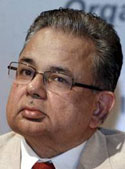 NEW YORK, April 27: The international community on Friday voted overwhelmingly to elect Dr. Justice Dalveer Bhandari, Senior Judge in the Supreme Court of India to the ICJ. In simultaneous elections held today at UN headquarters in New York, Dr. Justice Dalveer Bhandari obtained 122 votes in the General Assembly and an absolute majority in the Security Council.
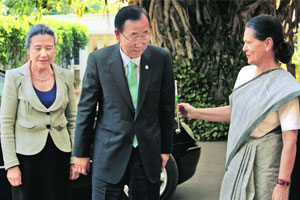 NEW DELHI, April 27: United Nations Secretary General Ban Ki-moon on Friday asked India and Pakistan to continue with the peace dialogue, saying it is “significant” for both regional and global peace. He also called for bringing the perpetrators of the Mumbai terror attacks to justice.
 NEW YORK, April 3: The Syrian govt has agreed to pull back its troops from cities and complete withdrawal of heavy weapons by 10th April, UN-Arab League envoy Kofi Annan told the UN Security Council, even as western nations expressed doubts that the new promises would be kept.
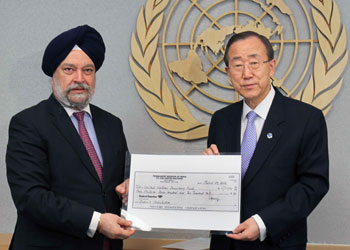 NEW YORK, March 30: The Permanent Representative of India to the UN, Ambassador Hardeep Singh Puri, today handed over a cheque for USD 4.71 million to Mr Ban Ki-moon, Secretary General of the UN, as a further contribution from India to the UN Democracy Fund (UNDEF). UN Secretary General thanked India for its consistent support to the UNDEF and said that he was pleased to receive the contribution from the 'greatest democracy'.
  DAMASCUS, March 10: Former UN chief Kofi Annan held crux talks in Damascus on Saturday with the hopes of the world pinned on his bid to prevent a nearly year-old uprising spiralling into all-out civil war.

Aviation
| Business | Defence | Foreign
Affairs | Communication | Health
| India | United Nations
India-US
| India-France | Entertainment
| Sports | Photo Gallery |
Tourism | Advertise with Us
| Contact Us
© Noyanika International, 2003-2009. All rights reserved.