


Environment
|
Climate change to displace millions: UN reportNEW DELHI, June 11: Climate change could uproot millions in the future causing displacement and migration, warns a new UN-supported report. The report said that displacement will get worse "unless vulnerable populations, especially the poorest are assisted in building climate-resilient livelihoods." Researchers interviewed more than 2,000 migrants in various parts of the world and mapped climate change in the Ganges, Nile and Mekong deltas, Tuvalu and the Maldives are among other areas. The publication supported by the UN University (UNU), UNHCR, the World Bank, Columbia University and the NGO CARE was launched at the UN climate change conference under way in Bonn, Germany. "In coming decades climate change will motivate or force millions of people to leave their homes in search of viable livelihoods and safety," it said. "Unless aggressive measures are taken to halt global warming the consequences for human migration and displacement could reach a scope and scale that vastly exceed anything that has occurred before," it warned. Koko Warner of UNU's Institute for Environment and Human Security told UN Radio that the majority of the migrants polled said that the environment has affected their decision on where and how to live. "People make their decision about migration to a large extent on their livelihood security," Warner said. The report recommends that all countries avoid climate changing activities, plan for human security, invest in resilient livelihoods, prioritize the world's most vulnerable populations and include migration and adaptation strategies in future planning. In Bonn, negotiations on a new agreement to curb greenhouse gas emissions, set to replace the Kyoto Protocol, are continuing to progress steadily, UN spokesperson Marie Okabe reported. Reducing deforestation as well as the facilitation and financing of technologies to help developing countries address climate change are among the issues delegates have been tackling at the two-week Bonn meeting which wraps up on Friday. Return your junk phone, get a tree plantedNEW DELHI, June 7: Every time you return a junk mobile phone to a Nokia dealer, the firm will thank you by planting a tree, apart from recycling that phone in an eco-friendly manner. Announcing the initiative on World Environment Day, Ambrish Bakaya, director of corporate affairs in Nokia India, said the firm had already tied up with two NGOs in Tamil Nadu and Karnataka to plant 22,000 trees. The programme would soon be extended to the top 15 cities of the country, he added. "We already have 1,300 bins at our main dealers' shops around the country where people can throw in their junk phones," Bakaya said. The mobile phone manufacturer with the largest market share in India has been getting a good response. "Now we have tied up with an NGO called Ahimsa in Kancheepuram district of Tamil Nadu to plant 12,000 trees, and with Bangalore's Rotary Midtown to plant 10,000 trees in educational institutions around that city." Nokia has also been working computer manufacturers to strengthen the laws on recycling of e-waste, which threatens to become a major problem in India. Saying that the firm was working with the Manufacturers Association for Information Technology, the Ministry of Environment and Forests and the Department of Telecommunications to put together stronger guidelines on the subject, Bakaya added: "We welcome any step which helps strengthen e-waste management and creates awareness about the need to recycle e-waste in an eco-friendly manner". World celebrates Environment DayNEW DELHI, June 5: India celebrated World Environment Day on Friday along with other countries. The theme this year reflects the urgency for nations to take adaptation and mitigation measures to address climate change consistence with the policy of sustainable development and reach agreed outcomes at the crucial climate convention meeting slated in Copenhagen in December 2009. The day has been marked by the United Nations to observe as World Environment Day to give a human face to environment issues, empower to become agents of sustainable and equitable development, promote to change attitude regarding the environment and advocate partnership between each human being and each society to ensure a safer and more prospers future. World Environment Day is being celebrated since 1974 every year. Diffferent themes have been declared to tackle various issues to protect environment. Indian President appeals to contribute to ensure health, diversity of the planet and conserve resourcesNEW DELHI, June 5: Indian President Pratibha Devisingh Patil appealed all citizens to contribute to ensure health and diversity of the planet and conserve its resources. Speaking at the World Environment Day function here today, she said that the International community is currently engaged in the process of negotiations on climate change. Regarding this climate change challenge, the President further said that eradication of poverty and the imperatives of economic and social development have been recognized as the over-riding priority for developing countries in all international conventions on sustainable development and environment. India needs an international environment supportive of its endeavour for ecological sustainable development. Support of financial resources and technology transfer are required. She emphasized on research partnerships between developed and developing countries to work towards cost effective technological innovations. Referring to the slogan for the World Environment Day this year, "Your Planet needs you - Unite to respond to climate change", she said that this is a reminder of the need for collective efforts to tackle the threats emanating from climate change, which is a major global environmental concern of our time. This challenge impacts each one of us in our habitats and affects our way of life. Quoting a shloka from Varaha Purana, she explained that as long as there are mountains and green forests on Earth, till then we and our future generations will survive and live happily. The President calls to inculcate the spirit of economical and optimum use of resources - be it electricity, paper, water, or any other resource. This will be an important contribution of individuals to the global effort to respond to climate change. In India, we have been practicing the spirit of reuse and recycle since time immemorial. It is a part of the Indian ethos not to waste anything. The President specially appealed the children to take a pledge to plant a tree by the end of this season, donate non-usable items to charitable organizations and imbibe the habit of carrying a cloth bag for shopping and say no to plastic. Jairam Ramesh, the Minister for Environment & Forests, remembered late Prime Minister Indira Gandhi who provided global leadership to the cause of development and environment. The Minister said that she advocated the welfare of human-kind and planet at global level. He said that it is a tough choice between economic development and sustainable development but the Ministry will preserve rivers, forests and ensure bio-diversity conservation. Regarding relocation of National Museum of Natural History, he assured that the Museum will be allotted place near Pragati Maidan and it will have the status of International repute. Dr. Ashok Khosla, Chairman, Development Alternatives and President, IUCN and Club of Rome, in his key-note address, said that our actions and life-styles caused the bulk of environment damage and now we have to apply corrective measure. He added that World Environment Day reminds us that we can go on counting the benefits and ignoring the costs of our activities only at our peril. Earlier, the President presented Indira Gandhi Paryavaran Puraskaar (IGPP). These awards were given to organizations and individuals who made measurable and major impact in the protection of environment. For the year 2006, Bongaigaon Refinery and Petro-chemicals Limited, Assam and 130 Infantry Battalion (TA), Ecological, Uttrakhand received joint award in organization category. Dr. J. Raghav Rao from Chennai, Tamil Nadu and Smt. S. Annapurna from Vizianagaram, Andhra Pradesh were awarded IGPP in individual category. IGPP Awards for the year 2007, BAIF Institute of Rural Development, Tiptur, Karnataka and Antyoday Nirbal Durbal Shoshit Mahila Evam Bal Kalyan Samiti, Luknow, Uttar Pradesh were awarded joint IGPP award in organization category. Shri Afzal Khatri and Smt. Nusrat Khatri from Mumbai, Maharashtra jointly and Dr. Rachna Gaur, Rajsamand, Rajasthan got IGPP award in individual category. The Young Environmentalist of the Year 2009 Award to Master Aviral Saxena, a Class X student of Jawaharlal Nehru School, Bhopal. He received an award of Rs. 10,000/-, a trophy, a certificate, a medal and a scroll. He got maximum marks in National Level Written Quiz Competition organized on 22nd April, 2009 on the occasion of the ‘Earth Day’. The Competition was organized by the National Museum of Natural History at its five centres located at Mysore, Bhopal, Bhubaneswar, Sawai Madhopur and New Delhi. The discoveries of flora and fauna during the year 2008 were also released on this occasion by the Minister for Environment & Forests and presented to the President. These species have been classified and published in the Books entitled ‘Animal Discoveries – 2008’ and ‘Plant Discoveries – 2008’ by Zoological Survey of India (ZSI) and Botanical Survey of India (BSI) respectively. The ZSI’s scientists have discovered 37 new species where one each is from Nepal and Sri Lanka. Two scientists outside ZSI have also contributed to new species and one new record of sea spider from India. Scientist from BSI and other institutions discovered three genera, 108 species, fourteen sub-species, twelve varieties and one forma as new to science. Twenty-Four species and three varieties have been discovered as new records for Indian flora. The National Award for Prevention of Pollution was also given in two categories for the year 2006 and 2007. No industry was selected for this award for the year 2008. The award comprises of a cash Rs. 1,00,000/- in addition to a silver trophy and a citation. The awards are given to highly polluting industries which have made a significant a measurable contribution towards development or use of clean technologies, products or practices that prevent pollution and find innovative solutions to environmental problems. Medini Puraskaar was also given which have been instituted to promote original writing in Hindi on Environment. Dr. Nishant Singh was awarded first award for his book ‘Paryavaran Vidhi’. He received Rs. 31,000 cash and a citation. This book narrates rules regarding conservation of environment in simple hindi. Pankaj Shrivastava was awarded second award for his book ‘Jungle Rahen, taqi Narmada Bahe’. He received Rs. 25,000 in cash and a citation. The river Narmada has been symbolized as a continuous flow of water and it throws light on importance of forests. Ajay Pathak got third award for his book ‘Jungle ek Geet hai’ and received Rs. 20,000 in cash and a citation. This is a book in verses which attracts common man towards forests. One consolation prize was also given for the book ‘Prayashchit’ written by Mahender Pratap. He received Rs. 15,000 in cash and a citation. This is an interesting novel which gives message on Importance of conservation and preservation of Environment and Forests. A Poster was released on this occasion conveying message to project our environment and adopt clean technology. A book “Environment in Parliament, 2007” and a special issue on Herbal plants of Paryavaran Patrika were also released. Indira Gandhi Paryavaran Puraskar presented on World Environment DayNEW DELHI, June 5: Indian President Pratibha Devi Singh Patil presented Indira Gandhi Paryavaran Puruskar (IGPP) for the years 2006 and 2007 on World Environment Day. These awards are given in recognition to those who have made measurable and major impact in the protection of Environment. Two awards, jointly in organization category and two awards in individual category have been given for each year. Congratulating the awardees, Mrs Patil said the work of awardees and their commitment to the environmental cause will bring good result. Quoting from Varaha Purana, the President said as long as mountains and green forests are flourished on the earth, our future generations will survive and live happily. She asked all to join in efforts to protect and conserve recourses of our planet and appealed to take a pledge to plant a tree and nurture it. For the Year 2006, in organization category, Bongaigaon Refinery and Petrochemicals Ltd., Assam and 130 Infantry Battalion (TA) Ecological, Uttarakhand have been presented IGPP award. In the individual category the first award was presented to Dr. J. Raghav Rao, Chennai, Tamil Nadu and the second award was presented to S. Annapurna, Vizianagaram , Andhra Pradesh. For the Year 2007, two organizations, one from Karnataka and another from Uttar Pradesh got IGPP award jointly. These are BAIF Institutes of Rural Development, Tiptur (Karnataka) and Antyoday Nirbal Durbal Shoshit Mahila Evam Bal Kalyan Samiti, Lucknow, U.P. For the same Year, Afzal Khatri and Nusrat Khatri, Mumbai, Maharashtra got the first IGPP award and Dr. Rachna Gaur, Rajsamand, Rajasthan in the individual category. The organizations have been given Rs.5 lakh. In individual category, the first prize is of Rs.3 lakh and the second individual has been given Rs.2 lakh. Along with the cash prize, awardees are given a silver lotus trophy and a citation. In reverential memory of late Prime Minister Indira Gandhi, the Ministry of Environment and Forests, in the year 1987, instituted an award called “Indira Gandhi Paryavaran Puraskar (IGPP)”. Indira Gandhi had made remarkable contribution in the field of eco-restoration and prompted the concept of sustainable development by combining our age old conservation ethics with the modern scientific and technological advances and emphasised the link between conservation, peace and eradication of poverty. Commissioner Dimas calls for greater ambition in talks on new global agreementEnvironment Commissioner Stavros Dimas called today for greater urgency and ambition in international negotiations on a new global climate agreement, warning that it represents the world's last chance to prevent climate change from reaching dangerous levels. Commissioner Dimas made the remarks in a statement to mark World Environment Day, which has climate change as its theme. Commissioner Dimas's statement reads as follows: The new global climate agreement that is due to be finalised at the Copenhagen climate conference in December is the world's last chance to prevent the dangerous, perhaps even catastrophic, levels of climate change that are projected by scientists to occur as early as 2050 ? well within the lifetimes of over a billion young people alive today. Last week a study for the Global Humanitarian Forum underlined the human tragedy climate change already represents. Today climate change seriously affects 325 million people every year, kills about 315,000 people a year through hunger, sickness and extreme weather, and causes global economic losses of over 125 billion dollars annually, the study estimates. These numbers are projected to rise substantially over the next 20 years. Governments around the world have rightly recognised that the recession is no reason to slow the battle against climate change. Indeed, governments in Europe and elsewhere are designing the stimulus measures our economies need so that they both create jobs and tackle climate change by investing in energy efficiency, renewable energy and other low-carbon technologies of the future. To prevent dangerous climate change, the international scientific consensus tells us that global warming must be kept to less than 2°C above the pre-industrial temperature. This translates into around 1.2°C above today's level since warming of 0.76°C has already occurred, and some studies suggest the amount of greenhouse gases already emitted makes it likely that further warming of up to 1°C is unavoidable. Time is not on our side. Urgent and ambitious global action is therefore imperative if we are to prevent dangerous climate change that threatens to cause enormous human suffering, undermine economic progress and poverty reduction, and trigger potentially catastrophic environmental changes. This need for urgency and ambition must be reflected in the pace and content of the international negotiations to prepare the Copenhagen agreement. The discussions under way in Bonn this week and next must take account of that. They need to inject greater momentum into the talks themselves and turn the draft negotiating texts now on the table into a blueprint for a sufficiently ambitious Copenhagen agreement. The developed world must lead the way. To get global emissions onto the right track to prevent dangerous climate change, developed countries must start by cutting their collective emissions to 30% below their 1990 levels by 2020, in accordance with the science evidenced by the findings of the Intergovernmental Panel on Climate Change (IPCC). The European Union has shown its leadership and determination by putting in place legislative measures to achieve a 20% reduction and by committing to scale this up to 30% if other countries agree to do their fair share. Now our partners need to show leadership, too. Some developed countries have yet to announce emission targets, while those targets on the table so far risk falling well short of the collective 30% reduction needed. Greater ambition is essential. We cannot win the battle against climate change unless developing countries, and particularly the big emerging economies, step up action to limit their rate of emissions growth. But only by setting a strong example themselves will developed countries succeed in convincing the developing world to join the global effort that Copenhagen must launch. DHL turns off the lights for World Environment DayNEW DELHI, June 5: DHL Express, a globally leading provider of express delivery services, today launched ‘My Green Day’ - an initiative designed to raise environmental awareness among employees. By turning off the lights in their offices for one hour, DHL employees around the world are being encouraged to commit to a more conscious use of energy, and hence a greener lifestyle at work and at home. In addition to the lights off initiative, DHL also encourages staff to make personal commitments, starting June 5, to adopt more environmentally conscientious habits and use resources such as paper and water responsibly. Symbolic of DHL’s commitment to reducing its environmental impact, ‘My Green Day’ is aligned with the company’s GoGreen Climate Protection Program launched in April last year. As part of this program, DHL is committed to improve its carbon efficiency by 30 percent by 2020, compared to 2007 levels. DHL, along with its parent company Deutsche Post DHL, is the first company in the logistics sector to set specific and quantifiable CO2 targets and will apply this by taking a focused approach across four key functions – air, road, real estate and products and services. For example, DHL will progressively modernize its fleet to more fuel efficient aircraft and vehicles, and install more energy efficient lighting and insulation among others. DHL offices worldwide regularly organize various awareness campaigns to provide employees with the opportunity to adapt and demonstrate more sustainable practices in their daily lives. DHL also offers an interactive on-line platform for all employees to share their green commitments and stories with colleagues around the world. Craig Grossgart, Country Manager, DHL Express India said “at DHL Express, employees play an important role in collectively reducing DHL’s environmental footprint. My Green Day is one of many projects within the GoGreen offering that works to facilitate a long-term cultural change toward being more environmentally responsible. For example, DHL has been engaging employees to reduce their environmental impact through a driver awareness program – helping drivers to understand the significant impact their driving behavior can have on DHL’s fuel efficiency.” The World Environment Day, held each year on June 5, is one of the principal events through which the United Nations stimulates worldwide awareness of the environment and enhances political attention and action. The slogan for 2009 is “Your Planet Needs You! UNite to Combat Climate Change.” UK on track to double Kyoto targetNEW DELHI, June 5: The UK remains on track to almost double its greenhouse gas reduction obligations under the Kyoto Protocol on climate change, a new report to the United Nations released by the UK's Department of Energy and Climate Change (DECC) reveals today. As communities across the globe mark United Nations World Environment Day, the report shows that UK greenhouse gas emissions are expected to be about 23% below 1990 levels by 2010 - well in excess of the target of 12.5% set out under the Kyoto agreement. The report highlights the importance of international agreements in reducing carbon emissions, and comes as the world prepares to gather in Copenhagen at the end of this year to reach an historic deal on climate change action. It also comes as officials meet at the UN Framework Convention on Climate Change in Bonn this week, to begin negotiations for the deal, which will replace the current Kyoto agreement. UK Climate Change Minister Joan Ruddock said: "Our latest report to the UN shows what can be achieved when Government, communities and business work together to reduce emissions. We already have significant achievements under our belt, but we know there is more to be done - we must continue to work urgently to reduce our emissions further and faster. "But our progress report tells those who claim there is no alternative to a high-carbon society: there is an alternative. We're creating an alternative. "We know that individual actions account for more than 40% of emissions, so I would urge people around the country to use World Environment Day as a chance to assess their own impact on the environment, and take steps to reduce their individual carbon footprint." The report to the UN outlines the policies and programmes in place which are helping the UK nearly double its emissions reductions targets, as well as future policies which help continue to reduce emissions in the long-term. These include the groundbreaking Climate Change Act, which puts the UK on the path to an 80% reduction in greenhouse gases by 2050; a comprehensive home energy efficiency programme; ambitious plans for more renewables, nuclear, and low-carbon fossil fuels; and championing of emissions targets for road vehicles, aviation and industry in Europe. Delhi Chief Minister unveils the longest poster on climate change in IndiaNEW DELHI, June 5: Delhi Chief Minister Sheila Dikshit and British High Commissioner to India Sir Richard Stagg today unveiled a unique 600 feet long wall mural on the boundary wall of the British High Commission in New Delhi. The mural calls for global action on climate change ahead of the crucial climate summit in Copenhagen in December 2009. British High Commissioner to India Sir Richard Stagg said: "The writing is on the wall. This mural is our attempt to create awareness about the impacts of climate change and inspire action amongst individuals and also collectively as a global society. While one side of the mural is a grim reminder of the clear and present danger we all face due to rising greenhouse gases, the other shows the way forward for a sustainable future driven by low carbon growth. The choice is ours. "Climate change will affect all of us but it is the poor people living in vulnerable countries like India that will be hardest hit. Our survival will very much depend on how well we are able to bring down the level of CO2 we release in to the atmosphere. Developed countries share the historic responsibility for causing climate change, and hence they have to take the lead in reducing emissions. "In December this year, world leaders will meet at a major UN conference on climate change in Copenhagen to agree a new global agreement to come into effect when the Kyoto Protocol ends in 2012. Climate change is a global threat, and Copenhagen represents our best opportunity yet to agree a meaningful global agreement on tackling it." UNIDO underlines need for environmental upgradation of industryNEW DELHI, June 4: Industry is one of the major sources of greenhouse gas and other emissions. It accounts for about 43 per cent of all carbon dioxide (CO2) emissions and is responsible for 65 per cent of the global growth in greenhouse gas emissions. This was underlined at a Lecture on “Industry, Energy, Environment and Climate Change” by Mr. Philippe Scholtes, Representative and Head of the United Nations Industrial Development Organisation (UNIDO) South Asia, organized jointly by the United Nations Information Centre (UNIC) and India Habitat Centre in New Delhi this evening to mark the World Environment Day. The lecture brought out the wide spectrum of UNIDO activities in the area of energy and environment, as a specialized agency of the UN for promoting sustainable industrial development worldwide. This includes technology strategies to mitigate climate change through energy efficiency, renewable energy and industrial process optimization; promotion of clean technologies; and implementation of various multilateral environmental agreements such as the Kyoto Protocol for the reduction of greenhouse gas emissions, Montreal Protocol on ozone-depleting substances, and the Stockholm Convention for the elimination of persistent organic pollutants (POPs). It also provides support to the Clean Development Mechanism (CDM) through CDM portfolio development and promotion of CDM projects across the globe. Spelling out the environmental initiatives in India, Mr. Scholtes said these were aimed at encouraging clean industry through the voluntary introduction of environment-friendly technologies. In this context, he mentioned that UNIDO in association with its Indian partners has already worked to promote energy efficiency in several small and medium enterprises (SME) clusters such as ceramics, hand tools and foundries, which resulted in energy savings in many enterprises of upto 20 %. It will also implement a new project for promoting energy efficiency and renewable energy in pre-selected SME clusters in cooperation with Government of India and the Global Environment Facility (GEF) – a three-year project which is expected to commence this year. Referring to waste management as an emerging new area of UNIDO-India cooperation, Mr. Scholtes said that waste management, especially e-waste management had been flagged by India as one of the priority areas in its 5-year Country Programme of Cooperation with UNIDO, and indicated that the aim of the proposed project would be to provide a solution for allowing safe participation of the existing informal sector in a proper e-waste management system as well as to help consumers in the disposal of the e-waste they generate. Hyundai Motor India organizes free pollution check up camps across IndiaNEW DELHI, June 4: On the occasion of World Environment Day, Hyundai Motor India Limited, the country’s largest passenger car exporter and the second largest car manufacturer, as part of its service initiative undertook the Free Pollution Check Up across India to promote greener driving experience for Hyundai car owners. This initiative was jointly conducted in association with Society for Indian Automobile Manufacturer (SIAM) and Society for Automotive Fitness & Environment (SAFE). As many as 39 Hyundai Motor dealer workshops across India participated in this initiative to provide Free Check-up of PUC (Pollution under Control) for their customers. Along with pollution checks the dealers also gave tips on how to maintain their vehicles well and keep them technically sound. Speaking on the occasion, Hyundai Motor India Ltd, Sr. Vice-President (Marketing & Sales), Arvind Saxena remarked, “Hyundai understands and reaffirms its commitment and responsibility towards being an environment friendly organization. We are happy to partner with SIAM & SAFE to promote clean environment drive on the occasion of World Environment Day. This activity is just a step further in HMIL’s continuing commitment towards clean and green environment initiatives.” Being the conscientious global citizen, HMIL is fully aware that the automobile industry can play a vital role in improving environmental conditions. This consciousness has made HMIL more responsible towards environmental issues. The protection of environment is one of the key focal point of the organization and HMIL has been conducting various programs focusing on nature conservation since 1998 and also introducing alternate fuel cars which run on CNG and LPG to promote environmental friendly technology. Currently HMIL offers CNG & LPG models in its popular Santro and Accent models and plans to introduce alternate fuel options in other models as well. This free campaign is integral part of a nation-wide initiative to promote eco-friendly and non-polluting means of transport to mitigate the vile effect of global warming. This customer service activity symbolizes the bond which Hyundai shares with their esteemed customers. The Free Pollution Check up Camps were conducted in 39 select dealerships and service centres across the country in cities like New Delhi, Sirsa, Lucknow, Pune, Aurangabad, Nanded, Akola, Solapur, Indore, Ratlam, Raipur, Goa, Ahmedabad, Baroda, Mehsana, Junagarh, Calicut, Bangalore, Mysore, Hassan and Hyderabad. Gore, others urge CEOs to back climate change deal
The CEOs of PepsiCo, Nestle, BP and other of the world's major businesses began meeting in Copenhagen, where politicians will gather in December to negotiate a new U.N.-brokered climate treaty. Despite the global financial crisis, both Mr. Ban and Mr. Gore said there was no time for delay in hashing out the specifics of how to cut greenhouse gases that contribute to warming the planet. ``We have to do it this year. Not next year. This year,'' Mr. Gore said. ``The clock is ticking, because Mother Nature does not do bailouts.'' The three-day World Business Summit on Climate Change is a precursor to the negotiations to determine what will succeed the Kyoto climate treaty that expires in 2012. ``Continuing to pour trillions of dollars into fossil-fuel subsidies is like investing in subprime real estate,'' Mr. Ban said. ``Our carbon-based infrastructure is like a toxic asset that threatens the portfolio of global goods, from public health to food security.'' A new global warming treaty would build on the Kyoto treaty's mixed success in requiring that 37 industrialized nations reduce greenhouse gas emissions an average of 5 percent below 1990 levels by 2012. Mr. Gore said any of the ambitious treaty goals being discussed will depend on CEOs working out greener ways of doing business and governments reining in unrestricted pollution. ``The business community and the leaders of the world must go together to safeguard the world,'' he told a forum that drew even Queen Margrethe of Denmark. About 300 anti-globalization activists marched Sunday toward a convention center, which was heavily guarded by police. No arrests were reported. Erik Rasmussen, founder of the Copenhagen Climate Council that sponsored the meeting, said business leaders were discussing specific and binding targets for reducing greenhouse gases within 10 years and 20 years that would be announced at the end of the conference. Anders Eldrup, CEO of Danish state-controlled oil and gas group DONG Energy, said businesses faced a big choice. ``There are two tracks being discussed now, one a tax on CO2 and a cap-and-trade,'' he said, leaning toward the carbon tax. However, Connie Hedegaard, the Danish minister for climate and energy, told The Associated Press the most workable solution would be global limits on the pollution blamed for global warming, rather than an outright tax on carbon dioxide and other major industrial warming gases. Ms. Hedegaard urged businesses to back such limits, called cap-and-trade, which call for governments to issue pollution allowances, or permits, to businesses that could be traded on the open market. ``I would hope that they would sort of agree that some kind of cap and trade will be the most efficient tool to achieve what science tells us what we must achieve,'' she said. ``A carbon tax _ you can just pay that tax _ but you must also have the caps so that you start innovating from there.'' An emissions trading plan advanced in the U.S. Congress last week, increasing the likelihood that the full House of Representatives will for the first time address broad legislation to tackle climate change later this year. Mr. Gore predicted it would pass the House, gain Senate approval and be signed into law by President Barack Obama. The United States has said it is committed to reaching a deal in Copenhagen as long as other major polluters such as China and India do their part as well. Earth Hour -- an hour of sanity in the dark
A large number of Delhiites turned up at Dilli Haat, where an event was organized by the World Wildlife Fund. Braving the downpour, they lit candles and watched the performance by Shovana Narayan's dance troupe. The Archaeological Survey of India turned off the lights at most of its major monuments, including Humayun's Tomb, Qutab Minar and Purana Qila, all through Saturday. At Red Fort, however, the symbolic turning off of lights took place at 8.30pm.
As several other landmarks in the city such as PVR cinemas, DLF buildings and the Raj Niwas turned off their non-essential lights, many residential colonies also pitched in. Discom NDPL, which sent out about 4.5 lakh messages to its consumers on Saturday to join the Earth Hour, reported a substantial drop in demand. According to its spokesperson, the demand in its distribution network fell from an average of 800-900 MW to 500 MW on Saturday. "We were underdrawing substantially due to this load relief,'' said the NDPL CEO. BSES also sent over 6 lakh SMSs to its consumers asking them to participate in the event. The voluntary blackout for an hour had a lot of enthusiastic takers. Residents, specially children, made posters and visited homes in their respective colonies asking their neighbours to join in. In Kaushambi, near Anand Vihar, children distributed posters and voluntarily switched off lights in their buildings and parking lots. Several sectors in Rohini also switched off the lights even though the weather dampened some residents' plans of a community get-together. "It was a blackout in our area during the Earth Hour. Besides the streetlights, residents had kept only those lights on that were necessary. We had requested all 10,000 residents to participate and most of them joined in happily,'' said R C Kamboj, president of Rohini RWA. Jangpura residents were also very supportive of the initiative. "We had requested all residents to be part of this initiative to save energy. At my home I organized a candlelight dinner with my family.'' said Monu Chaddha, RWA president, Jangpura. Romi Chopra, a Vasant Vihar resident, said: "In any case we are used to load-shedding throughout the day. This symbolic gesture of switching off all non-essential lights is a novel idea and has the scope of creating an enormous impact.'' Environmentalists hail Earth Hour as a big successBONN, March 28: For environmental activists, the message was clear: Earth Hour was a huge success. Now they say it's time for nations to tackle climate change. ``The world said yes to climate action, now governments must follow,'' the World Wildlife Fund (WWF) said a day after hundreds of millions of people worldwide followed its call to turn off lights for a full hour. From an Antarctic research base and the Great Pyramids of Egypt, from the Colosseum in Rome to the Empire State building in New York, illuminated patches of the globe went dark Saturday night to highlight the threat of climate change. Time zone by time zone, nearly 4,000 cities and towns in 88 countries dimmed nonessential lights from 8:30 p.m. to 9:30 p.m. WWF called the event, which began in Australia in 2007 and grew last year to 400 cities worldwide, ``the world's first-ever global vote about the future of our planet.'' ``Last night's message from the masses was loud and clear: Delay no more, real action now!'' Kim Carstensen, the leader of WWF's Global Climate Initiative, said in a statement. Negotiators from 175 countries gathered on Sunday in Bonn for the latest round in an effort to craft a deal to control emissions of the heat-trapping gases responsible for global warming. Earth Hour officially began when the Chatham Islands, 500 miles (800 kilometers) east of New Zealand, switched off its diesel generators. At Scott Base in Antarctica, New Zealand's 26-member winter team resorted to minimum safety lighting and switched off appliances and computers. In Australia, Sydney's glittering harbor was bathed in shadows as lights dimmed on the steel arch of the city's iconic Harbour Bridge and the nearby Opera House. As the sun moved west, the Great Pyramids and Sphinx in Egypt darkened. So did the Acropolis in Athens and the Colosseum in Rome. In Paris, the Eiffel Tower, Louvre and Notre Dame Cathedral were among 200 monuments and buildings that went dark. The Eiffel Tower, however, only extinguished its lights for five minutes for security reasons because visitors were on the tower. The celebration then crossed the Atlantic, where crowds at New York's Times Square watched as many of the massive billboards, including the giant Coca-Cola display, darkened. The Majestic Theater marquee at the home of ``The Phantom of the Opera'' went dark, along with the marquees at other Broadway shows. Mikel Rouse, 52, a composer who lives and works nearby came to watch. ``C'mon, is it really necessary? ... All this ridiculous advertising ... all this corporate advertising taking up all that energy seems to be a waste,'' Rouse said. Hundreds of other cities also joined in, from Chicago to San Francisco to Rio de Janeiro in Brazil, where the iconic Christ the Redeemer statue that watches over the city was darkened, along with the beachfront of the famed Copacabana. ``Earth Hour has always been a positive campaign,'' said Earth Hour executive director Andy Ridley. ``It's always around street parties, not street protests, it's the idea of hope, not despair. And I think that's something that's been incredibly important this year because there is so much despair around.'' WWF’s Earth Hour call receives unprecedented support in IndiaBy Deepak Arora Secretary General and CEO, WWF-India Ravi Singh said “It is heartening to learn the tremendous support that the campaign is receiving from all sections of the society across the country. Earth Hour shows the power of collective action towards a vote for the planet”. As many as 85 countries including India have committed to participate in WWF’s Earth Hour in 2009. The campaign, which hopes to reach out to more than one billion people in 2000 cities around the world, encourage individuals, businesses and governments to switch off lights for just one hour on Saturday to convey their support for action on climate change. Cities already committed to Earth Hour include Los Angeles, Las Vegas, London, Hong Kong, Sydney, Rome, Manila, Oslo, Cape Town, Warsaw, Lisbon, Singapore, Istanbul, Mexico City, Toronto, Dubai and Copenhagen. 2009 is a critical year in terms of the political decisions that will be made at global climate negotiations in December 2009. Earth Hour, aims to highlight the voice of the people of the world and represent a visual mandate for meaningful policy on climate change. Some of India’s best known landmarks like the Reserve Bank of India and Air India building, PVR Cinemas and educational institutions like Delhi University anad Jamia Milia and hotel chains like ITC Welcome and Indian IT giants like WIPRO and Infosys, leading banks such as ICICI, HDFC, HSBC, Standard Chartered, ING Vyasa, industry leaders Godrej Group, Genpact, Tata Indicom, Nokia, Nestle and many more have come forward to observe Earth Hour. Utilities like BEST and NDPL in Mumbai and Delhi respectively have been promoting the campaign through innovative means like showcasing Earth Hour promos in BEST Buses and reaching out through their model RWA associations. The Government of NCT of Delhi has been proactively supporting the campaigning by urging citizens to participate in large numbers. Public service announcements have been appealing to citizens to participate in global movement. They have reached out to over 2000 RWAs and schools in the city. The Mayor of Mumbai has also been actively promoting Earth Hour through media and other channels. Aamir Khan, Amitabh Bachhan, Sachin Tendulkar and several other prominent individuals have extended their support for the campaign and urged citizens to turn off their lights. Noted Bollywood actor & filmmaker Aamir Khan said "climate Change is undoubtedly and regrettably, the biggest immediate long-term environmental challenge we face. A failure to come to sound policy outcomes on climate change will not only have a negative environmental impact but also social and economic consequences for all of us. Stand up and join us in the fight against climate change. Support Earth Hour." Noble peace prize winner Archbishop Desmond Tutu and UN secretary General Ban Ki Moon have also supported this campaign and have appealed global citizens to sign up. Earth Hour 2009 is reaching out to 1 billion people across the world. It was initiated in Australia on 31st March 2007 where 2 million people and two thousand corporate houses turned out their lights for one hour and became a part of the event. The campaign became wider with 35 countries and about 50 million people participating across the globe in 2008. 8.30 pm Saturday: Switch off lights for an hourNEW DELHI, March 26: On Saturday, March 28, instead of planning for a weekend party, do something different. At 8.30 pm, if you are in New Delhi or Mumbai, join citizens in over 80 countries around the world to save the earth from global warming by simply switching off electricity. This is "Earth Hour", in which these two Indian metropolises will be participating for the first time. You will join celebrities like Aamir Khan, Nicole Kidman and Cate Blanchett who have pledged to help save the earth by saving energy. It might be a little inconvenience, but the long-term effects are immense. Figures have shown that during that one hour, cities have been able to save upto 10 per cent of total energy consumption. In New Delhi and Mumbai, government bodies, corporate groups, NGOs and a host of outfits in the voluntary sector have pledged to take the lead in the campaign. A major hotel chain will take it further and switch off all non-essential power for an hour not only in its Mumbai and New Delhi properties but in a number of its other hotels across the country. "The idea is to switch off non-emergency lights, to encourage people to come out of their rooms and gather in some sort of hub where they won’t need electricity... In some places there will be live poolside performances, in others concerts by candlelight," a spokesperson of the chain said. Earth Hour is an annual event initiated by the World Wide Fund for Nature, held on the last Saturday of March to draw the world’s attention to the way global warming is destroying the planet. It was first launched in Sydney, Australia, in 2007, and last year it became global: observed by over 50 million people in 35 countries across 18 time zones. This year participation by one billion people in 2,100 cities worldwide is expected. Households, businesses and public places are asked to switch off all "non-essential" power for an hour. The spirit of Earth Hour is purely voluntary: people are being urged to congregate in groups, organise community events or have dinner by candlelight to raise awareness about climate change. Dilli Haat, for example, will be all lit up with solar lanterns. Small Bang: World waits to see if God is a particleGENEVA, Sept 10: The world’s largest particle collider passed its first major tests by firing two beams of protons in opposite directions around a 27-km underground ring on Wednesday in what scientists hope is the next great step to understanding the makeup of the universe. After a series of trial runs, two white dots flashed on a computer screen at 10.26 am (1.56 pm IST), indicating the protons had travelled clockwise along the full length of the $3.8 billion Large Hadron Collider, described as the biggest physics experiment in history. "There it is," project leader Lyn Evans said when the beam completed its lap. Champagne corks popped in labs as far away as Chicago, where scientists watched the proceedings by satellite. Five hours later, scientists successfully fired a beam counterclockwise. Physicists now have much greater power to smash the components of atoms together in attempts to learn about their structure. "Well done, everybody," said Robert Aymar, director-general of the European Organisation for Nuclear Research, to cheers from the assembled scientists in the collider’s control room at the Swiss-French border. The organisation, known by its French acronym Cern, began firing the protons — a type of subatomic particle — around the tunnel in stages less than an hour earlier, with the first beam injection at 9.35 am (1.05 pm GMT). Eventually two beams will be fired at the same time in opposite directions with the aim of recreating conditions a split second after the big bang, which scientists theorise was the massive explosion that created the universe. "My first thought was relief," said Evans, who has worked on the project since its 1984 inception. "This is a machine of enormous complexity. Things can go wrong anytime. But this morning has been a great start." He didn’t want to set a date, but said scientists might be able to conduct collisions "within a few months." The collider is designed to push the proton beam close to the speed of light, whizzing 11,000 times a second around the tunnel. Scientists hope to eventually send two beams of protons through two tubes about the width of fire hoses, speeding through a vacuum that is colder and emptier than outer space. The paths of these beams will cross, and a few protons will collide. The supercooled magnets heated slightly in the morning’s first test, leading to a pause to recool them. The Cern experiments could reveal more about "dark matter," antimatter and possibly hidden dimensions of space and time. It could also find evidence of the hypothetical particle — the Higgs boson — which is sometimes called the "God particle" because it is believed to give mass to all other particles, and thus to matter that makes up the universe. Earth Sciences Forum launchedBy Deepak Arora
The forum will be known as the “Earth Sciences Forum”, and shall facilitate solutions in relation to climate change through participation from industry, NGOs, academia, government and concerned citizens. Speaking about the launch, Science and Technology Minister Kapil Sibal said “Climate Change is an issue that impacts, not just a person, region or country, but the whole world. A solution to this problem will require the collective and active participation of all segments of society. Through the launch of the Earth Sciences Forum, we have created a platform where informed people from academia, industry and even the general public can put forth their views and help finds ways to mitigate the effects of climate change on all of us.” Added Ms. Naina Lal Kidwai, Group General Manager and Country Head, HSBC India, “HSBC is at the forefront, among global companies, in the study of the impact of climate change and has been working towards doing its bit as a concerned global citizen. We are privileged that the Government of India and Sibal have given HSBC the opportunity to work with them on this important issue. We are extremely hopeful that the Earth Sciences Forum will result in, not just a constructive dialogue on climate change, but active participation from all stakeholders.” The Earth Sciences Forum will consist of Climate Change Leadership Council; Climate Change Awareness Workshops for Industries (including SME); and Climate Change Outreach and Communication Climate Change Leadership Council chaired by Kapil Sibal and co-chaired by Naina Lal Kidwai, with representatives from the industry, government, academia and NGOs. The Council shall meet at least twice a year to chart a climate action course and strive to arrive at a solution with the various stakeholders in relation to climate change. With regard to Climate Change Awareness Workshops for Industrie, there will be periodic industry-specific learning workshops on climate change across the country to demonstrate profitable low carbon growth strategies. These workshops will be conducted in cities where there is SME / industry concentration and will target carbon intensive industries such as Iron and Steel, Electricity, Automotive, Extractive industries (oil, mining), Real Estate, Information Technology, FMCG, among others. The workshops will cover issues like: • Sustainable use of natural resources, including water and environment conservation, and reduction of direct impact on environment or reduction of carbon footprint; • Responsible financing of industries, which rely heavily on natural resources: energy, mining, steel, infrastructure, etc.; • Investments/financing in green business models with a product prototype or proven product success: renewables, bio-diesels, techniques in sustainable resource utilisation, pollution reduction, etc.; • Research and technology application to ensure reduction in carbon footprint. The Forum will also disseminate the Climate Change Leadership Council proceedings, Industry Workshop proceedings, Research monographs, Industry specific low carbon strategies, Theme Papers, Country climate report etc. Additionally, the Earth Sciences Forum will also create communication to bring about awareness on climate change amongst general public, children and youth. HSBC works in the community in India in the areas of financial inclusion, environment and sustainability. Our financial inclusion initiatives support education of children from underprivileged communities, life skills training for disadvantaged youth and financial literacy and entrepreneurship capacity building for rural women in marginalised communities. HSBC’s environmental initiatives support water harvesting, habitat and biodiversity conservation, sustainable livelihoods and climate change awareness. HSBC has launched a number of climate change initiatives such as the global HSBC Climate Partnership, HSBC Climate Confidence Index, HSBC Global Environment Efficiency Programme, HSBC Global Climate Change Benchmark Index and HSBC Climate Change Fund. HSBC Climate Partnership was launched in India in January 2008 and will support Earthwatch, WWF, The Climate Group and Smithsonian Tropical Research Institute, who will collaborate with research institutions, businesses and individuals to combat the impact of climate change on forests, freshwater, cities and people. HSBC India also supports water harvesting and drought proofing projects as an essential measure to reduce climate stress on agriculture. HSBC India’s Young Rangers Programme, presently launched in Mumbai, helps children understand the need to protect the environment and take small steps to combat climate change in their schools and homes. Globally, HSBC has won the 2007 Asian CSR Award for Environment Excellence, Environmental Protection Agency (EPA) Climate Protection Award 2007, and has been recognised as the Covalence Top Financial Company 2006, FT Sustainable Bank of the Year 2006, EPA Green Partner of the Year 2005 and 2006. HSBC is ranked 4th in Accountability Ranking 2007, is a member of the Carbon Disclosure Leadership Index 2007, Dow Jones Sustainability Indexes - World Index Market 2007 and FTSE4Good Environmental Leaders Europe 40 Index 2006. HSBC India has been recognised for its work in corporate sustainability and has received commendation at the Business World – SEDF FICCI CSR Award 2007 and nomination for the Economic Times Corporate Citizen Award 2007. Al Gore to make a sequel to his Oscar-winning documentaryLONDON, April 21: Saying little has changed regarding global warming, Nobel Peace Prize-winner Al Gore has said he would make a sequel to his Oscar-winning documentary, 'An Inconvenient Truth'. The former US Vice President said: "I will make a sequel to the 2006 documentary 'An Inconvenient Truth' and despite earths 'rising fever', I am hopeful for a happy ending". However, he admitted that the situation had instead got worse since his documentary hit cinemas in 2006. Gore said: "I have to say the situation has not improved since I made the movie in 2006. Sure, awareness has grown and more people are concerned since scientists said we had just 10 years to take action to halt rising sea levels," was quoted as saying by The Sun. "But the situation has got worse. The entire North Polar ice cap is melting and could be gone in some areas in as little as five years," he said. He warned that individual efforts such as changing to low energy lightbulks are important, it is more significant for world leaders to change laws to stop pollution pouring into the atmosphere and affecting the climate. Recent polls had found that while people rate climate change as a serious problem, some ranked it lower than clearing up dog mess, he was quoted as saying. Gore said the incoming US President - whether it is either of the Democratic candidates, Barack Obama or Hillary Clinton, or the Republican John McCain - would be a force for change on environmental issues. He also claimed no one could be worse than US President George W Bush in actively working against the cause. The US has failed to live up to the Kyoto Protocol to reduce carbon emissions, he said. World’s most energy efficient building to come up in FaridabadBy Deepak Arora NEW DELHI, March 28: ITT India, a 100 percent subsidiary of ITT Corporation, has signed a memorandum of understanding (MOU) with Selecto Systems Private Limited to help make GreenSpaces, an IT / ITES SEZ being set up in Faridabad, the most energy efficient commercial building in the world. For the GreenSpaces project, ITT Corporation will provide world-class fluid technology solutions. Speaking on the occasion Kamal Meattle, CEO, GreenSpaces, remarked “to create a truly green building of world standards, we plan to work with the world leader in fluid technology as applied to water and wastewater treatment, sewage treatment and recycling of water.” “ITT’s fluid handling solutions proven world over will significantly contribute to our plans to make GreenSpaces the world’s most energy efficient commercial building and achieve the coveted status of a Platinum Leed certified building. The IT / ITES SEZ in Faridabad is the first of the GreenSpaces projects,” he added. ITT Corporation, a USD 9 billion global multi-industry corporation, has businesses in Fluid Technology, Motion & Flow Control and Defense. The Fluid Technology Group with sales of over USD 3 billion is the largest pump company in the world and a leader in the water and wastewater market. The Fluid Transport brands are Goulds, Bell & Gosset, Lowara, Flygt, AC Pumps, Pumpsmart etc. whereas the Fluid Treatment brands are Sanitaire, Wedeco and Leopold. “ITT’s Fluid Technology Group plans to achieve a leadership position in the US $ 3 billion market for transport and treatment business in India. The tie-up with GreenSpaces will give us an opportunity to showcase some of our global solutions in India,” said William Taylor, ITT’s President for China and India. “ITT’s leading brands are very popular globally and in India. With the launch of our first-ever pump engineering, assembly and testing facility in India at Vadodara in May 2008, we are in a position to grow aggressively in different customer segments including oil & gas building services, municipal, thermal and nuclear power, pipeline, steel, paper, utility and aquaculture”, said Sam Yamdagni, President and Managing Director, ITT India. The SEZ will have a built up area of 160,000 square meters with International quality plug and play offices with flexible interiors on large floor plates. It will offer world class telecom infrastructure with optical fiber backbone enabling reliable and fast data communication linkages and uninterrupted clean power supply backed by a captive power plant. India can lead the world in climate change solution: Al Gore
"India has proven its capability in sectors like Information Technology and can be a leader in the world in developing new renewable technologies to combat climate change," he told reporters in New Delhi. Gore was speaking at the launch of the India chapter of 'The Climate Project', a US-based non-profit organisation that supports the former vice-president's efforts in promoting climate change activism globally. Asked about the differences between developed and developing countries on greenhouse gas emission cuts, Gore said fast developing nations like India has a right to aspire for higher standard of living and set whatever goals they think is appropriate. Using 21st century-efficient technologies is the relevant issue today, not the comparison in emissions by countries, he said. "India itself is vulnerable to effects of climate change and can be a part of the solution," he said. Gore said there is need for a change in the US policy on climate and whoever comes to the White House after the November presidential polls will have to take necessary steps. "My country is the largest source of pollution and most responsible for creating the problem. We need a change in policy in the US," said the environmental activist who has won an Oscar for his documentary on global warming, "An Inconvenient Truth". Asked whether economic recession fears and paucity of time before the December 2009 climate meet will push aside climate change issues from the agenda of the new US President, Gore said they were working on building a "groundswell of public opinion" to ensure that the US take a position of leadership on climate change in the Copenhagen conference. The 2009 climate meet aims at concluding a comprehensive new global climate treaty to replace the Kyoto Protocol by 2013. Pachauri, the chairman of the Intergovernmental Panel on Climate Change (IPCC), that shared the 2007 Peace Nobel with Gore, said "unprecedented understanding and knowledge across the globe" is needed to tackle the "daunting challenge" of climate change. Corporate sector, political leaders, civil society and research community will have to come together for a solution, he said adding, creating public awareness is important. The Climate Project (TCP) India, a joint initiative of The Energy Research Institute (TERI) and Jindal South West Foundation, will hold training and workshops to create awareness about climate change at grassroots level. A 100-strong first batch under TCP-India has already started training and will fan out across India to spread the message of fight against global warming. DMRC becomes world's first rail project on UN's green listNEW DELHI: Riding high on its achievements, the Delhi Metro has added another feather in its cap when it became the first railway project in the world to be registered by the UN Framework Convention on Climate Change. This feat would help financially by earning carbon credits, which is measured in terms of reduction of carbon dioxide by adequate measures. "This is the first time in the world that the UNFCCC has registered a project based on regenerating braking technology (RBT)," DMRC Chief Public Relation Officer Anuj Dayal said. The registration under the UNFCCC's Clean Development Mechanism (CDM) will enable Delhi Metro Rail Corporation to claim carbon credits, Dayal said, adding DMRC will earn lacs of rupees annually by converting energy into financial terms. Under the RBT system, whenever a train applies brake, the 30 per cent of the energy released by it is conserved and is used by the train coming behind. The total amount of energy thus conserved can be converted into financial terms - Certified Emission Reduction (CER). Dayal said, "DMRC can now claim 400,000 CERs for a 10-year crediting period. This translates to Rs 1.2 crore per year for 10 years." "It took over a year for DMRC to get itself registered as it had to go through several procedure. The entire project was carried out with the support of Japan Carbon Finance Ltd which provided USD 95,000," he said, adding Germany-based technical service provider TUV NORD validated the project on behalf of the UNFCCC. TUV NORD submitted its reports in September 2007 after checking and verifying the DMRC's claim of energy consumption. UN climate panel chief supports India's nuclear power questNEW DELHI: Supporting India's quest for nuclear power, United Nations climate panel's chief scientist R K Pachauri has said that country should pursue it to contain emission and meet energy needs. "Nuclear power in my mind will have a place in overall scheme of things. Firstly, it is a clean energy as it does not emit any green house gases. Secondly, to certain extent, it would offset the pressure on fossil fuel," Pachauri, chairman, Intergovernmental Panel on Climate Change, said. In next one decade, you will not get a major chunk of energy from Nuclear power. Only six to seven percent of energy need will be met. But you are laying the foundation of a much larger share of nuclear energy. "I am not saying that nuclear is without any problems. Ensuring the safeguards of handling nuclear energy, the government must pursue with it as we have very serious shortage of national resources in this country like coal and hydrocarbons," he said. "Therefore, nuclear power provides an opportunity to enhance energy sources and cut pollution levels. The government also understands this," Pachauri said. On the issue of reducing emission to control climate change, Pachauri said that though India should not shy away from its responsibility of cutting emission, the onus lay on the developed countries to start the process. "This is an issue, based on common but differentiated responsibility. India cannot be expected to commit to reduce emissions. It has to be first done by the developed nations," the Nobel laureate said. IPCC led by Pachauri last year won the Nobel Peace Prize for sounding the alarm over global warming and spreading awareness on how to counteract it. Pachauri, said that the last two years' award selection clearly reflected the fact that poverty and climate change can lead towards disruption of peace. It is a very clear signal that world must understand these are a serious impediments for world peace, he said. In 2006, Nobel Peace Prize went to Muhammad Yunus for poverty alleviation in Bangladesh. "Continuation of poverty is very serious threat to peace. The countries with largest amount of threat to security are in the poorest regions of the world like Afghanistan, Darfur and others. It is essentially the persistence of poverty which threatens peace," Pachauri said. This is where Muhammad Yunus has done a remarkable job by setting up Grameen Banks for poverty alleviation in one of the poorest countries in the world, he said. "Yunus has created the conditions for removing poverty among women, and those who are generally outside the system which would help in their uplifment. He has extended that system to include those who were earlier excluded," he said. Similarly, climate change would have worst possible impact on the poor, Pachauri said, adding it would also provide basis for conflict in situations like water scarcity. "It would also affect agriculture, particularly farmers depending on rain fed agriculture. If their livelihood is affected, they would be forced to migrate. This would put strain on limited resources, leading to conflicts," he added. CO2 cuts vital for survival of civilization: GoreOSLO, Dec 9: Nobel Peace Prize winner Al Gore said Sunday that reducing CO2 emissions is essential to the ``survival of our civilization'' _ and reiterated he had ``no plans'' to run for U.S. president. Gore, speaking at a joint news conference with the chief U.N. climate scientist, said cutting emissions was ``in our self-interest.'' ``It is a question of the survival of our civilization,'' Gore told reporters in Oslo. The former U.S. vice president and the U.N.'s Intergovernmental Panel on Climate Change shared the coveted award for their efforts to draw the world's attention to the dangers of global warming. Asked whether he had made any final decision on whether to enter the U.S. presidential race, Gore said: ``I have no plans to be a candidate.'' He added that he didn't expect re-enter politics in the future, ``but I see no reason to rule it out entirely.'' Gore also said he had not decided which candidate to endorse in next year's presidential election, or whether to endorse anyone at all. Gore and IPCC chairman Rajendra Pachauri -- who are to formally receive the Nobel Peace Price on Monday -- met with Norwegian leaders Sunday. Law students asked to specialize in environmental, cyber lawsJAMMU, NOV 22: Underscoring the need for law students to focus on environment and cyber crimes, the Chief Minister Ghulam Nabi Azad today said these were the two main issues concerning the world at present. Specialization in certain branches of law like environment and cyber crimes had become increasingly important at present, he said addressing a function after inaugurating the Law School building in Jammu University here today. Protection and preservation of environment was a pressing issue the world over, he said, adding that problems like global warming, depletion of ozone layer, pollution, water resource management and natural disasters were confronting the world today. He said both central and state governments as well as Parliament and state legislatures were supportive of stringent environmental legislations. The Chief Minister also alluded to the growing menace of cyber crimes throughout the world and highlighted the need to curb these effectively. He said the area required special attention of legal fraternity and asked the law students to focus on this subject. Cyber crimes are a reality now and the situation calls for specialisation in cyber laws by law students to tackle the menace, he said. 'India's renewable energy capacity to grow eight-fold'NEW DELHI, Nov 22: India's renewable energy capacity will grow eight-fold to touch 80,000 MW by 2032 and will account for 10 percent of the country's total electricity generation capacity, Renewable Energy Minister Vilas Muttemwar said Thursday. 'We are working for facilitating the implementation of a broad spectrum programme covering the entire range of new and renewable sources,' the minister said in a paper submitted at a seminar on renewable energy organised by PHD Chamber of Commerce and Industry here. 'India has one of the largest programmes in renewable energy in the world,' the minister said, adding the government has identified alternate fuels, namely hydrogen, synthetic fuels and bio-fuels, as thrust areas. In wind power alone, the government proposes a capacity addition of 10,500 MW during the 11th plan period (2007-08 to 2011-12). K.P. Sukumaran, advisor in the ministry, told the seminar that the growth in wind power generation in the country in recent years was a reflection of the investors' growing confidence in this clean energy source. He said that generation capacity in wind power was currently being added at the rate of 1,700 MW every year compared to just 200 MW a year four years ago. 'This reflects the dramatic turnaround in investors' confidence in the wind power.' He said this had also put to rest the debate on whether wind power generation was viable or not. 'Instead, the debate has moved on to how capacity addition in wind power can be accelerated,' he maintained. Speaking earlier, Rakesh Bakshi, managing director, Vestas RRB India Ltd, a key player in wind power, said the share of renewable power in the energy mix must be raised to 20-25 percent if the country's long-term energy security is to be ensured. It will help fight the growing threat of greenhouse gas emissions, he said, adding that wind energy, which is clean and environment-friendly, is not just an option but a need of the hour. He appreciated the support being provided by the government to developers of wind power projects. However, he added that wind power was still at a disadvantage vis-a-vis hydrocarbon fuels. 'The government should impose environment protection cess on fossil fuel-generated power in order to level the playing field for renewable power project developers,' said Bakshi. Wind power is emerging as a key factor in India's quest for energy security as fossil fuel-based power generation has failed to keep pace with growing electricity requirement of a surging economy. Wind power accounts for 7,230 MW of the country's 10,175 MW of renewable electricity generation capacity. The share of wind power in the country's total generation capacity stands at 7.5 percent.
|
||||
 COPENHAGEN, May 24: Climate-change heavyweights U.N. chief Ban Ki-moon and Nobel prize winner Al Gore urged more than 500 business leaders on Sunday to lend their corporate muscle to reaching a global deal on reducing greenhouse gases.
  NEW DELHI, March 28: Accompanied by pelting rain and loud claps of thunder, Delhiites observed the Earth Hour one hour on Saturday when the city enforced its pledge for climate change. Between 8.30pm and 9.30pm on Saturday, as the city witnessed an unexpected but welcome thunderstorm, several of its resident welfare associations, corporates, cinema halls and heritage monuments switched off all non-essential lights. Over one billion people across the world were expected to be a part of this event.
  ITDC also joined hands by turning off all non-essential lights at three of its hotels in Delhi. Through this, they estimated, they would have saved 1,200 units of electricity. According to the ITDC spokesperson, the hotels used only emergency lights, candles and diyas during the one hour.
 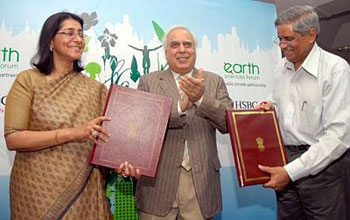 NEW DELHI, April 21: The Ministries of Science and Technology and HSBC India have signed a Memorandum of Understanding (MoU) for creating an informed environment amongst various stakeholders on climate change in India and encouraging various representatives to work together to tackle climate change by sharing and communicating best practices in climate change adaptation and mitigation.
 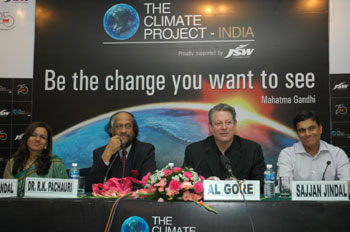 NEW DELHI, March 15: Nobel Peace Laureate Al Gore has said that India, as an advanced developing country, can lead the world in renewable energy technologies as part of a solution to the climate change crisis.
 Aviation
| Business | Defence
| Foreign Affairs | Communication
| Health | India |
United Nations
India-US | India-France
| Entertainment | Sports
| Photo Gallery | Tourism
| Advertise with Us | Contact
Us
© Noyanika International, 2007. All rights reserved.