


Foreign Affairs
| Five million pay homage to N Korea leader Kim Jong-ilPyongyang, Dec 21: More than five million North Koreans have so far turned out to pay their respects to late leader Kim Jong-il, state media say. The body of Mr Kim is lying in state in the capital Pyongyang as organised public mourning continues in streets and halls around the country. His son and presumed heir, Kim Jong-un, has publicly led funeral proceedings. State media hailed the new leader as "the outstanding leader of our party, army and people". Kim Jong-il died on Saturday of a heart attack caused by overwork and stress at the age of 69, state media said. He will be buried on 28 December. Elsewhere in the region, the flurry of telephone diplomacy continues as governments try to digest the news of his death. Indian PM back home after concluding two-nation visit
Dr Singh returned from Singapore where he was on a two-day trip, holding talks with his counterpart Lee Hsien Loong and unveiled the bust of first Indian Prime Minister Jawaharlal Nehru. In Singapore, he invited greater investments from the city-state which he describe as a "valued partner" for India's ambitious plans for infrastructure development. Lee extended his country's support to India's bid for a permanent membership of an expanded UN Security Council. In the first leg of the four-day tour, Dr Singh was in Bali to attend the East Asian summit and the summit of Association for South East Asian Nations (ASEAN). On the sidelines of the summits, he held talks with Obama, Wen and Australian Prime Minister Julia Gillard, among other leaders. Indian PM: Will address N-Liability grievances, but within our lawBALI, Nov 18: Asserting that there were "no irritants" in India and the U.S. working together, India's Prime Minister, Dr Manmohan Singh, said India had already "gone some way to respond to the concerns of American companies" with the notification of the nuclear liability law. Prime Minister Manmohan Singh and U.S. President Barack Obama met here on Friday and declared their intention to push the Indo-U.S. cooperation both at bilateral and at multilateral forums. Dr. Singh and Mr. Obama, who met here on the sidelines of ASEAN and East Asia Summits, talked about strengthening the bonds of strategic ties put in place during the U.S. President’s visit to India in November last year. Recalling the Mr. Obama’s “historic visit” to India, Dr. Singh said, “in the last one year, we have made progress in every direction, strengthening our bilateral cooperation in investment, trade, higher education, clean energy and defence.” “I am very happy to report to you that today there are no irritants whatsoever in our working together in multiplicity of areas both bilaterally and on global issues,” Dr. Singh said. “We have strengthened in many ways the path set out during the historic visit, whether it is civil nuclear cooperation, whether it is humanitarian relief, in disaster management, or maritime security, all the issues which unite us in our quest for a world free from war,” he added. In his opening remarks, the U.S. president refereed to his “extraordinary” trip to India during which the two sides strengthened the bonds of friendship, commercial links and security cooperation. “We continue to make progress on a wide range of issues. The bonds between our two countries are not just at the leadership level but also at personal levels,” said Mr. Obama. “This is an outstanding opportunity for us to continue to explore how we can work together,” Mr. Obama said, identifying some of the issues as maritime security, non-proliferation and terrorism. Among the issues discussed was the implementation of civil nuclear deal against the backdrop of apprehensions among American companies over the liability aspect. "We have gone some way to respond to the concerns of American companies," Dr. Singh on notification of nuclear liability law. "Within the four corners of the law, we are ready to address any specific grievances," he added. Ahead of the meeting, India had asserted that its domestic laws with regard to nuclear liability and compensation will have to prevail and any contention otherwise would not be realistic after the Fukushima incident. Indian PM to visit Russia on 16th DecemberMOSCOW, Nov 17: Prime Minister Manmohan Singh will arrive Moscow on 16th December to attend the annual Indo-Russian summit. The announcement was made by External Affairs Minister S M Krishna, who arrived in Moscow on Thursday on a three-day visit to finalize political and economic agenda of the summit. Krishna met his Russian counterpart Sergei Lavrov and is understood to have discussed key regional and global issues including the situation in Afghanistan, West Asia and Syria. Krishna and Lavrov are also expected to finalize the draft of joint political document to be issued after Singh's last Kremlin summit talks with his Russian host Dmitry Medvedev, who will be demitting his office in early May 2012 after next March's presidential polls. Australia to revoke ban on uranium sale to IndiaNEW DELHI, Nov 15: In a major policy change, Australian prime minister Julia Gillard declared that her ruling Labour Party would reverse its ban on selling uranium to India. Australia refuses to sell uranium to India since it isn't a signatory to NPT. Gillard also wrote a letter to Prime Minister Manmohan Singh on Monday flagging the debate at her party's conference. If cleared, it would open the doors to Australia selling uranium to India. It will help strengthen ties exponentially with one of India's key partners, said government sources, which has been somewhat constrained by the ban. Supporting uranium sale to India, Gillard explained at a press conference in Canberra why her government should overturn its current ban. Recognizing that the old strategy of bringing India into the NPT had been overtaken by the US-India civil nuclear agreement, Gillard said, "It effectively lifted the de-facto international ban on cooperation with India in this area. ... for us to refuse to budge is all pain with no gain and I believe that our national platform should recognize that reality." She added, "Selling uranium to India will be good for the Australian economy and good for Australian jobs... as India rises ... it will need more energy, it is looking to supply 40% of that energy need through nuclear energy, we are a very big supplier of uranium so having access to this new and growing market is good for Australian jobs." The spot price of uranium after Fukushima has fallen to below $50 a pound as compared to over $140 in 2007. She was fairly candid about the fact that improving ties with India was one of her chief considerations. Gillard, however, was clear that reversing the ban on uranium sales to India would not apply to other countries like Pakistan and Israel. Australian foreign minister Kevin Rudd, formerly PM, concurred. In Bangalore to attend a meeting of foreign ministers of Indian Ocean rim countries, Rudd told journalists, "On one side of this argument there are many passions, of course, concerning non-proliferation. The other side of this argument of course there are deep concerns about the strategic importance of India, and how we further strengthen our relationship with India." Rory Medcalf, expert at the Lowy Institute and a former Australian diplomat to India, told TOI, "The old discriminatory position of the Labour Party is not sustainable. Australia was becoming the lone ranger among uranium suppliers in refusing even to talk about doing legal nuclear commerce with India...This move is long overdue. It shows Australia's recognition of the need to build strategic trust with India as a partner for the Indo-Pacific century." As PM, Rudd had refused to countenance sale of uranium to India, though his predecessor John Howard had cleared it. Rudd indicated on Tuesday that the decision would not be an easy one for the Labour Party to take, particularly with its commitment to the NPT. India has maintained that while it would not sign the NPT, it adheres to the tenets of the treaty, besides having maintained an impeccable record on non-proliferation. China, who is a recipient of Australian uranium, has had a recorded history of proliferation to Pakistan, North Korea and even Iran. Australia had supported the NSG waiver for India in 2008, and since then India had maintained that it would wait for Australia to make its own decision on uranium sales. However, it's well known that this has been a diplomatic thorn in the flesh. There was speculation recently that PM Singh skipped the CHOGM summit in Perth as a silent protest against Australia's policy. Netanyahu: Iran is closer to a nuclear bomb than people thinkTEL AVIV, Nov 13: Iran is closer to assembling a nuclear bomb than "people think," Prime Minister Benjamin Netanyahu said on Sunday, following a the publication of a report by the United Nations' nuclear watchdog on Tehran's nuclear program. Last week, the hotly anticipated document said Iran appeared to have worked on designing an atomic bomb and that secret research may continue. It was the most detailed International Atomic Energy Agency (IAEA) report to date on the issue. Based on what the agency called "credible" information, the IAEA repot indicated that Iran had built a large explosives vessel there to conduct hydrodynamic experiments, which are "strong indicators of possible weapon development." Israel has used the report to convince the international community to impose tougher sanctions on the Islamic Republic, a move opposed by countries such as China and Russia. Commenting on the Iranian nuclear program on Sunday, Netanyahu said that "international [diplomatic] efforts did not prevent Iran from advancing toward a nuclear bomb, and it may get there sooner than people think." "The IAEA report includes only the evidence provable at a court of law, but the reality is that there are many more things that we are seeing beyond what the report states," Netanyahu added. On Friday, U.S. Secretary of State Hillary Clinton said that Iran must respond soon to a report by the UN atomic agency alleging that it is working secretly on developing a nuclear weapon, saying that “Iran has a long history of deception and denial regarding its nuclear program and in the coming days we expect Iran to answer the serious questions raised by this report." “The U.S. will continue to consult closely with our allies on the next steps we can take to increase pressure on Iran,” Clinton said. Indian Prez pitches for Permanent UN Council Seat as 11 envoys present credentialsBy Deepak Arora
The envoys presented their credentials at a ceremony at Rashtrapati Bhavan attended by senior officials of the missions and the external affairs ministry.
She also emphasized that reforms in international bodies must be taken up, so that they reflect contemporary realities as well as to make them more credible and effective.
The President mentioned that to fulfill these aspirations, it is expanding its social infrastructure particularly education, skill building and health, as well as putting into place extensive physical infrastructure over the next five years, with an investment of over US Dollar one trillion. A growing India will expand opportunities for the global economy as well, the President emphasized. India also seeks to enlarge economic engagement with other countries for peace, progress and development. French Ambassador François Richier pays tributes to Mahatma Gandhi at Rajghat
He also presented the warmest regards of French President Nicolas Sarkozy to Indian President Pratibha Devisingh Patil. After presenting his Credentials, he visited Mahatma Gandhi’s memorial at Rajghat, to pay tribute to the Mahatma’s memory and message of peace, which carries universal appeal. Born on 11 August 1963, Mr François Richier graduated from the Institut d’Etudes Politiques (Institute of Political Studies) and holds a degree in Law. He is an alumnus of the French National School of Administration (1989-1991).
Thereafter, he was posted at the Embassy of France in Berlin as Second Counsellor (1999-2002), and then appointed Sous-Directeur (Director) of the Nuclear Disarmament and Non-Proliferation Division, Department for Political and Security Affairs. He served subsequently as Deputy Under-Secretary of the same Department. In June 2007, he was appointed as Adviser for Strategic and Security Affairs at the Presidency of the French Republic. Manmohan sets Bali date with Obama, Wen
While the assertive China does factor in US’s east Asia calculus, the other important bilateral meet will be between singh and Chinese Premier Wen Jiabao in Bali. Cambodia and Indonesia are the two other countries Singh will be engaging bilaterally in Bali, according to sources. The Prime Minister will be embarking on Indonesia-Singapore trip from November 17 to 20. It has been a while since the meeting between Singh and Obama took place. Due to what Indian officials had then termed as "scheduling issues" Singh couldn't meet Obama on the sidelines of the United Nations General Assembly (UNGA) in New York in September. A meeting also couldn't be scheduled on the sidelines of the G-20 summit in Cannes. The PM will be in France from November 2 to 5 for the G-20 summit as well as the annual India-France summit. In the past G-20 venues had witnessed Obama-Singh meets. In fact, the first substantial meeting between the two leaders was on the sidelines of the G-20 meeting in London in 2009. They had also met on the sidelines of the G- 20 summit in Toronto in early 2010. However, as US's policy focus shifts from middle-east and Europe's economic crisis, to east Asia, Indonesia — where Obama spent part of his childhood — is becoming a key venue. The meeting between the Prime Minister and Wen Jiabao is also significant. The meeting is taking place after the first India-China strategic economic dialogue. 22 Indian illegal workers arrested in UKLONDON, Nov 1: Twenty two illegal workers from India have been arrested in enforcement operations over the past five weeks. The UK Border Agency is now working to remove them from the UK as soon as possible. India, Oman hold Strategic DialogueBy Deepak Arora
At the Eighth session of the Oman-India Strategic Dialogue held here, the two sides also reviewed the bilateral cooperation and the bilateral agreements. The meeting stressed the importance of activating what has been agreed upon in setting up the appropriate mechanisms to closely follow up aspects of cooperation to serve the interests of the two countries and peoples. The meeting also exchanged views on a number of regional and international issues of common interest. The delegation from Oman was led by Ahmed bin Yusuf al Harthy, Under-Secretary in the Ministry of Foreign Affairs for Diplomatic Affairs, while the Indian side was led by Sanjay Singh, Foreign Ministry’s Under-Secretary for Middle East Affairs. On sidelines of the session, Indian External Affairs Minister S M Krishna and Minister of State for External Affairs E Ahmed separately received Al Harthy. The session was attended from the Omani side by Shaikh Humaid bin Ali al Maani, Oman’s Ambassador to India, Saud bin Ahmed al Barwani, Head of West Asia Department at the Foreign Ministry, and a number of other officials. A number of officials from the Indian Foreign Ministry also participated in the session. Former Afghan Prez Burhanuddin Rabbani killed in Kabul blast
The assassination marked another dark chapter in a war that the U.S.-led coalition is preparing to exit, with international troops set to leave Afghanistan by 2014. For the past year, Rabbani had been in charge of a government peace council that tried to facilitate contacts with Taliban insurgents. But the council failed to make headway as warring sides and disparate groups maneuvered for an edge in the long-running conflict. Rabbani was assassinated Tuesday by a suicide bomber concealing explosives in his turban, a tactic that has been used with lethal effect against other Afghan officials. He was president from 1992-1996, heading the Afghan government that preceded the Taliban rule. After he was driven from Kabul in 1996, he became the nominal head of the Northern Alliance, mostly minority Tajiks and Uzbeks, who swept to power in Kabul after the Taliban’s fall. Rabbani is an ethnic Tajik. The soft-spoken Rabbani used to spend most of his time translating poetry before assuming political power in Afghanistan, with its trappings of heavily armed bodyguards and armored vehicles with tinted windows. In 1996, as leader of a country contested by nearly a dozen factions, he vowed to resist the Taliban even as the Islamic fundamentalist force closed in on the capital. “We are ready to force the Taliban out of rocket range,” he said in an interview with The Associated Press shortly before he was ousted. “That might make them ready to negotiate a peace agreement with us.” In the 1996 interview, Rabbani also said the United States should help put together a government representing Afghanistan’s various factions: “They are a powerful country and they must do their duty.” Rabbani’s up-and-down political career was entwined with the wars that have torn Afghanistan for decades, well before the U.S.-led invasion that ousted the Taliban in 2001 because of their support for Osama bin Laden. Born in 1940 outside Faizabad in northeastern Badakhshan province, he studied Islamic law at the University of Kabul. Fluent in Arabic, he also translated Persian poetry while attending Al-Azhar University in Egypt, before returning to Kabul to join the Faculty of Islamic Law. There he formed the Jamiat-e-Islami group after Afghanistan’s king was toppled and forced into exile by a cousin, Mohammed Daoud, with the help of the country’s communist Khalq and Parchami parties. Rabbani spent nearly two decades in exile. He fled to neighboring Pakistan after a bungled coup attempt against Daoud in 1973. Ahmed Shah Massood, the Northern Alliance military commander who was assassinated two days before the Sept. 11 terror attacks in the United States, joined Rabbani in Pakistan. When Daoud was overthrown by his communist allies, which led to the intervention of Soviet troops at the end of 1979, Rabbani and Massood launched a jihad, or holy war, against the regime. Rabbani was the political chief, Massood its military leader. Jamait-e-Islami was one of seven Pakistan-based anti-communist groups that received backing from the United States and other Western countries to wage war against the Soviet Union. After the Soviet withdrawal in 1989 and the collapse of Afghanistan’s Marxist government in 1992, Rabbani and the other six rebel leaders agreed to form a government. But long-standing rivalries and animosities soon plunged the groups into conflict and prevented any real government. In January 1994, three factions allied against Rabbani, who had refused to relinquish his hold on the rotating presidency. For a full year Kabul was engulfed in civil war. Neighborhoods were controlled by different factions, with gunmen on every street corner. Entire neighborhoods were wrecked and an estimated 50,000 people died. Chaos across Afghanistan led to the rise of the hardline Taliban religious militia, which forced Rabbani’s forces to flee the capital in 1996. His and other factions were driven into a corner of Afghanistan, where they put aside their feuds to unite in the fight with the Taliban. It was this Northern Alliance, with the help of the U.S. bombing campaign, that swept south and returned Rabbani to Kabul. He then professed loyalty to Afghanistan’s new leader and current president, Hamid Karzai. Even so, Rabbani was viewed with concern because he had presided over ferocious fighting in a quest to cling to personal power in the mid-1990s. He sought to dispel those fears in a 2002 interview. “From now on,” he said. “I am going to commence my activities for the national unity of Afghanistan.” US, Japan focus on freedom of navigation in South China Sea
The issue came up for discussion when the Secretary of State Hillary Clinton met her Japanese counterpart Foreign Minister Koichiro Gemba in New York yesterday on sidelines of the 66th session of the UN General Assembly, a senior State Department official said on condition of anonymity. "They both underscored the importance of freedom of navigation in the Asia Pacific region, South China Sea issue," he said. "Both Secretary Clinton and Foreign Minister Gemba expressed the hope that we can make significant progress on the South China Sea issue in the context of the East Asia Summit later in the year in Bali," the official said. The US President Barack Obama would be meeting the new Japanese Prime Minister Noda Yoshihiko in New York later this week. During the meeting, Clinton spoke about the New Silk Road Initiative that the US is pursuing and hoped that Japan will be an active player in this effort to strengthen regional economic integration in South and Central Asia, he said. Clinton told her Japanese counterpart that the US consider US-Japan alliance as the cornerstone of peace and stability in the Asia Pacific region. "She noted that despite the difficult year that Japan has had, our alliance remains very much a global one. We work together all around the world, and she noted in particular that Japan was front and centre this morning at the Haiti ministerial and she thanked Japan for its continued global leadership and commitment," the official said. The two leaders also discussed over a wide range of bilateral, regional and global issues. "On the bilateral side, the foreign minister noted that there's concern in Japan, and the Secretary seconded this, that fewer Japanese are visiting the United States and studying in the US and fewer Americans are studying in Japan," the official said. He said that both the leaders committed to work on the issue as the students and business folk going both ways have really deepened and enriched the alliance as well as mutual understanding. The issue of North Korea also came up during the half-an-hour meeting, the official added. India warns China to keep off PoKNEW DELHI, Sept 16: India has upped the ante against Chinese activities in Pakistan occupied Kashmir (PoK). A few months ago, when China sent a diplomatic protest (demarche) to India regarding proposed oil and gas exploration in the South China Sea off Vietnam, India had refused to entertain it. Instead, in its reply, India told China that it should stop its activities in Pakistan occupied Kashmir (POK). In fact, India has followed up its criticism with another strongly worded representation to China, issued a few weeks ago, asking it to stop its activities in PoK. India said Pakistan was in illegal occupation of that part of Kashmir and Chinese activities were in contravention of international norms. In Vietnam, India's ONGC and Petro Vietnam are in a joint venture in oil exploration in the South China Sea. India bought BP's assets in the project after it exited in 2006. India has particular concerns on two infrastructure projects by China in PoK: the Diamer-Bhasha dam and upgradation of the Karakoram Highway. While China has insisted that these are all civilian in nature, India remains concerned that the Chinese presence here poses a security threat. In 2010, foreign minister SM Krishna told his Chinese counterpart that Kashmir was a "core" issue for India in the way that Tibet and Taiwan were "core" issues for China. This was in response to the stapled visas that China issues to Indian citizens from Jammu and Kashmir. Answering questions in Rajya Sabha last month, the foreign ministry had said, "Government is aware that China is executing infrastructure projects in Pakistan-occupied Kashmir. Government has raised this issue with the Chinese side and has clearly conveyed India's consistent position that Pakistan has been in illegal occupation of parts of the Indian state of Jammu and Kashmir since 1947. Government has conveyed its concerns to China about their activities in Pakistan-occupied Kashmir, and asked them to cease such activities." During a recent visit to China by Pakistan president Asif Zardari, he took along the Prime Minister and other notables from PoK even to Xinjiang. This was accepted without question by the Chinese authorities. Given that China issues stapled visas to Indians from J&K on the grounds that it was "disputed", the Chinese silence on the PoK presence in the Zardari delegation was interpreted as meaning that China considered PoK a legitimate part of Pakistan. This would be double standards, said Indian officials. In April 2011, the Northern Army commander, Lt Gen KT Parnaik, had said at a seminar, "Chinese presence in Gilgit-Baltistan and the Northern Areas is increasing steadily... There are many people who are concerned about the fact that if there was to be hostility between us and Pakistan, what would be the complicity of Chinese. Not only they are in the neighbourhood but the fact is that they are actually present and stationed along the LoC." It's unlikely that China will back off from its PoK presence, just as it will be difficult for India to do so in the South China Sea as well. China pushed matters there recently by harassing an Indian ship in the waters. This prompted India to clearly articulate its position that it considered South China Sea to be international waters and that India stood for freedom of navigation in these waters. 27 killed in terror strike in KabulKABUL, Sept 14: The 20-hour insurgent assault on the heavily guarded Afghan capital left 27 dead including police, civilians and attackers when fighting finally ended today. Eleven Afghan civilians were killed, more than half of them children, said US Marine Corps Gen John Allen. Five Afghan police officers also died, he said. A total of 11 insurgents were also killed in the fighting, seven of them as NATO and Afghan forces launched an operation to clear the attackers out of a half-built concrete high-rise near the US Embassy and a NATO compound where they were holed up for the assault. Four other attackers served as suicide bombers in what was a coordinated attack in several areas of Kabul. The fighting around the high-rise at the Abdul Haq traffic circle finally ended about 9:30 am after a night of roaring helicopters, gunshots and tracers streaking through the sky. The Afghan Interior Ministry announced that the final holdouts in the 12-story concrete building had been killed and police officers could be seen clapping their hands in celebration on the roof of the building. But the coordinated strikes raised fresh doubts about the Afghans' ability to secure their nation as US and other foreign troops begin to withdraw. Afghan forces have nominally been in control of security in the capital since 2008, but still depend heavily on foreign forces to help protect the city and assist when it comes under attack. Iran nuclear plant linked to grid: atomic agencyTEHERAN, Sept 5: Iran's first nuclear power plant has been hooked up to the national grid supplying 60 megawatts of its 1,000 megawatt capacity, the country's Atomic Energy Organisation announced on Sunday. "Last night at 11:29 pm (0029 IST), the Bushehr power plant was connected with 60 megawatts to the national grid," the organisation's spokesman Hamid Khadem Qaemi, told Al-Alam television. The connection of the Russian-built plant in southern Iran to the national grid was originally scheduled for the end of 2010. The Bushehr plant was started up in November 2010 but repeated technical problems delayed its operations, leading to the removal of its fuel rods last March. "The capacity will gradually increase and it (is going through its) testing phase and on Shahrviar 21 (September 12) in a ceremony the power plant will reach its 40-per cent capacity," Khadem Qaemi said. The deputy atomic chief in charge of power plants, Mohammad Ahmadian, told state television the plant was expected to reach full capacity at "around the end of Aban or beginning of Azar (November)." "But it is very important for us to take these final steps with utmost safety concerns in mind. We want to have guaranteed functional operation," Ahmadian added. In mid-August, Iran's atomic organisation chief Fereydoon Abbasi Davani said the plant was expected to reach "full capacity of 1,000 megawatts" in late November or early December. Russia, which built the plant, has pinned the delays on Iran, saying its engineers have been forced to work with outdated parts. The latest delay in March was blamed on wear and tear at the plant. |

| |||||||
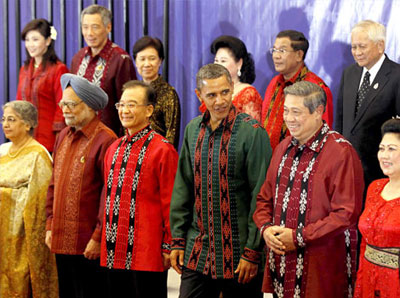 NEW DELHI, Nov 21: Prime Minister Manmohan Singh arrived in New Delhi on Sunday night after concluding his two-nation visit to Indonesia and Singapore during which he attended two key Asian summits and held talks with US President Barack Obama and Chinese Premier Wen Jiabao.
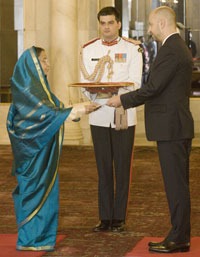 NEW DELHI, Nov 1: Indian President Pratibha Patil on Tuesday pitched for a permanent seat for India in the UN Security Council as 11 envoys, including those of France, Cuba, Tunisia and Nigeria, presented their credentials to her at a ceremony here.
  Speaking about global governance structures, the President said India has all the credentials for its legitimate aspiration to become a permanent member of the UN Security Council.
  She stated that India is working for greater growth to meet the aspirations of its people and is committed to inclusive growth.
 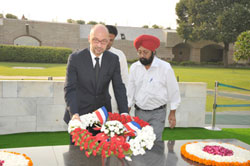 While presenting his Letter of credence to the President of India, French Ambassador François Richier reaffirmed the historical ties of friendship and mutual respect between India and France, and the determination of the French authorities to deepen and expand the strategic partnership between the two countries.
 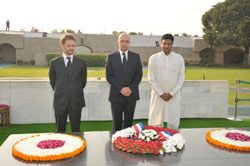 On 1 February 1991, he commenced his diplomatic career with a two-year stint as Under-Secretary, Asia-Pacific Division, at the Ministry of Foreign Affairs (1991-1993). He then served as Technical Adviser to the Minister of Foreign Affairs (1993-1995), before being posted as First Secretary at the French Permanent Mission to the United Nations in New York (1995-1999).
  NEW DELHI, Nov 1: The much anticipated meeting between Prime Minister Manmohan Singh and US president Barack Obama is set to take place in Bali, Indonesia, later this month.
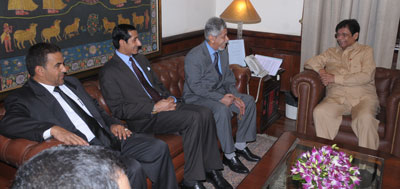 NEW DELHI, Sept 20: India and Oman have decided to strengthen bilateral co-operation in the fields of educational, technology and tourism and also enhance joint investment in economic projects.
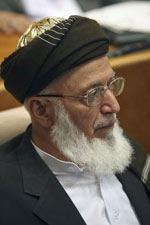 KABUL, Sept 20: Former Afghan president Burhanuddin Rabbani, who was appointed last year to head a commission trying to broker a peace deal with the Taliban, was killed inside his Kabul home on Tuesday in a suicide bombing, Afghan officials said. He was about 70 years old.
 NEW YORK, Sept 20: The US and Japan has stressed on the need to have freedom of navigation in the South China Sea amidst reports of Chinese warning to other countries in the region, including India, claiming its sovereignty over it, which is being disputed by other countries.
Aviation
| Business | Defence | Foreign
Affairs | Communication | Health
| India | United Nations
India-US
| India-France | Entertainment
| Sports | Photo Gallery |
Tourism | Advertise with Us
| Contact Us
© Noyanika International, 2003-2009. All rights reserved.